

Dementia is a journey that often begins with subtle, easily dismissed changes.Dementia is a journey that often begins with subtle, easily dismissed changes. While occasional forgetfulness is a normal part of aging, the early signs of dementia are more persistent and impactful, signaling a progressive decline in cognitive function that interferes with daily life. Recognizing these initial symptoms is the first and most critical step toward seeking a diagnosis, accessing support, and planning for the future. Many families find themselves wondering if a loved one's behavior is just a phase or something more serious.
This guide is designed to provide clarity. We will explore ten of the most common early indicators, offering detailed descriptions, real-world examples, and actionable advice to help you distinguish between normal aging and potential cognitive decline. Beyond the specific cognitive symptoms detailed here, it's also helpful to be aware of other indicators that a loved one might benefit from support in their daily life, such as changes in home upkeep or social withdrawal.
Understanding these signs empowers you to act decisively and compassionately, ensuring your loved one receives the appropriate care and support they deserve. This article will break down what to look for, from memory loss and communication difficulties to shifts in personality and impaired judgment, providing you with a comprehensive roadmap for navigating this challenging territory.
1. Memory Loss, Especially Short-Term Memory Decline
One of the most widely recognized early signs of dementia is a noticeable decline in short-term memory. This isn't about occasionally misplacing your keys or forgetting a name; it's a more persistent pattern that disrupts daily life. The brain changes associated with dementia often first affect the hippocampus, the area responsible for forming new memories. As a result, an individual may easily recall events from decades ago but struggle to remember what they ate for breakfast or a conversation they had just an hour before.

This type of memory loss leads to repetitive behaviors, such as asking the same question multiple times or retelling the same story in a short period, as if for the first time. They are not doing this for attention; they genuinely do not recall the previous interaction. This distinguishes it from normal age-related forgetfulness, which is typically less frequent and doesn't significantly impair one's ability to function independently.
Red Flags vs. Normal Aging
Distinguishing between dementia-related memory loss and typical forgetfulness is crucial.
- Dementia Sign: Forgetting recent conversations or events entirely. For example, not recalling that their daughter visited that morning.
- Normal Aging: Occasionally forgetting details of a conversation but remembering it later. For example, momentarily forgetting a specific point their daughter made but remembering the visit itself.
Actionable Steps for Caregivers
If you notice these patterns in a loved one, it's important to document them.
- Keep a Journal: Note specific instances of memory loss, including the date, time, and what was forgotten. This provides a concrete record to share with a healthcare professional.
- Assess Daily Impact: Does the memory loss interfere with safety or daily tasks, such as managing medications or preparing meals?
- Seek Evaluation: Schedule an appointment with a primary care physician or a neurologist for a cognitive assessment if the memory issues consistently affect daily functioning.
2. Difficulty with Familiar Tasks and Reduced Problem-Solving Ability
A subtle yet significant early sign of dementia involves a growing struggle with once-familiar tasks and a decline in problem-solving skills. This is not about making an occasional error, but a consistent difficulty in planning or completing routine activities. The cognitive changes from dementia can impair executive functions, which govern our ability to organize thoughts, make decisions, and execute multi-step processes. A person may suddenly find themselves confused while following a lifelong recipe or feel overwhelmed trying to manage a household budget they’ve handled for years.

This difficulty extends beyond simple forgetfulness. For example, a person might not just forget to pay a bill but may no longer understand the steps involved in writing a check and mailing it. They may also lose the ability to think abstractly, making it hard to play strategy games like chess or bridge that they previously enjoyed. This change is often frustrating and confusing for the individual, who may become withdrawn or anxious as a result.
Red Flags vs. Normal Aging
It's important to differentiate these challenges from typical age-related changes.
- Dementia Sign: Getting confused in the middle of a familiar task, like preparing a meal or using a well-known appliance. Forgetting the rules of a favorite card game.
- Normal Aging: Needing occasional help with the settings on a new microwave or making a calculation error once in a while when balancing a checkbook.
Actionable Steps for Caregivers
Observing these changes warrants a gentle and proactive approach.
- Document Specifics: Keep a log of instances where your loved one struggled with a task. Note what they were trying to do and what seemed to cause the confusion.
- Observe Emotional Responses: Pay attention to whether they express frustration, anxiety, or embarrassment when unable to complete a task. This can be a key indicator.
- Encourage a Medical Check-up: Share your documented concerns with a doctor. A professional evaluation can help determine the underlying cause and rule out other treatable conditions.
3. Language and Communication Difficulties
Another significant early sign of dementia involves a noticeable decline in an individual's ability to communicate. This goes beyond the occasional "tip-of-the-tongue" moment that everyone experiences. Instead, it’s a consistent struggle to find the right words, follow a conversation, or express a clear thought. Brain changes affecting language centers can make conversations confusing or frustrating for the person, as they may lose their train of thought mid-sentence or use vague substitutions for common words.
This difficulty isn't limited to speaking; it can also affect comprehension. An individual may struggle to understand complex sentences, jokes, or instructions, leading to social withdrawal or apparent uncooperativeness. They might frequently ask for things to be repeated or respond in ways that suggest they haven't fully grasped the conversation. These communication challenges are often a key indicator that cognitive changes are impacting daily interactions.
Red Flags vs. Normal Aging
Recognizing the difference between dementia-related language issues and normal age-related changes is key.
- Dementia Sign: Frequently struggling to name familiar objects, for instance, calling a watch "that round thing with numbers." Or stopping mid-sentence with no idea how to continue.
- Normal Aging: Occasionally having trouble finding the right word but being able to describe it or remember it later.
Actionable Steps for Caregivers
Documenting these changes provides valuable information for a medical professional.
- Note Specifics: Keep a log of communication struggles. Write down examples, such as when they couldn't name an object or lost their place in a story.
- Observe Comprehension: Pay attention to whether they have trouble following multi-step instructions or understanding plots on TV shows.
- Seek Professional Insight: Share these documented observations with a doctor to help them assess the situation accurately. Understanding these patterns is the first step toward effective strategies. Learn more about communicating with dementia patients on njcaregiving.com.
4. Disorientation to Time and Place
Another one of the significant early signs of dementia is a growing confusion about time and place. This goes beyond momentarily forgetting what day it is; it involves a consistent struggle with the passage of time, such as losing track of dates, seasons, or even the year. The brain's ability to process temporal and spatial information deteriorates, making it difficult for an individual to situate themselves in their own life's timeline or physical environment. This can lead to them becoming lost in familiar places, like their own neighborhood or a frequently visited store.
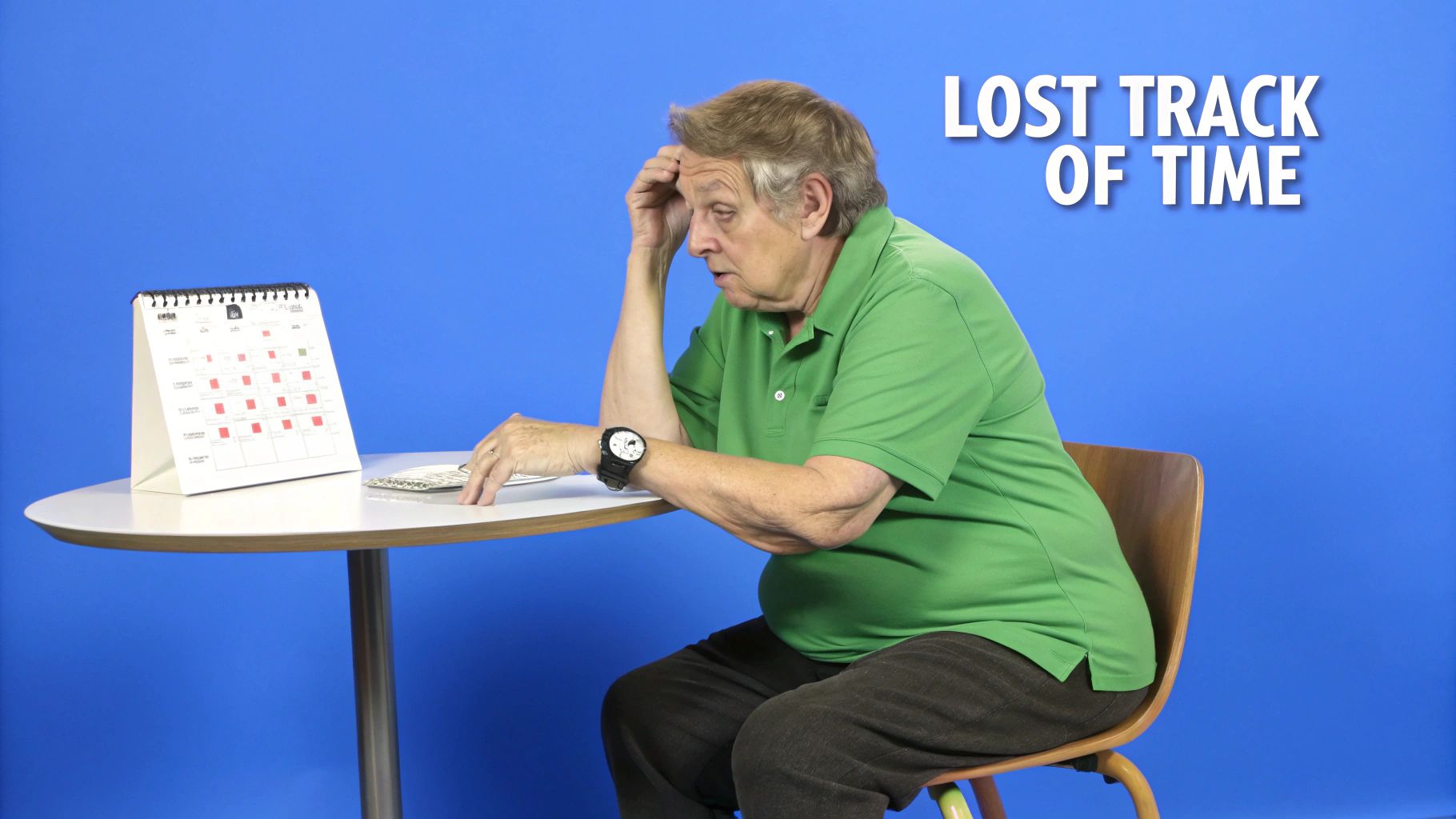
This disorientation can be deeply unsettling for the individual, causing anxiety and a loss of confidence. They might believe it is a different time of day, such as thinking it's morning in the middle of the night, or they may not understand how they arrived at their current location. This is not a simple lapse in attention but a fundamental breakdown in the brain’s internal clock and GPS.
Red Flags vs. Normal Aging
It's important to understand the difference between dementia-related disorientation and a typical memory slip.
- Dementia Sign: Getting lost on a route they have driven hundreds of times or being unable to recall how they got somewhere.
- Normal Aging: Briefly forgetting which day of the week it is but remembering it later or needing directions in an unfamiliar area.
Actionable Steps for Caregivers
Observing and documenting this symptom provides valuable information for healthcare providers.
- Note Specifics: Keep a log of when disorientation occurs. Does it happen more in the evening? Is it related to a specific place or time?
- Use Orientation Aids: Place large clocks and calendars in prominent locations. This can help with orientation and also allows you to gauge if they are referencing these tools.
- Monitor for Safety: Assess if the disorientation poses a risk. For example, is the person at risk of wandering off or getting lost? This is a crucial factor to discuss with a doctor.
5. Mood and Personality Changes
Significant shifts in mood and personality are often overlooked but are key early signs of dementia. The neurological changes in the brain can affect judgment and emotional regulation, leading a person to act in ways that are uncharacteristic of their former self. This isn't just a bad mood; it's a fundamental change in their disposition. For instance, a once social and easygoing individual might become withdrawn, anxious, suspicious, or easily upset.
These changes can be confusing and distressing for both the individual and their family. They may lose interest in hobbies they once loved or become apathetic and emotionally flat. Conversely, some may become more disinhibited or impulsive. The key is a noticeable and persistent departure from their lifelong personality, often without any clear external cause.
Red Flags vs. Normal Aging
It's important to distinguish dementia-related personality shifts from typical age-related moodiness.
- Dementia Sign: A significant, lasting personality change. For example, a formerly calm person developing persistent, uncharacteristic anxiety or irritability over minor issues.
- Normal Aging: Occasional moodiness or irritability due to specific stressors, like health problems or fatigue, which doesn't represent a core personality change.
Actionable Steps for Caregivers
Documenting these behavioral changes can provide valuable information for a medical professional.
- Note Specific Changes: Write down instances of uncharacteristic behavior, such as sudden anger, suspicion, or withdrawal from social events.
- Consult Family: Ask close friends and family if they have also noticed a departure from your loved one's baseline personality.
- Consider Context: It can be difficult to separate these changes from other conditions. Learn more about the signs of depression in seniors to better understand the differences and discuss all observations with a doctor.
6. Difficulty with Visual and Spatial Abilities
One of the more subtle early signs of dementia involves changes in how the brain processes visual information, which is distinct from issues with eyesight. This can manifest as difficulty with spatial awareness, depth perception, and recognizing familiar objects or faces. The problem isn't the eyes themselves but the brain's ability to interpret what the eyes are seeing. An individual might struggle to navigate around furniture in a well-known room or misjudge the distance when placing a cup on a table.

These challenges can lead to increased clumsiness, falls, or difficulty with tasks that require good hand-eye coordination. For example, they may have trouble finding an item in a cluttered refrigerator despite it being in plain sight or fail to recognize a lifelong friend. This is a significant indicator because it points to cognitive processing issues rather than a simple need for new glasses.
Red Flags vs. Normal Aging
Understanding the difference between dementia-related spatial issues and typical age-related vision changes is key.
- Dementia Sign: Failing to recognize a familiar family member or getting lost in a familiar neighborhood.
- Normal Aging: Needing glasses to read or having difficulty with vision due to cataracts or macular degeneration.
Actionable Steps for Caregivers
Documenting these issues can help a doctor make an accurate assessment.
- Rule Out Vision Problems: Schedule an appointment with an optometrist or ophthalmologist first to ensure the issues are not caused by a treatable eye condition.
- Note Specific Examples: Keep a log of instances, such as difficulty parking a car, trouble judging stair depth, or bumping into walls.
- Observe Task-Related Struggles: Pay attention to challenges with reading, writing, or copying a simple drawing, as these tasks require strong visual-spatial skills.
7. Impaired Judgment and Decision-Making
A significant decline in judgment is one of the more subtle but concerning early signs of dementia. This goes beyond making a single bad decision; it represents a consistent pattern of poor choices that can affect personal safety, finances, and social interactions. Dementia can impair executive functions, the mental processes that allow us to plan, focus, and weigh the consequences of our actions. This cognitive decline can lead an individual to make decisions that are uncharacteristic of their personality and values.
This impairment might manifest as uncharacteristically risky financial behavior, such as a normally frugal person suddenly spending recklessly or falling for obvious scams. It can also appear as a lack of awareness regarding safety, like dressing in light summer clothes during cold weather or failing to recognize a dangerous situation. These actions are not deliberate but are a direct result of the brain's diminished capacity to reason and evaluate outcomes.
Red Flags vs. Normal Aging
Understanding the difference between an occasional mistake and a symptom of dementia is key.
- Dementia Sign: A pattern of poor financial choices, like giving away large sums of money to strangers or making repeated, unnecessary purchases.
- Normal Aging: Making an isolated poor decision, such as a one-time unwise purchase, but recognizing the mistake later.
Actionable Steps for Caregivers
If you observe these changes, proactive steps are necessary to protect your loved one.
- Monitor Finances: Watch for unusual bank account activity, new credit cards, or large withdrawals. This is crucial for preventing financial exploitation.
- Document Specifics: Keep a log of poor judgment examples, noting the situation and the outcome. This information is vital for medical consultations.
- Consider Legal Protections: If impaired judgment is consistent and poses a risk, it may be time to consult with an attorney about options like a power of attorney. This allows a trusted person to make financial and healthcare decisions.
8. Apathy and Loss of Initiative
Apathy, a significant loss of motivation and initiative, is one of the more subtle early signs of dementia. It's often mistaken for depression, but it lacks the persistent sadness or low mood associated with that condition. Instead, an individual experiencing apathy may seem emotionally flat, indifferent, and disengaged from life. This withdrawal stems from changes in the frontal lobes of the brain, which control executive functions like planning, motivation, and starting tasks.
This isn't simple laziness or a bad mood; it's a profound change in a person's drive. They might lose all interest in hobbies they once cherished, such as an avid gardener who abandons their plants or a social butterfly who stops calling friends. They may need to be prompted to do almost anything, from getting dressed to participating in a conversation, and seem content to sit passively for hours. This lack of initiative can be very concerning and significantly impacts their quality of life.
Red Flags vs. Normal Aging
It's important to distinguish this symptom from a temporary lack of motivation or a personality trait.
- Dementia Sign: A complete and sustained withdrawal from social activities, work, and personal interests they once loved. For example, an avid golfer no longer showing any desire to play or even watch the sport.
- Normal Aging: Sometimes feeling less motivated to go out or trying fewer new activities but still finding joy in established hobbies and relationships.
Actionable Steps for Caregivers
Observing and documenting this behavior is key to getting a clear diagnosis.
- Document Specific Changes: Keep a log of activities the person has stopped doing. Note when they lost interest and if they can be engaged with encouragement.
- Differentiate from Depression: Observe their emotional state. Do they express sadness or hopelessness (suggesting depression), or do they seem emotionally indifferent and passive (suggesting apathy)?
- Consult a Professional: Discuss these behavioral changes with their doctor. Apathy is a significant symptom that warrants a neurological and psychological evaluation to understand the underlying cause.
9. Sleep Disturbances and Sundowning
Changes in the brain's regulation of circadian rhythms can lead to significant sleep problems, which are often overlooked as early signs of dementia. An individual may begin experiencing fragmented sleep, insomnia, or an inverted sleep-wake cycle, causing them to be awake and confused at night while sleeping excessively during the day. This disruption is frequently accompanied by "sundowning," a state of increased confusion, anxiety, and agitation that begins in the late afternoon and can last into the evening.
Sundowning is particularly common in Alzheimer's disease and can manifest as wandering, heightened suspicion, or aggression. These behaviors are not intentional but are a direct result of the neurological changes affecting the brain's internal clock. The fading light seems to act as a trigger, creating a challenging and distressing period for both the individual and their caregivers.
Red Flags vs. Normal Aging
It's important to distinguish dementia-related sleep issues from typical age-related changes.
- Dementia Sign: A consistent pattern of increased agitation, confusion, or wandering that begins daily between 4-8 PM. The person may wake up multiple times at night, disoriented and not knowing where they are.
- Normal Aging: Occasionally having trouble falling asleep or waking up once during the night, but without significant confusion or behavioral changes.
Actionable Steps for Caregivers
Managing these symptoms requires creating a structured and calming routine.
- Regulate the Environment: Increase light exposure during the day and reduce it in the evening to help regulate the body's internal clock. Keep the home well-lit in the late afternoon to ease the transition to nighttime.
- Establish a Routine: Maintain a consistent schedule for waking, meals, and bedtime. Avoid stimulating activities, caffeine, and heavy meals in the evening. Creating a calm, safe environment can reduce nighttime anxiety.
- Document and Discuss: Keep a log of sleep patterns and sundowning episodes to share with a doctor. This information can help identify triggers and guide treatment. For more information, you can learn about managing insomnia in the elderly on njcaregiving.com.
10. Repetitive Behaviors and Compulsive Actions
The onset of dementia can lead to repetitive or compulsive behaviors that may seem unusual or out of character. This isn't a deliberate choice but a symptom of the brain's struggle to process information, retain new memories, and manage impulses. These actions, such as asking the same question repeatedly, pacing, or meticulously arranging objects, can be a way for the individual to find comfort and structure in a world that is becoming increasingly confusing for them.
These behaviors stem from cognitive decline, particularly short-term memory loss, rather than anxiety, which is more typical of obsessive-compulsive disorder. A person with dementia may ask "What time is dinner?" multiple times because they genuinely do not remember asking before or hearing the answer. The repetition can also be a way of expressing an unmet need, such as hunger, boredom, or anxiety, that they can no longer communicate effectively.
Red Flags vs. Normal Habits
Understanding the difference between an ingrained habit and a dementia-related repetitive action is key.
- Dementia Sign: Persistently asking the same question just minutes apart, such as "When is my daughter visiting?" despite being told she arrives at 3 PM. Continuously checking that the door is locked moments after locking it.
- Normal Habit: Following a consistent daily routine, like reading the newspaper every morning or having a specific way of organizing the kitchen.
Actionable Steps for Caregivers
Responding to these behaviors requires patience and a strategic approach.
- Look for Triggers: Note what is happening in the environment when the behavior occurs. Is it a noisy room? A specific time of day? Identifying triggers can help you modify the situation.
- Redirect, Don't Argue: Instead of repeatedly answering the same question or correcting the action, try to gently redirect their attention. For example, if they are restlessly folding a napkin, offer them a different activity like sorting laundry or looking at a photo album.
- Respond to the Emotion: Acknowledge the underlying feeling. For instance, if they keep asking when a loved one is coming, you might say, "It sounds like you miss her. Let's look at some pictures of her while we wait." This validates their feelings and offers a soothing distraction.
Comparison of 10 Early Signs of Dementia
| Symptom / Sign | Assessment Complexity 🔄 | Resource Needs ⚡ | Diagnostic Value ⭐ | Typical Impact 📊 | Ideal Use Cases / When to Act 💡 |
|---|---|---|---|---|---|
| Memory Loss — Short-Term Decline | Low–Moderate; easily noticed but needs cognitive screening | Low; caregiver reports + brief tests (MMSE/MoCA) | High sensitivity for cognitive impairment; not highly specific | Significant effect on daily routines and self-care | When repetition/frequency increases or daily function is affected; document and refer |
| Difficulty with Familiar Tasks & Problem-Solving | Moderate; requires direct task observation or functional assessment | Moderate; occupational therapy, task-based testing | High for executive dysfunction and functional decline | Reduces independence (finances, cooking, safety) | If routine tasks are repeatedly mismanaged; arrange functional assessment |
| Language & Communication Difficulties | Moderate; may need speech-language evaluation | Moderate; hearing check + SLP assessment | High for primary progressive aphasia; moderate elsewhere | Impairs conversation, may cause social withdrawal | When word-finding or comprehension worsens; record examples for clinicians |
| Disorientation to Time & Place | Low; orientation items are straightforward to test | Low; brief screening tools and observation | High indicator of cognitive impairment (consider delirium) | Major safety risk (getting lost), affects navigation | Persistent or worsening confusion about date/place — urgent assessment |
| Mood & Personality Changes | Moderate; needs history and psychiatric differential | Moderate; caregiver interviews, mental-health evaluation | Medium; may precede cognitive signs but is nonspecific | Strains relationships and may alter care needs | Sudden or unexplained personality shifts from baseline; document timing |
| Visual & Spatial Difficulties | Moderate; must distinguish from ocular disease | Moderate; vision exam + neuropsych/OT testing | High for certain types (Lewy body, posterior cortical atrophy) | Impairs navigation, recognition; increases fall risk | When spatial errors occur despite normal eyesight; get vision/neuro assessment |
| Impaired Judgment & Decision-Making | Moderate; requires behavioral and financial review | Moderate; collateral history, possible legal/financial review | High for executive dysfunction and safety concerns | High risk for scams, unsafe choices, neglect | Uncharacteristic risky spending or decisions — consider protective measures |
| Apathy & Loss of Initiative | Low–Moderate; differentiate carefully from depression | Low; caregiver reports, mood/apathy scales | Medium; common early sign but nonspecific | Reduced engagement in activities and self-care | When motivation drops without sadness; track engagement and other signs |
| Sleep Disturbances & Sundowning | Moderate; multifactorial assessment (circadian/environmental) | Moderate; sleep logs, environmental interventions, possible PSG | Medium; common in dementia but not specific | Increases caregiver burden; nighttime safety concerns | If sleep–wake reversal or evening agitation appears; modify environment and document |
| Repetitive & Compulsive Behaviors | Low–Moderate; usually observable, analyze triggers | Low; behavioral documentation and management strategies | Medium; may indicate progression or specific patterns | Disrupts activities and caregiver routines | When rituals persist despite redirection; implement structure and redirection strategies |
From Observation to Action: Your Next Steps
Navigating the landscape of cognitive health can feel overwhelming, especially when you start noticing potential changes in a loved one or yourself. The signs detailed in this article, from subtle shifts in short-term memory to more pronounced difficulties with familiar tasks and communication, are not isolated incidents. They form a complex picture that deserves careful and compassionate attention. Recognizing these early signs of dementia is the critical first step, transforming passive worry into proactive care.
The journey from observation to diagnosis is a process, not a single event. It begins with documenting specific instances of concerning behaviors. For example, noting when a loved one struggled to follow a recipe they've used for years, or when they repeatedly asked the same question within a short timeframe. This log of concrete examples becomes an invaluable tool when you consult a healthcare professional. It moves the conversation from "I think something is wrong" to "Here is what I have observed," allowing for a more accurate and efficient evaluation.
Taking Proactive Steps for Diagnosis and Care
The most important takeaway is that early intervention matters profoundly. A prompt medical evaluation can rule out other reversible conditions that mimic dementia symptoms, such as thyroid problems, vitamin deficiencies, or medication side effects. If the diagnosis is dementia, an early start on a care plan can significantly improve the quality of life. This includes:
- Accessing Treatments: While there is no cure for most forms of dementia, certain medications and therapies can help manage symptoms and slow progression.
- Building a Support System: Connecting with support groups, counselors, and community resources provides emotional and practical assistance for both the individual and their family caregivers.
- Planning for the Future: An early diagnosis allows for crucial conversations about long-term care, financial planning, and legal arrangements while the individual can still participate in decision-making.
As you observe these signs, understanding key legal tools for future planning is crucial. Delve deeper into Power of Attorney and Advanced Directives to ensure that your loved one’s wishes are documented and can be legally honored as their condition progresses. This proactive planning provides peace of mind and clarity during a challenging time.
Ultimately, confronting the possibility of dementia is a courageous act of love. It’s about ensuring the person you care for receives the dignity, support, and specialized care they deserve. By turning your observations into informed action, you are not just identifying a problem; you are opening the door to a network of support and a pathway to managing the future with confidence and compassion. Your vigilance today can make all the difference in the journey ahead.
Navigating the complexities of dementia care requires a trusted partner. At NJ Caregiving, we provide specialized, compassionate in-home support for individuals living with dementia, helping them maintain their independence and quality of life in the comfort of their own home. Contact us today to learn how our dedicated caregivers can support your family's journey.