
The real difference between private duty nursing and home health care boils down to one simple question: are you looking for ongoing, long-term support for a complex medical issue, or do you need short-term, doctor-prescribed help to get back on your feet? Think of it as the difference between a marathon and a sprint. Your choice completely depends on whether the goal is to manage a chronic condition for the long haul or recover from a specific event.
Choosing Your In-Home Medical Care
When a loved one needs help at home, navigating the world of medical support can feel like a maze. The very first step to finding your way is understanding the fundamental distinction between private duty nursing and home health care. These two services are designed for very different situations, and figuring out which one fits is the key to making a confident decision.

The biggest things that set them apart are how long the care lasts, what the primary goals are, who pays for it, and who shows up at the door.
Private duty nursing is all about continuous, personalized care—often provided by the same nurse for shifts ranging from 8 to 24 hours a day. On the other hand, home health care is focused on short-term rehabilitation, with a team of specialists visiting intermittently under strict orders from a doctor.
To get a clearer picture of these differences, let's break them down side-by-side.
Quick Comparison Private Duty Nursing vs Home Health
This table gives you a quick, at-a-glance look at how these two crucial services stack up against each other.
| Feature | Private Duty Nursing | Home Health Care |
|---|---|---|
| Primary Goal | Long-term management of complex medical needs and chronic conditions. | Short-term recovery and rehabilitation after an injury, illness, or surgery. |
| Care Duration | Ongoing and long-term, lasting months or even years as needed. | Intermittent and temporary, usually lasting for a prescribed period of 60 days. |
| Payment Source | Primarily paid for with private funds, long-term care insurance, or VA benefits. | Primarily covered by Medicare, Medicaid, and private health insurance. |
| Caregiver | Consistent one-on-one care from a dedicated RN or LPN. | A team of different specialists (nurses, therapists) who visit intermittently. |
As you can see, the right choice really hinges on the specific needs of the patient and family.
As you weigh these in-home medical care choices, it can also be helpful to look at the bigger picture by exploring care options for assisted living to understand the full spectrum of support available. This guide is here to give you a practical framework to help you choose the best path forward.
Defining Private Duty Nursing Services
While home health care steps in for short-term, intermittent recovery, private duty nursing is a whole different level of support. It provides continuous, one-on-one medical care right in the comfort of home. Think of it as bringing the skilled oversight of a hospital room to the patient, without them ever having to leave.
This type of care is specifically for people with complex, long-term health needs—the kind that demand the constant attention of a Registered Nurse (RN) or Licensed Practical Nurse (LPN).
Unlike the goal-oriented, often temporary nature of home health, private duty nursing is all about long-term management and stability. It’s what allows individuals with chronic illnesses, significant disabilities, or life-limiting conditions to receive high-level medical care in a familiar, comforting environment.
What Does Private Duty Nursing Involve?
The scope here is extensive, covering clinical tasks that go well beyond basic personal assistance. The main goal is to manage a patient's medical condition around the clock, ensuring their safety and well-being.
Every care plan is tailored to the individual, but some common skilled services include:
- Ventilator and Tracheostomy Care: Managing complex respiratory equipment to ensure clear airways and proper breathing.
- Complex Wound Care: Treating serious or non-healing wounds to prevent infection and help the body recover.
- Gastric Tube Management: Handling the administration of nutrition and medication through feeding tubes.
- Intravenous (IV) Therapy: Managing IV lines for medications, hydration, or specialized nutrition.
- Continuous Monitoring: Closely tracking vital signs and other health indicators, ready to respond to any change in the patient's condition.
A key differentiator of private duty nursing is caregiver consistency. Having the same dedicated nurse for extended shifts builds a deep level of trust and familiarity. This allows the nurse to notice subtle changes in a patient's condition that a rotating team of caregivers might easily miss.
Real-World Scenarios for Private Duty Care
This level of continuous support is absolutely essential in many situations.
Imagine a child with a severe respiratory condition. They need constant monitoring and ventilator management to live safely at home with their family. Private duty nursing makes that possible.
Another common scenario is an adult recovering from a major neurological event, like a severe stroke or a traumatic brain injury. They might require ongoing assistance with a feeding tube and a complicated schedule of medications.
In these cases, private duty nursing provides the critical, moment-to-moment medical oversight needed to manage their health effectively. It truly bridges the gap between hospital-level care and the comfort of home, creating long-term stability for patients facing the most challenging health issues.
Understanding Home Health Care Services
When it comes to in-home medical care, home health care is the goal-oriented, recovery-focused option. It’s a service ordered by a doctor, designed specifically to help someone get back on their feet after a recent illness, injury, or hospital stay. Unlike the steady, long-term support you get with private duty nursing, home health is intermittent and short-term.
The whole point is to provide targeted, skilled services that help a patient regain their independence and live safely at home again. Think of it as a bridge connecting the hospital to self-sufficiency. A team of clinicians, like nurses and therapists, provides this care through scheduled visits.
Key Features of Home Health
Home health care isn't about ongoing maintenance; it’s all about rehabilitation and recovery. This model is built around a clear plan of care with specific, achievable goals.
The services provided are strictly medical or therapeutic. They often include things like:
- Skilled Nursing Visits: For tasks like wound care, managing medications, and teaching patients about their condition.
- Physical Therapy: To help restore mobility, strength, and balance.
- Occupational Therapy: To help patients safely manage daily activities like getting dressed or bathing.
- Speech Therapy: To work on any issues with communication or swallowing.
This kind of care is usually prescribed for a limited time, often in 60-day certification periods. Once the patient’s recovery goals are met, the services come to an end.
Eligibility and a Practical Example
One of the biggest requirements for home health care, especially when covered by Medicare, is that the patient must be considered "homebound." This doesn't mean they're bedridden, but it does mean it takes a considerable and taxing effort for them to leave the house. Any trips out are usually infrequent and for short periods, like for a doctor’s appointment. Our guide on Medicare home health benefits goes much deeper into these specific rules.
Here’s a real-world example: imagine a senior recovering from hip replacement surgery. After coming home from the hospital, their doctor orders home health care. Over the next few weeks, a nurse might visit to check on the incision, a physical therapist works with them on walking and strength exercises, and an occupational therapist teaches them how to use assistive devices to bathe and dress safely. Once they can get around on their own, the services are discontinued.
The intermittent nature of home health is its defining characteristic. It is not designed for 24/7 monitoring but rather for structured, therapeutic interventions that empower patients to manage their own care over time.
This model is a huge part of our healthcare system. Between 2010 and 2016, around 39% of Medicare beneficiaries used home health care after a hospital stay. Interestingly, recent studies show that patient experiences can really differ depending on their insurance plan. You can read more about home health utilization trends on jamanetwork.com. This data just underscores how critical this type of care is for post-acute recovery.
Comparing Care Models Side By Side
To really understand the difference between private duty nursing and home health, you have to look past the textbook definitions. The real distinction is in how they actually work day-to-day—everything from the kind of care provided to who’s picking up the tab. Getting these key differences straight is the only way to figure out which path makes sense for your family.
When you put them head-to-head, it becomes clear they’re built for completely different situations. One is designed for long-term, complex medical stability, while the other is a short-term, get-back-on-your-feet kind of service.
Duration and Frequency of Care
The most obvious difference right off the bat is how long and how often a caregiver is in the home.
Private duty nursing is a marathon, not a sprint. Care is delivered in continuous shifts that can be anything from a few hours a day to full 24/7 round-the-clock support. This isn't temporary; it can go on for months or even years, providing a constant, reliable presence for someone with significant ongoing medical needs.
Home health care, on the other hand, is all about intermittent visits. A nurse or therapist shows up for a scheduled appointment to do something specific—like check vitals, change a dressing, or lead a physical therapy session—and then they leave. It’s temporary by design, usually prescribed for a 60-day period with a clear finish line tied to specific recovery goals.
Scope of Services and Medical Oversight
What the caregiver is doing in the home is also worlds apart. Private duty nursing is all about managing complex, skilled medical tasks on an ongoing basis. You'll have a dedicated RN or LPN managing ventilators, administering IV medications, handling complex wound care, and overseeing other advanced clinical needs based on a comprehensive plan of care they help create.
Home health care operates strictly under a doctor's orders. Its purpose is rehabilitative, focusing on skilled nursing visits and therapies (like physical or occupational therapy) to help someone get their independence back after a hospital stay. The whole point is recovery and teaching the patient how to manage their condition, not providing continuous medical care.
This visual really captures the essence of the home health model.
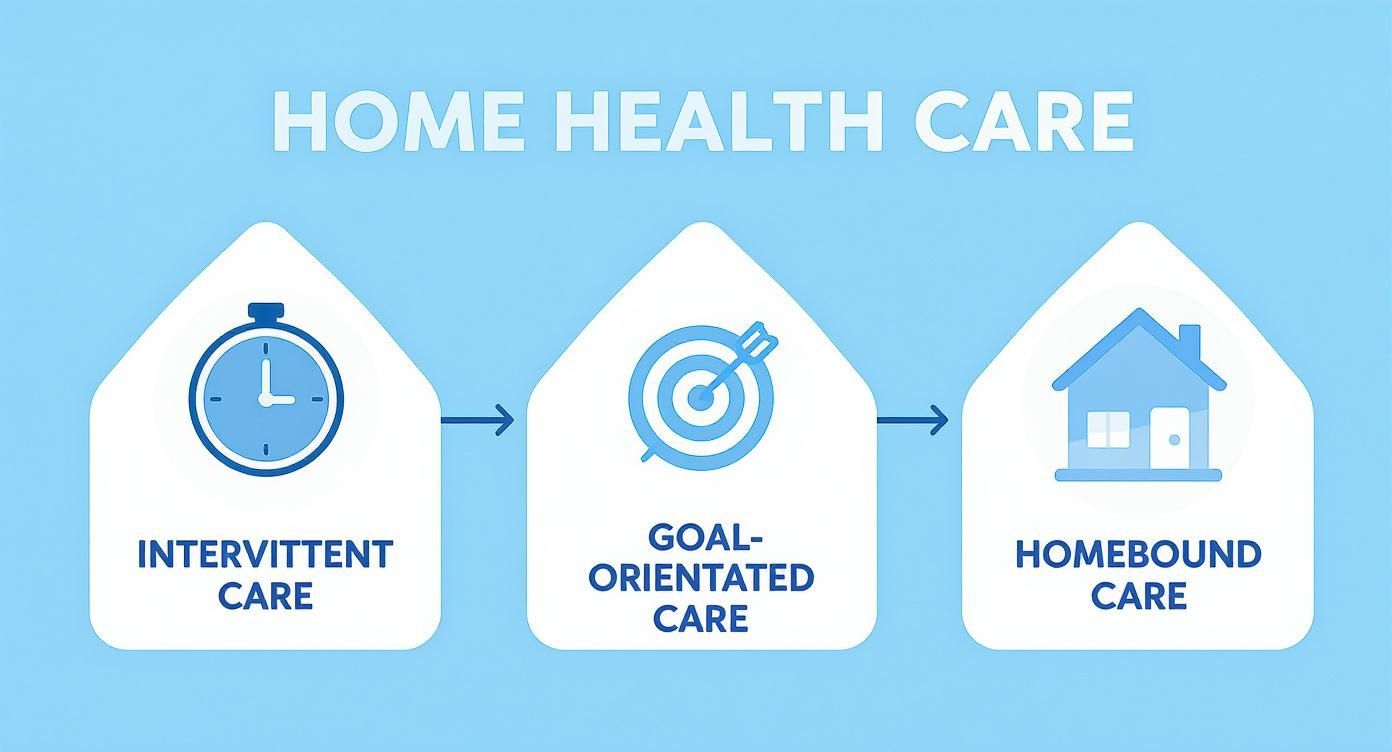
It drives home the point that home health is a temporary, recovery-focused service, which is a stark contrast to the continuous support you get with private duty nursing.
To make these distinctions even clearer, let's break them down side-by-side.
In-Depth Feature Analysis: Private Duty Nursing vs Home Health
| Comparison Point | Private Duty Nursing | Home Health Care |
|---|---|---|
| Primary Goal | Long-term management of chronic or complex medical conditions at home. | Short-term recovery and rehabilitation after an illness, injury, or hospital stay. |
| Care Schedule | Continuous care in shifts, ranging from a few hours a day to 24/7. | Intermittent, scheduled visits from clinicians, typically a few times a week. |
| Duration of Service | Long-term; can last for months or years depending on the patient's needs. | Short-term; usually prescribed in 60-day "episodes" with specific recovery goals. |
| Typical Services | Ventilator management, IV therapy, feeding tube care, complex wound care, seizure monitoring. | Skilled nursing visits, physical therapy, occupational therapy, speech therapy. |
| Who Pays? | Primarily private pay, long-term care insurance, or VA benefits. | Medicare, Medicaid, and private health insurance. |
| Key Eligibility | A documented medical need for skilled nursing care on an ongoing basis. | Must be certified "homebound" by a doctor and require intermittent skilled care. |
| Who's in Charge? | The family and patient work with the nursing agency to develop a plan of care. | The physician orders the care and oversees the plan. |
This table highlights that your choice really depends on whether you're dealing with a short-term recovery event or a long-term chronic condition.
Patient Eligibility and Payment Sources
Who qualifies for each service—and who pays for it—is another major fork in the road.
For private duty nursing, the main requirement is medical complexity. The patient simply needs a level of care that requires the skills of a licensed nurse. Since it’s seen as a long-term solution for maintaining quality of life at home, it’s almost always paid for with private funds, a long-term care insurance policy, or certain VA benefits.
The core difference in the private duty nursing vs home health debate often comes down to payment. Home health is a medically prescribed benefit covered by insurance for acute recovery, while private duty nursing is a privately funded service for managing chronic conditions.
Home health care has much tighter restrictions. To get Medicare to cover it, a doctor has to certify that the patient is "homebound" and needs intermittent skilled services to recover from a specific illness or injury. It’s funded primarily by Medicare, Medicaid, and private insurance—not out-of-pocket payments. This makes it a great, accessible option for post-hospital care, but a non-starter for anyone needing long-term help.
Analyzing Costs and Payment Options
Let’s talk about one of the biggest factors in this decision: the cost. How you pay for care is a major fork in the road, and the funding models for private duty nursing and home health care are completely different. Getting a handle on these differences is the key to planning for your loved one’s care without hitting any surprise financial roadblocks.
Private duty nursing is almost always paid for out-of-pocket. It’s designed for long-term, ongoing management of chronic conditions, which puts it outside the scope of what most traditional health insurance, including Medicare, is built to cover.
Funding Long-Term Private Duty Nursing
So, how do families typically cover this kind of care? It usually comes down to a few main sources.
- Private Funds: This is the most direct route, using personal savings, retirement funds, or other family assets to pay for the care as you go.
- Long-Term Care Insurance: These are specific insurance policies designed for exactly this kind of situation—covering ongoing care needs that regular health insurance won’t touch.
- VA Benefits: Some veterans are eligible for benefits that can be a huge help in offsetting the costs of in-home nursing.
Working through these options can feel overwhelming. We've actually put together a resource that breaks it down even further. You can learn more by checking out our guide on how to pay for home care.
How Home Health Care is Covered
Home health care, on the other hand, is a prescribed medical benefit. It’s intended for short-term recovery, so it’s typically covered by insurance as long as a doctor orders it and the patient meets certain criteria, like being certified as "homebound."
The real financial difference in the private duty nursing vs home health discussion boils down to this: home health is an insurance-covered benefit for acute recovery, while private duty nursing is a privately funded service for managing long-term needs.
For patients who qualify, this means their health plan handles most of the bill. The primary payers for home health services are exactly who you'd expect:
- Medicare
- Medicaid
- Private Health Insurance
Even with coverage, some plans might have co-pays or limits on how many visits they’ll cover. The cost gap between the two options can be stark. While the median monthly cost for full-time home care can hover around $6,292, skilled, round-the-clock private duty nursing from an RN can easily reach $33 per hour or more. This is a critical distinction that shapes how families need to plan for the future.
How to Choose the Right In-Home Care
Figuring out whether private duty nursing or home health care makes more sense can feel overwhelming, but it doesn't have to be. The best choice always comes down to the reality of the situation: your loved one's specific medical needs, their long-term health goals, and your family's financial picture.
At its core, the decision boils down to one simple question: are you planning for short-term recovery or long-term management? Someone coming home after knee surgery who just needs a physical therapist for a few weeks is a perfect fit for home health. On the other hand, a person with a stable but complex chronic condition, like muscular dystrophy, needs the kind of continuous medical oversight that only private duty nursing can offer.
A Framework for Your Decision
To get some clarity, it helps to ask a few direct questions. Your answers will shine a light on the right path and make the private duty nursing vs home health choice much clearer. Take a moment to think through each one, because it will help you pinpoint what’s truly non-negotiable for your loved one.
Here are a few questions to guide you:
- What’s the main goal? Is it about bouncing back from a specific event (home health) or managing an ongoing illness for the long haul (private duty nursing)?
- Is constant medical supervision necessary? If your loved one needs round-the-clock help with things like a ventilator or IV therapy, private duty nursing is the only way to go.
- Has a doctor officially declared the patient "homebound"? This isn't just a suggestion; it's a strict requirement if you want Medicare to cover home health services.
- How long will care be needed? If the answer is "indefinitely" or for many months to come, you’re almost certainly in private duty territory.
- How will you pay for it? If you're counting on Medicare or health insurance to cover care after a hospital stay, home health is designed for that. If you're using private funds or a long-term care insurance policy, private duty becomes a realistic option.
The biggest difference really comes down to intensity and duration. Home health is all about intermittent, goal-focused support to get someone back on their feet. Private duty nursing provides continuous, skilled care to maintain stability over the long term.
Ultimately, this isn't just about a diagnosis; it's about finding a solution that works for your family and is sustainable over time. If you want to dig a little deeper into making a selection, our guide on how to choose a home care agency has some more great tips. Answering these questions honestly will give you the confidence to match the right service to your family’s unique situation.
Answering Your Questions
When you're trying to decide between private duty nursing and home health, a lot of questions come up. It's completely normal. Getting clear answers is the first step toward making a choice you feel good about, one that truly fits what your loved one needs.
Can My Loved One Have Both Services at the Same Time?
Yes, and in many cases, it’s the best approach. Because private duty nursing and home health serve different purposes and are paid for in different ways, they can work together beautifully.
Think of someone coming home after surgery. They might use their Medicare-funded home health benefits for a physical therapist to visit a few times a week. At the same time, they could have a private duty nurse to help with round-the-clock monitoring, pain management, and personal care. This way, both the short-term recovery goals and the ongoing daily needs are covered without any conflict.
Who Is in Charge of Creating the Care Plan?
This is one of the biggest differences between the two, and it really gets to the heart of who directs the care.
- Home Health Care: The doctor is in the driver's seat. A physician has to order the services and sign off on the official plan of care. The home health agency's team then follows that specific medical plan.
- Private Duty Nursing: This is a partnership. The family, the patient, and the private duty agency work together to build a care plan from the ground up. While a doctor might recommend it, you have direct control and input into what services are provided and when.
When comparing private duty nursing vs home health, the key distinction is who directs the care. Home health is physician-prescribed and medically driven, while private duty nursing is client-driven and tailored to long-term needs and personal preferences.
Is Private Duty Nursing Just for Seniors?
Not at all. While seniors make up a large portion of clients, private duty nursing is a vital service for people of all ages who have complex medical needs. We see it all the time.
It could be a child with a chronic illness that requires constant skilled monitoring, a young adult recovering from a serious accident, or anyone who needs ongoing, expert medical supervision to live safely at home. Age isn't the deciding factor—the need for continuous, skilled care is.
At NJ Caregiving, we know every family's story is different. If you’re trying to figure out these options for someone you love in Mercer County, our team is here to listen and help you find the right path forward with compassionate, professional care. To learn more about how we can help, please visit us at https://njcaregiving.com.