

When you're navigating a serious illness, the terms hospice and palliative care often come up. It's easy to get them confused, but understanding the distinction is crucial for making informed decisions that honor your family's wishes.
While both focus on comfort, symptom relief, and supporting patients and their families, they serve different purposes at different times.
Hospice vs Palliative Care A Quick Comparison
Think of palliative care as an extra layer of support you can add at any point after a serious diagnosis. It works right alongside curative treatments—like chemotherapy or surgery—to manage pain, stress, and other difficult symptoms. Its whole purpose is to improve your quality of life while you continue to fight the illness.
Hospice care, on the other hand, is for the final chapter of life. This is comfort care without the goal of a cure. The entire focus shifts from treating the disease to ensuring the patient is as comfortable, peaceful, and dignified as possible. A doctor typically has to certify that the patient has a life expectancy of six months or less.
The easiest way to remember it is this: All hospice care is a form of palliative care, but not all palliative care leads to hospice. Palliative care is a broad approach to managing symptoms, while hospice is a specific philosophy of care for the end of life.
This side-by-side graphic offers a clear visual breakdown of each care model.
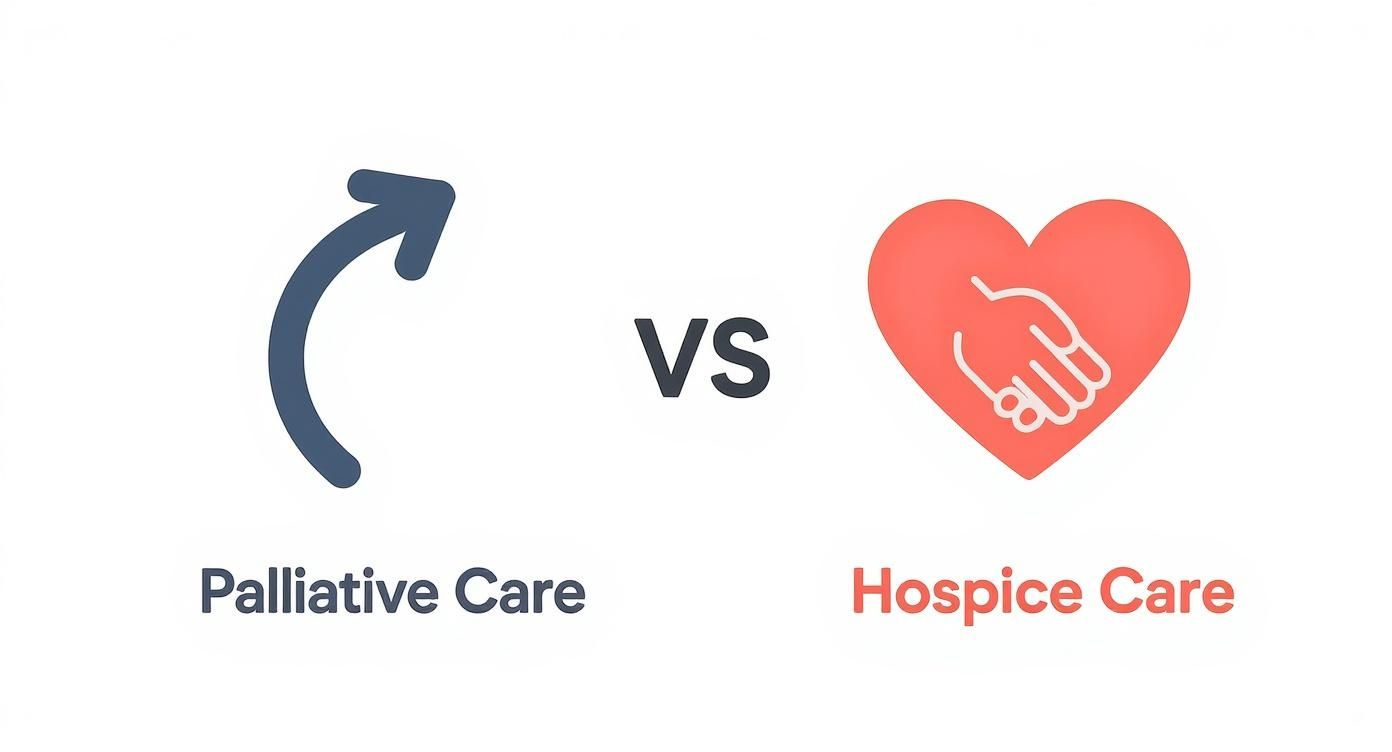
As the image shows, palliative care can run parallel to your primary medical treatments for as long as you need it. Hospice is a dedicated path taken when the journey turns toward comfort above all else.
To give you an even clearer, at-a-glance view, here’s a table that breaks down the key differences.
Key Differences Hospice Care vs Palliative Care
This table provides a side-by-side summary of the main distinctions between hospice and palliative care to help you quickly understand their unique purposes and applications.
| Criteria | Palliative Care | Hospice Care |
|---|---|---|
| Primary Goal | To improve quality of life and provide relief from the symptoms and stress of a serious illness. | To provide comfort, compassion, and dignity for a person in the final phase of a terminal illness. |
| Timing | Can begin at diagnosis and be provided at the same time as curative treatment. | Begins after treatment of the disease is stopped and when a doctor determines the person has six months or less to live. |
| Treatment Approach | Provided alongside curative treatments (e.g., chemotherapy, radiation, surgery). | Focuses on comfort care and symptom management; curative treatments are discontinued. |
| Location of Care | Can be provided in hospitals, outpatient clinics, long-term care facilities, or at home. | Most often provided in the patient's home, but also available in hospice centers, hospitals, and nursing homes. |
Understanding these distinctions is the first step in choosing the right support system for yourself or a loved one. Each path offers a unique kind of care designed for a specific stage of a health challenge.
Defining The Philosophy Behind Each Care Approach
While definitions give us a starting point, the real heart of the difference between hospice and palliative care is in their guiding philosophies. These core beliefs shape every single decision, from the details of a treatment plan to the way conversations with family are handled. They are two distinct roadmaps for navigating a serious illness, each with its own clear purpose.
The Palliative Goal: Quality Of Life At Any Stage
Palliative care is all about supportive partnership. The fundamental idea is to improve quality of life for anyone facing a serious, chronic, or life-limiting illness, no matter their prognosis. It’s designed to be an extra layer of support that works right alongside curative treatments.
This approach recognizes that a heavy diagnosis brings more than just physical pain—it also brings emotional, spiritual, and logistical stress. The palliative philosophy is to tackle all of these challenges at once. The main goal is to provide relief from the symptoms and stress of an illness, focusing on the person, not just the disease. It empowers patients and their families by helping them manage tough symptoms like pain, nausea, or anxiety, which makes it easier to keep up with ongoing medical treatments.
Think about someone newly diagnosed with congestive heart failure. They'll have a cardiologist's plan to manage the disease, and a palliative care team can step in to help them:
- Manage Symptoms: Address the shortness of breath and fatigue so they can stay active.
- Coordinate Care: Make sure all the doctors are on the same page, cutting down on conflicting advice.
- Provide Emotional Support: Help both the patient and their family cope with the stress of living with a chronic condition.
This philosophy isn't about giving up; it's about adding strength. It helps people live as well as they can, for as long as they can, while they continue to pursue a cure or manage their disease.
The core idea behind palliative care is that you don't have to choose between treating your disease and feeling well. It's a 'both/and' approach that integrates symptom relief and emotional support directly into your primary medical care from day one.
Unfortunately, this broader view of care hasn't been adopted everywhere. A major study looking at 198 countries found that only about 14% of the world's population has access to top-tier palliative care services. This really highlights how differently this supportive philosophy has been woven into healthcare systems across the globe.
The Hospice Goal: Comfort And Dignity In The Final Chapter
Hospice care, on the other hand, is centered entirely on compassion and peace when a cure is no longer the goal. It represents a major shift in focus from treating the illness to caring for the whole person during their final months. It's a profound change from "fighting the disease" to "honoring the individual."
Hospice embraces the belief that the end of life is a natural part of being human, and it deserves to be met with dignity, comfort, and respect. Its entire structure is built around that principle. If you want to dig deeper, exploring a compassionate guide to understanding hospice care can really illuminate its unique philosophy.
The decision to start hospice means that the patient, their family, and their doctor all agree to stop treatments aimed at a cure. Instead, the focus turns completely to comfort and quality of life for the time that remains.
For example, someone with late-stage cancer might find that chemotherapy is causing more suffering than benefit. By choosing hospice, the philosophy is to:
- Maximize Comfort: Aggressively manage pain and other symptoms to ensure they are at peace.
- Support Emotional and Spiritual Needs: Provide counselors and chaplains for both the patient and their family.
- Empower Patient Wishes: Honor what the patient wants, whether that’s being at home surrounded by family or achieving one final goal.
Ultimately, the hospice philosophy is about making the end of life as meaningful and peaceful as possible. It affirms life and sees dying as a normal process. It doesn't try to speed up or postpone death, but instead provides a support system to help patients live as fully as they can, right up to the very end.
Comparing Eligibility, Timing, and Location of Care
When you’re trying to grasp the real difference between hospice and palliative care, it often boils down to two simple questions: "When can we start?" and "Where does the care happen?" The answers to these questions show two very different paths, each built for a specific stage of a serious illness.
One of the biggest distinctions is the timing. Palliative care is incredibly flexible. It can begin the moment someone is diagnosed with a serious or chronic illness, like cancer, heart disease, or COPD. There’s absolutely no requirement for a doctor to estimate a limited life expectancy.
Getting this support early is a huge advantage. A patient can receive palliative care at the same time they are undergoing aggressive, curative treatments like chemotherapy or surgery. The palliative team works right alongside their primary doctors, helping manage tough symptoms and making it easier to tolerate those intensive therapies.
Palliative Care: When and Where You Need It
Just as the timing is flexible, so is the location. Palliative care is designed to meet patients wherever they are on their healthcare journey. That means services can be provided in a few different settings.
- In the Hospital: Many hospitals have their own palliative care teams. They can consult with patients during a hospital stay to get severe symptoms under control and help create a safe plan for returning home.
- Outpatient Clinics: Patients can go to specialized palliative care clinics for appointments, just like they would for any other medical specialist, to get ongoing help with symptom management.
- At Home: Some programs bring palliative care right to the patient’s front door. These in-home visits provide support in a comfortable and familiar environment.
This adaptability makes palliative care feel like an extra layer of support that weaves through the entire illness, not some separate, isolated service. It follows the patient from one care setting to the next as their needs change over months or even years.
Palliative care isn’t about a timeline; it's about a need. If a serious illness is hurting someone's quality of life, palliative care is the right choice, no matter what the prognosis or treatment plan looks like.
Hospice Eligibility: A More Specific Path
Hospice care, on the other hand, has very specific rules for eligibility that are tied directly to a patient's prognosis. This is where the distinction becomes crystal clear. For someone to qualify for hospice, two things must happen.
First, a doctor must certify that the patient has a terminal illness and, if the disease runs its natural course, has a life expectancy of six months or less. It's important to remember this is a professional medical estimate, not a strict deadline.
Second, the patient has to choose to stop curative treatments and focus entirely on comfort. This is a major shift in goals—moving away from fighting the disease itself and toward managing symptoms for the best possible quality of life in the time that remains.
The Focus on Comfort at Home
While hospice can be provided in a few different places, the overwhelming preference—and the most common setting—is the patient’s own home. This is at the heart of the hospice philosophy: providing comfort, dignity, and peace in a familiar place, surrounded by family. In fact, over 90% of hospice care is delivered right where the patient lives.
The main settings for hospice care include:
- Routine Home Care: This is the most common level of hospice care. The team, including nurses, aides, and social workers, makes regular visits to the patient wherever they call home—be it a private residence, an assisted living community, or a nursing home. To get a better sense of how this works, you can explore the details of in-home hospice care support and see how a dedicated team provides comfort where it matters most.
- General Inpatient Care: If pain or other symptoms become too difficult to manage at home, a patient can be admitted for a short time to a hospital, a dedicated hospice facility, or a contracted nursing facility.
- Continuous Home Care: During a medical crisis, this level brings more intensive, round-the-clock nursing support directly into the home for a short period to manage severe symptoms and hopefully avoid a trip to the hospital.
- Inpatient Respite Care: To give exhausted family caregivers a much-needed break, a hospice patient can be temporarily admitted to a facility for up to five days.
This structure ensures that even with its specific eligibility rules, hospice remains flexible enough to meet the patient’s needs, with a strong focus on allowing them to stay at home.
A Side-By-Side Look at Your Care Team and Services
When you're weighing your options, it helps to know exactly who will be providing the care and what services are actually included. The differences between hospice and palliative care really come to life when you look at how their care teams are structured and what they offer. Each is built for different needs at different points in an illness.
Think of palliative care as a supportive, collaborative layer. It brings in extra expertise without replacing the doctors you already trust. It's a specialist team that works alongside your primary physician or oncologist to help manage the day-to-day burdens of your illness.
Hospice, on the other hand, provides a comprehensive, all-in-one team that takes over the primary management of your loved one’s care as it relates to their terminal illness. This dedicated team is designed to address every part of their well-being—physical, emotional, and spiritual.
The Palliative Care Team: A Collaborative Approach
The heart of a palliative care team is its interdisciplinary nature. It’s designed to fit seamlessly into your current medical treatments, not take them over. This team won’t direct the overall treatment plan but will offer specialized input to make it more manageable.
Your palliative care team usually includes:
- Palliative Care Specialist Doctor or Nurse Practitioner: These are the experts in managing pain and other difficult symptoms. They coordinate with your other doctors to find the best ways to control pain, nausea, fatigue, and other side effects from your illness or its treatment.
- Social Worker: A social worker is your guide for navigating the practical and emotional hurdles that come with a serious diagnosis. They can connect you with community resources, help with overwhelming paperwork, and provide valuable counseling.
- Other Specialists as Needed: Depending on what you need most, the team might bring in pharmacists, nutritionists, or spiritual counselors to provide targeted support.
The main goal here is to provide focused relief so you can better tolerate curative treatments and hang on to your quality of life. The need for this kind of support is massive. Globally, it was estimated that over 29 million people who died in 2011 needed palliative care, with many requiring this support long before their final months. You can discover more about these global palliative care needs and see just how widespread this necessity is.
The Hospice Care Team: An All-Inclusive Circle of Support
When someone moves to hospice, they get an entire team focused solely on their comfort and dignity. The hospice team, led by its medical director, takes full responsibility for creating and managing a care plan centered on the patient's end-of-life wishes. It's a much broader and more self-contained group.
A complete hospice team always includes:
- Hospice Medical Director: A physician who oversees the patient's plan of care and consults with the entire team.
- Registered Nurse (RN) Case Manager: The RN is your main point of contact. They make regular visits to manage symptoms, administer medications, and teach the family how to provide care.
- Hospice Aide (HHA): Aides provide that essential hands-on personal care—helping with bathing, dressing, and other daily activities. Many home health services offer similar support, which is often a key part of a wider care strategy. You can learn more by checking out our guide on what home health services entail.
- Social Worker: They provide crucial emotional support and counseling while also helping with things like final arrangements.
- Spiritual Counselor or Chaplain: This person offers non-denominational spiritual support for both the patient and the family, always honoring their specific beliefs and values.
- Volunteers: Specially trained volunteers can offer companionship, run a few errands, or give family caregivers a much-needed break.
- Bereavement Coordinator: This professional provides grief support to the family for up to 13 months after their loved one has passed away.
The palliative team is a consultant that adds value to your existing care, while the hospice team becomes your primary provider, wrapping a complete circle of support around you and your family.
The services offered by each directly reflect these team structures. Palliative care zeroes in on symptom management and better communication. Hospice provides a comprehensive benefit that covers almost everything related to the terminal diagnosis—from nursing visits and medications to medical equipment and supplies, all with a clear focus on comfort and peace.
Navigating Payment Options and Insurance Coverage

Let's be honest—financial concerns add a heavy layer of stress when your family is already managing a serious illness. Figuring out how different types of care are covered by insurance is a huge piece of the puzzle. The way palliative and hospice care are paid for is quite distinct, which makes sense given their different roles in a person's health journey.
Put simply, palliative care is billed just like any other specialized medical service. This means it's typically covered by Medicare Part B, Medicaid, and most private insurance plans. When your loved one sees a palliative care specialist for symptom management, their insurance gets billed for the consultation—much like a visit to a cardiologist or an oncologist.
This structure allows palliative care to fit right in with ongoing, curative treatments without needing a separate or special benefits package. Still, you should always check your specific plan for details on co-pays, deductibles, and any limits on specialist visits to avoid surprise bills.
How Palliative Care Is Covered
Since it falls under your standard medical benefits, getting palliative care is usually pretty straightforward. All it takes is a referral from a physician to a palliative specialist to start addressing the symptoms of a serious illness.
Coverage typically includes:
- Doctor and Nurse Practitioner Visits: These can be consultations in a hospital, an outpatient clinic, or sometimes even at home.
- Social Worker Consultations: Essential support for navigating the emotional and practical hurdles.
- Coordination with Other Doctors: Making sure every member of the care team is on the same page.
It's so important to get the specifics of your policy. If you have questions about your benefits, our guide explaining how Medicare pays for palliative care can give you more clarity on what to expect.
One of the most significant differences between hospice and palliative care funding is that palliative care is paid for in addition to curative treatments. You don’t have to choose between getting treatment for your disease and getting help with its symptoms.
Understanding the Hospice Benefit
Hospice coverage is a different world entirely—and it's often far more inclusive. The main source of payment is the Medicare Hospice Benefit, a comprehensive, all-in-one package designed to lift the financial burden from families during an incredibly difficult time.
When a patient elects the Medicare Hospice Benefit, they agree to stop curative treatments for their terminal illness. In return, Medicare pays the hospice agency a daily (per diem) rate that covers almost everything related to that specific illness. For most families, this means zero out-of-pocket costs.
This benefit is remarkably thorough and covers services that standard Medicare doesn't. This includes:
- The entire care team, from the doctor and nurses to aides and counselors.
- All medications related to pain and symptom management for the terminal diagnosis.
- Medical equipment like a hospital bed, oxygen, or a wheelchair.
- Medical supplies such as catheters and bandages.
- Spiritual and emotional counseling for both the patient and the family.
- Respite care, which gives family caregivers a much-needed break.
Medicaid and many private insurance plans have their own hospice benefits that are modeled very closely on Medicare's comprehensive plan. While trends can shift, the value of this care model is undeniable. A 2022 study showed that hospice use among Medicare decedents fell from 51.6% in 2019 to 47.8% in 2020, even as the total number of patients using hospice services increased. This just underscores the ongoing importance of understanding and accessing this vital end-of-life support.
How to Choose the Right Path for Your Family
Knowing the definitions of hospice and palliative care is one thing, but applying that knowledge to your own family’s situation is where the real work begins. The right choice isn’t found in a textbook; it’s determined by your specific circumstances, the medical prognosis, and—most importantly—your goals for care.
This decision requires a series of candid, heartfelt conversations with doctors, family members, and yourself. It’s about getting honest about what a “good day” truly looks like and what you hope to accomplish, whether that’s continuing to fight an illness or prioritizing comfort and peace at home.
Evaluating Real-World Scenarios
To make this clearer, let’s walk through a couple of common situations. These examples show how a person’s medical status and personal goals naturally point them toward one path over the other.
-
Scenario 1: Starting Aggressive Treatment
A patient has just been diagnosed with early-stage lung cancer and is about to start chemotherapy and radiation. They're hopeful about the treatment but are already struggling with severe nausea and fatigue that make daily life a challenge.
Best Path: Palliative care. The goal is still curative, but the side effects are taking a toll on their quality of life. A palliative team can work right alongside the oncologist to manage these symptoms, making it much easier for the patient to stick with their cancer treatments. -
Scenario 2: Living with Advanced Dementia
An individual with late-stage Alzheimer's is no longer able to communicate, has trouble swallowing, and has been in and out of the hospital for infections over the past year. The family feels the repeated hospital trips are causing more distress than providing any real benefit.
Best Path: Hospice care. At this point, the focus has shifted away from curing the dementia (which isn't possible) and toward providing comfort. A hospice team can manage symptoms at home, prevent traumatic hospitalizations, and offer emotional support to the family during this final stage.
As you can see, there’s no single correct answer—only the answer that’s right for the patient at this specific moment in their journey.
The most important question to ask is this: "What are our primary goals right now?" If the answer involves continuing treatment to cure or control a disease, palliative care is the answer. If the goal shifts to maximizing comfort when a cure is no longer possible, it’s time to talk about hospice.
The Natural Transition From Palliative to Hospice
It's actually quite common for patients to move from palliative care to hospice. This isn't a step backward or a sign of failure; it’s a natural progression as an illness advances and a family’s goals for care evolve. Often, the palliative care team is the first to help a family see when that shift might be appropriate.
Think of it as a gentle handoff. The palliative team, which already has a deep understanding of the patient's history and values, can ensure a smooth transition to a hospice provider. They make sure the focus on comfort, dignity, and quality of life remains the top priority, just under a different model of care.
Navigating these decisions also brings up legal and personal planning. For families in Texas, understanding documents like a Living Will and Power of Attorney can bring much-needed peace of mind when making end-of-life care choices. Having these legal protections in place clarifies a patient’s wishes and ensures they will be honored, making the path forward clearer for everyone involved.
Got Questions? We've Got Answers
Even with the clearest explanations, it's natural to have specific questions pop up when you're navigating the differences between hospice and palliative care. Getting these details straight is what helps families make decisions with confidence. Here are the answers to some of the most common questions we hear.
Can a Patient Be on Both Hospice and Palliative Care at the Same Time?
The short answer is no, a patient can’t be enrolled in both simultaneously. The easiest way to think about it is that hospice is a very specific type of palliative care.
Palliative care is a broad layer of support that can be added at any point during a serious illness, right alongside treatments meant to cure you. Hospice, on the other hand, is reserved for the final phase of life—once curative treatments have stopped and a doctor believes there are six months or less to live. When someone transitions to hospice, that becomes their entire model of care, focusing completely on comfort.
What Happens if Someone on Hospice Lives Longer Than Six Months?
First, it’s important to remember that a prognosis is just a professional estimate, not an expiration date. If a patient outlives that initial six-month projection, they can absolutely continue receiving hospice care without any interruption.
Hospice is provided in what are known as "benefit periods." As long as a physician re-certifies that the patient's condition still meets the criteria at the end of each period, their care continues. There is no lifetime limit on how long someone can receive hospice support.
The six-month guideline is really about eligibility to start hospice. It's not a countdown clock. The focus always stays on the patient’s needs, not the calendar.
Can You Stop Hospice Care After It Starts?
Yes, absolutely. A patient has the right to stop hospice care at any time, for any reason. This is officially called "revoking" the hospice benefit, and it puts the patient and their family back in the driver's seat.
Someone might decide to do this if their condition unexpectedly improves, or maybe a promising new curative treatment becomes available. Once hospice is revoked, their original insurance coverage, like Medicare, kicks back in for medical treatments. And if things change down the road, they can always re-enroll in hospice as long as they meet the criteria again.
Navigating these important choices is easier when you have a team you can trust. At NJ Caregiving, we provide compassionate, skilled in-home care to support families through every stage of a health journey. Whether you need an extra set of hands alongside palliative treatments or dedicated support during hospice, our caregivers are here for you. Learn more about our personalized services by visiting us at https://njcaregiving.com.
