
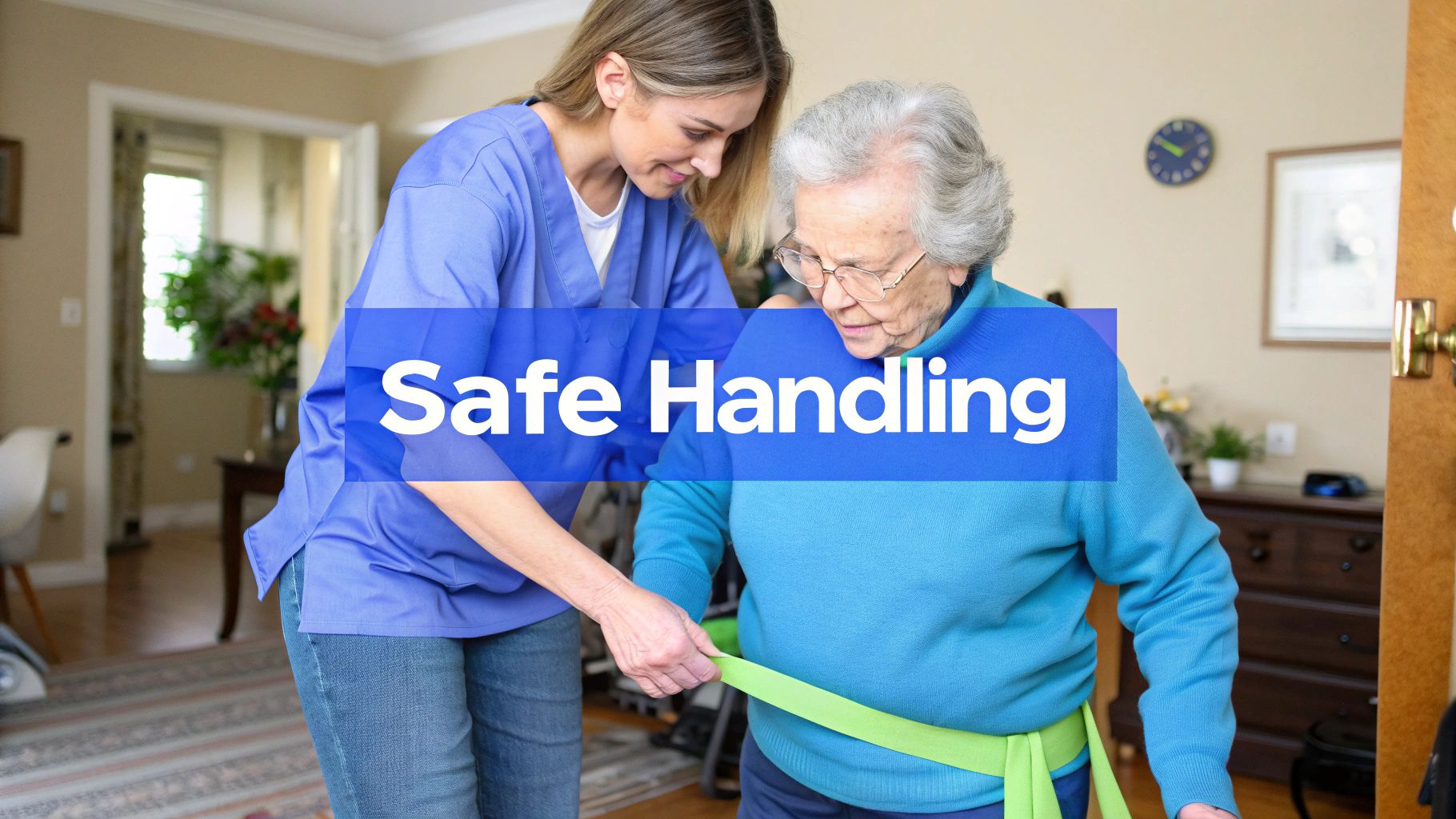
When we talk about "safe patient handling," we're not just talking about a list of rules. We're talking about a complete shift in how you approach moving and repositioning a person you care for. It's about protecting both of you from injury by working smarter, not harder.
The old way of thinking often relied on pure physical strength. We now know this leads to an unacceptable risk of injury. The modern approach focuses on using proper body mechanics and the right assistive devices to make every transfer as safe as possible.
Why Safe Patient Handling Is Non-Negotiable
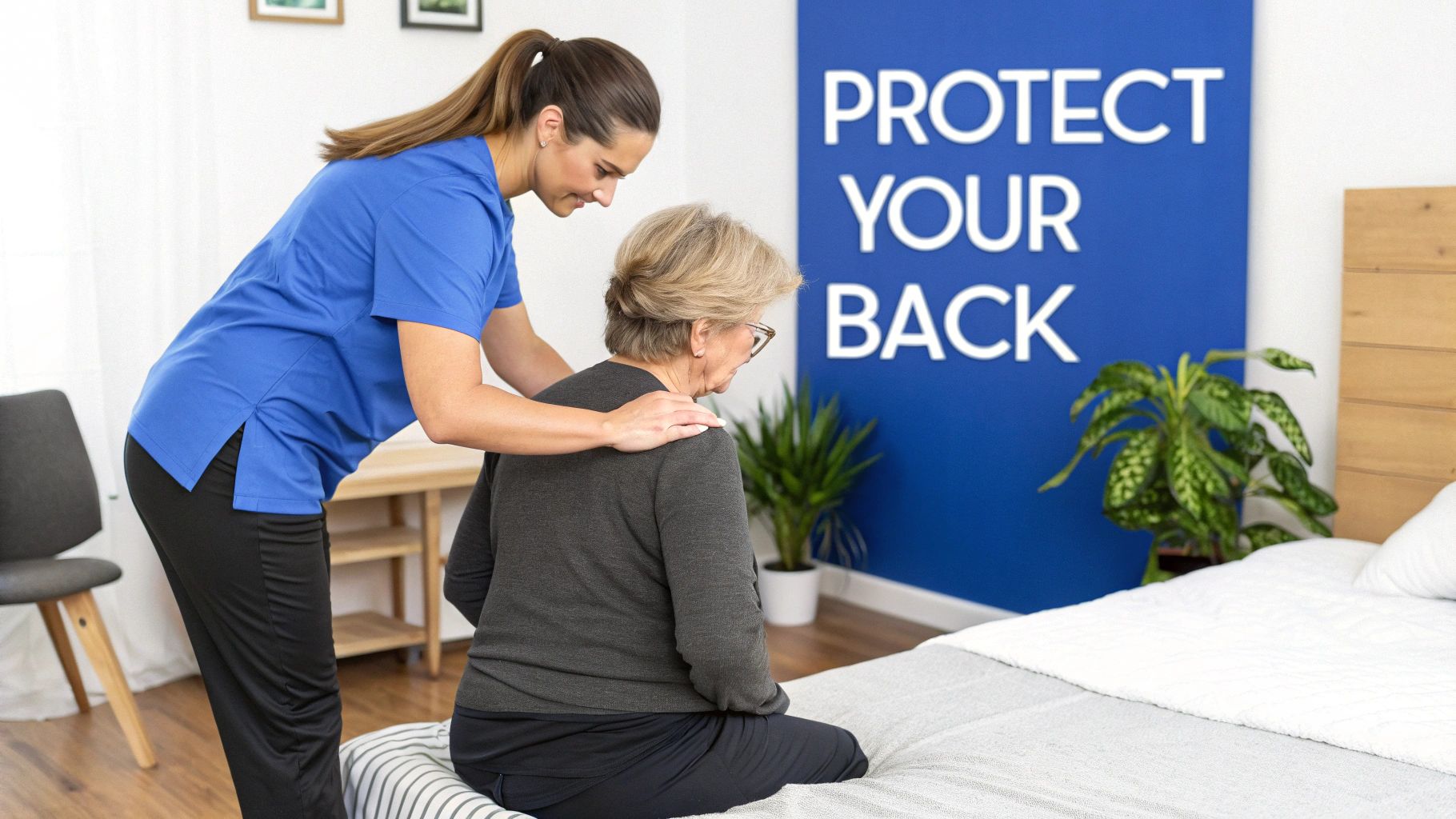
This isn't just about following best practices; it’s a mindset that safeguards your own health and the well-being of the person you're caring for. For far too long, the default method for moving someone was simply to lift and pull, which created a staggering rate of musculoskeletal injuries among caregivers.
Back injuries, in particular, are one of the top reasons dedicated caregivers are forced to leave a job they love. The core of safe handling is moving away from brute force and embracing smarter, biomechanically sound movements that work with your body, not against it. Your ability to provide great care is directly tied to your own well-being.
The True Cost of Improper Lifting
The physical toll of caregiving can be immense. Statistics show that caregivers and healthcare workers suffer from work-related musculoskeletal disorders (MSDs) at a higher rate than almost any other profession. These aren't just minor aches; they are career-ending injuries.
In fact, up to 72% of nurses report living with chronic lower back pain directly linked to unsafe patient handling. This isn't just a job hazard; it's a preventable crisis that affects countless families and the entire healthcare system.
The old advice to "lift with your legs" is dangerously outdated. We now know that relying on body mechanics alone isn't enough to prevent injury. Real safety is a combination of smart movement and using the right tools for the specific situation.
The Pillars of a Safer Caregiving Journey
Adopting a safety-first mindset really comes down to mastering a few fundamental areas. Think of these as the foundation for every single transfer or repositioning you do.
- Situational Assessment: Before you even think about moving someone, you have to pause. Take a moment to assess the person's condition, the surrounding environment, and your own physical readiness for the task.
- Proper Body Mechanics: This is your core technique. It's about creating a stable base, keeping your spine neutral, and letting your powerful leg muscles do the heavy lifting—not your back.
- Use of Assistive Devices: A smart caregiver knows their limits. Recognizing when a manual lift is too risky and reaching for a transfer belt, slide sheet, or mechanical lift is a sign of expertise, not weakness.
Getting these skills down protects your body and dramatically increases the comfort, safety, and dignity of the person in your care. For those looking to master complex skills in a risk-free setting, new technologies like virtual reality for medical training offer an incredible way to practice and perfect these essential techniques. By making these pillars a priority, you're investing in a longer, healthier caregiving journey for yourself and ensuring better outcomes for the person who depends on you.
How to Assess Risk Before Every Transfer
Every single transfer you perform starts long before anyone actually moves. The most critical part of safe patient handling isn't brute strength—it's the 30-second pause you take to size up the situation. This isn't some formal checklist; it's a quick, practical mental scan that can mean the difference between a smooth move and a dangerous fall.
I like to think of it as a three-part check: a look at the person you’re caring for, a scan of the environment around you, and an honest check-in with yourself. If you skip even one of these, you're turning a routine transfer into a high-risk gamble. Making this a habit is the bedrock of keeping everyone safe.
Evaluating the Patient's Status
First, tune in to the person you're helping. Their condition can change in a heartbeat—what was true yesterday might not be true today. Before you even think about moving them, ask a few direct questions.
How are they feeling right now? The person who was steady on their feet yesterday might be dizzy, weak, or in pain today. Just ask them. But also, use your eyes. Are they grimacing? Do they look unsteady? Those non-verbal cues are your signal that they might not be ready.
Next, consider their cognitive state. Are they alert enough to follow your instructions? Someone who is groggy from medication or feeling confused won't be able to help, which puts all the physical strain on you. If they seem less capable than usual, it’s a sign to change your plan. Maybe that means getting extra help or using a different piece of equipment.
Your quick assessment is the first line of defense. Taking a moment to acknowledge a person's dizziness or sudden weakness isn't a delay—it's the smartest thing you can do to prevent a fall and build trust.
Scanning Your Immediate Environment
Once you've checked on your loved one, shift your focus to the physical space. I've seen more accidents happen because of a cluttered room than almost anything else. Your goal is simple: create a clear, safe path from point A to point B.
Take a quick look around and clear out any potential hazards. This is non-negotiable.
- Get rid of throw rugs or mats that can easily slip.
- Move any cords or clutter on the floor that someone could trip over.
- Wipe up any spills or wet spots immediately.
With the path clear, check the equipment. Are the wheelchair brakes locked? Is the bed at the right height? Ideally, you want it level with or just a bit higher than the chair they're moving to. Trying to lift someone out of a low, squishy couch is a world away from a firm, height-adjusted bed—and it requires a lot more from you. Paying attention to these details is a huge part of managing fall risks. For a deeper dive, our guide on nursing interventions for risk for falls has more great tips you can use at home.
Conducting a Self-Assessment
Finally—and caregivers are notoriously bad at this—you have to assess yourself. We get so wrapped up in caring for our loved one that we completely ignore what our own body is telling us. That's a mistake you can't afford to make.
Are you physically up for this transfer right now? If you're tired, stressed, or feeling that familiar twinge in your lower back, your own body mechanics are going to be sloppy. That puts you at a huge risk for injury. Pushing through fatigue is how so many caregivers end up with back injuries that can take them out of commission.
Look down at your feet. Do you have the right shoes on? You need non-slip, supportive footwear, period. Trying to do a transfer in socks or flimsy slippers is just asking for trouble. Be brutally honest with yourself about your physical and mental state before every single transfer. If you have any doubt at all, it's always safer to ask for help or grab an assistive device.
Mastering Body Mechanics to Protect Your Back
As a caregiver, your body is your most valuable tool. Keeping it safe isn't just a good idea—it's absolutely essential for a long, healthy career. We've all heard the advice to "lift with your legs," but what does that actually look like when you’re helping someone from a chair?
It’s about making a conscious choice to shift the strain away from your vulnerable back and onto the powerhouse muscles in your legs and core.
Think about a professional weightlifter before a heavy squat. They don’t just yank the bar up. They set their feet, brace their core, and keep their spine perfectly aligned. Adopting that same intentional mindset for every single transfer is one of the most powerful habits you can build.
Create a Wide and Stable Base
Your balance starts from the ground up. Before you even think about moving someone, plant your feet about shoulder-width apart. Putting one foot slightly in front of the other creates a staggered stance that gives you a rock-solid base of support.
This simple setup keeps you from getting pulled off balance. It allows you to smoothly shift your weight from your back foot to your front foot, keeping you in complete control through the entire movement.
Hinge at Your Hips, Not Your Waist
If you only remember one thing, make it this: hinge, don't bend. Bending over at the waist puts a massive amount of pressure on your lower back. Instead, protect your spine by hinging at your hips.
To do this, just push your hips back like you're about to sit down in a chair, making sure to keep your chest up and your back straight. This motion automatically engages your glutes and leg muscles—the strongest muscles in your body—and forces them to do the work. It’s a game-changer.
A straight back is a safe back. Twisting your torso while lifting or carrying a load is one of the fastest ways to sustain a serious back injury. Always pivot your feet to turn your entire body instead.
Keep the Person Close
The further someone is from your body, the heavier they feel and the more strain it puts on your spine. Before you start any transfer, get as close as you possibly can.
This brings their center of gravity closer to yours, which makes the load feel lighter and dramatically reduces the stress on your back and arms. Keeping the person close lets you use your own body weight as a counterbalance, turning a difficult lift into a controlled pivot.
To make these rules easy to remember, here's a quick cheat sheet comparing the right way to the risky way.
Do's and Don'ts of Caregiver Body Mechanics
| Action | Do This (The Safe Way) | Don't Do This (The Risky Way) |
|---|---|---|
| Stance | Feet shoulder-width apart, one foot slightly forward. | Feet close together or side-by-side. |
| Back Position | Keep back straight, chest up, and shoulders back. | Round or arch the back, bending at the waist. |
| Lifting Power | Use the large muscles in your legs and glutes. | Rely on your smaller back and arm muscles. |
| Turning | Pivot with your feet to turn your entire body. | Twist your torso or spine while holding weight. |
| Proximity | Hold the person as close to your body as possible. | Lift or transfer with your arms fully extended. |
Making these safe habits second nature is the best thing you can do for your long-term health as a caregiver.
Use Your Legs and Core
Once you’re in position with a straight back, the real power comes from your legs. As you get ready to help the person stand, tighten your abdominal muscles. Think of it like bracing for a punch—this simple action acts like a natural weightlifting belt, protecting your spine.
Then, drive the movement by pushing up through your heels to straighten your legs. This powerful motion does all the heavy lifting, so your arms are just there to guide and support. It’s a coordinated effort that ensures the right muscles are doing the job they were built for. For more general advice, this is a great resource on safe lifting techniques to protect your back. Making these movements automatic is the key to preserving your own health for the long haul.
Practical Guides for Common Patient Transfers
Knowing the theory is one thing, but building real confidence comes from doing. This is where we put the principles into practice, focusing on the transfers you'll be doing day in and day out. Getting these common movements right is the absolute key to protecting your back and keeping the person you care for safe.
Let's walk through the mechanics of a few essential transfers. We'll focus on setting up the space, positioning your body, and communicating like a pro. Think of these not as rigid rules, but as flexible frameworks that will help you build skill and confidence with every successful move.
The Foundational Sit-to-Stand Transfer
The sit-to-stand is the cornerstone of almost every other move you'll make, whether you're getting out of bed, off the couch, or onto the toilet. If you nail this one, everything that follows becomes a whole lot easier.
First, get the destination ready. If they're moving to a walker, it needs to be directly in front of them, close enough to grab easily. If they're just standing up for a moment, scan the area and make sure the path is clear of trip hazards like loose rugs or clutter.
Now, get your loved one in position. Have them scoot forward to the very edge of the chair or bed. Their feet should be flat on the floor, tucked back slightly behind their knees. This simple adjustment naturally shifts their weight forward, giving them a head start on standing up.
You'll want to stand directly in front of them with your feet in a wide, staggered stance for balance. Hinge at your hips and bend your knees—never your back—until you're on their level. You're essentially mirroring their posture to create a solid, supportive base for both of you.
Your voice is your best tool. Use simple, direct cues like, "Okay, on three, we're going to stand. One… two… three… push!" This gives them a heads-up and lets them help with the movement, which makes a huge difference in the physical effort required from you.
Executing the Bed-to-Chair Transfer
Moving from a bed to a wheelchair or armchair is all about a smooth, controlled pivot. The goal here is to minimize the distance and completely avoid any actual lifting.
Start by placing the chair at a 45-degree angle to the bed, getting it as close as you possibly can. Always, always lock the brakes. For a wheelchair, swing the footrests out of the way to give them a clear path.
Once you’ve completed the sit-to-stand, it’s time to pivot. With a firm grip on their back or a transfer belt, coach them to take tiny steps to turn towards the chair. You move right along with them, pivoting on your own feet—never, ever twist your spine.
When they feel the back of the chair against their legs, cue them to reach back for the armrests. This gives them a secure target to aim for. From there, you'll guide them as they slowly lower into the seat, controlling the motion by bending your knees and hips, not your back. For a more detailed walkthrough, check out our complete guide on wheelchair transfer techniques which has extra tips and visuals.
This infographic is a great reminder of where your power comes from during any transfer: your base and your legs.
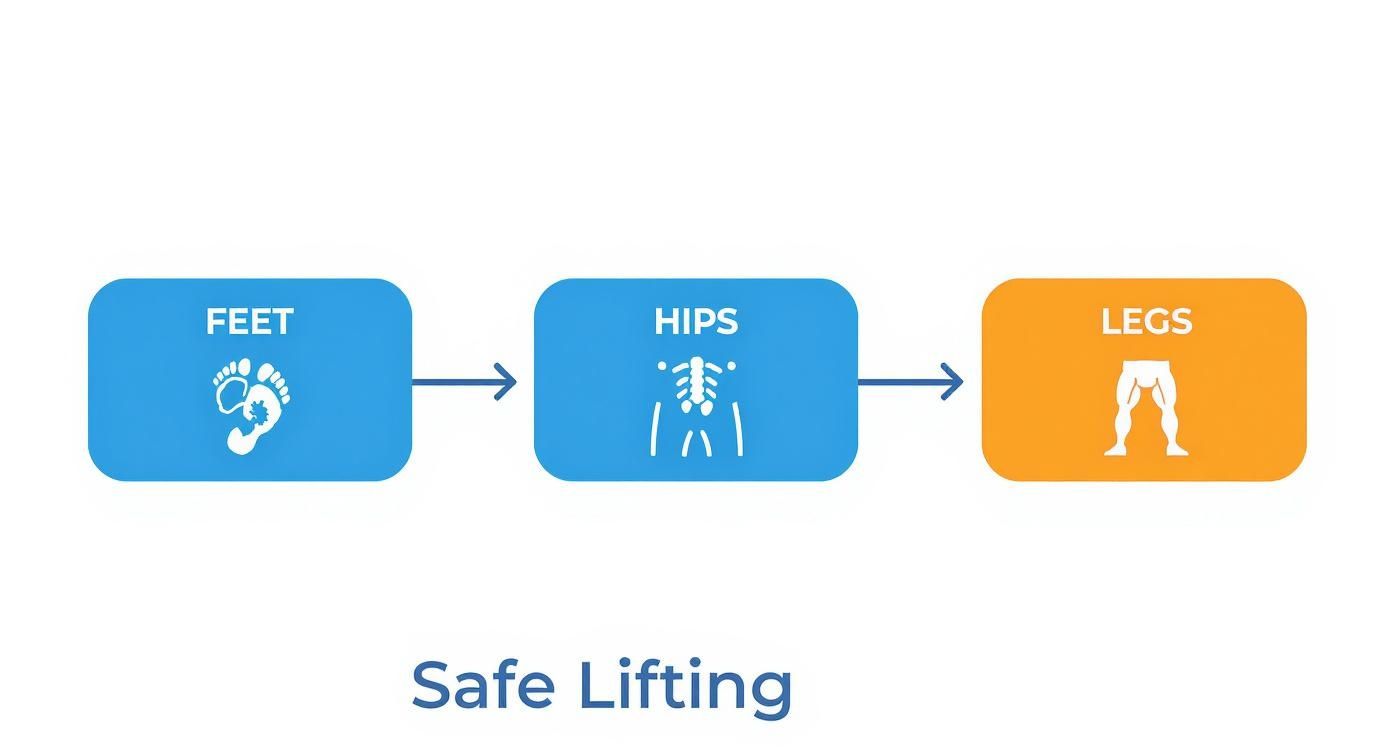
It really reinforces the idea that true strength for safe handling comes from a stable stance and using your powerful leg muscles, not from straining your back.
Adapting Transfers for the Toilet
Bathroom transfers can be tricky. You're often working in a tight, awkward space, which makes using proper technique even more critical. The core principles don't change, but the environment demands some extra planning.
Before you even start, clear the deck. Get any bath mats, scales, or trash cans out of the way to open up as much floor space as you can. If you have one, a raised toilet seat or a commode with grab bars can be a game-changer, making the transfer much safer by reducing how far the person needs to lower themselves.
Position the wheelchair or walker as close to the toilet as the space allows; sometimes a 90-degree angle works best in a small bathroom. Lock the brakes, then help the person come to a standing position using the same sit-to-stand method.
The pivot here is everything. Guide them with small, shuffling steps until they are lined up right in front of the toilet. As soon as they feel the bowl on the back of their legs, they can start to sit. A quick tip: talk about any clothing adjustments before they sit down. Trying to reposition someone who is already seated is awkward and unsafe. Make sure they are stable and secure before you step back, and simply reverse the process when they're finished.
Using Assistive Devices for Safer Transfers
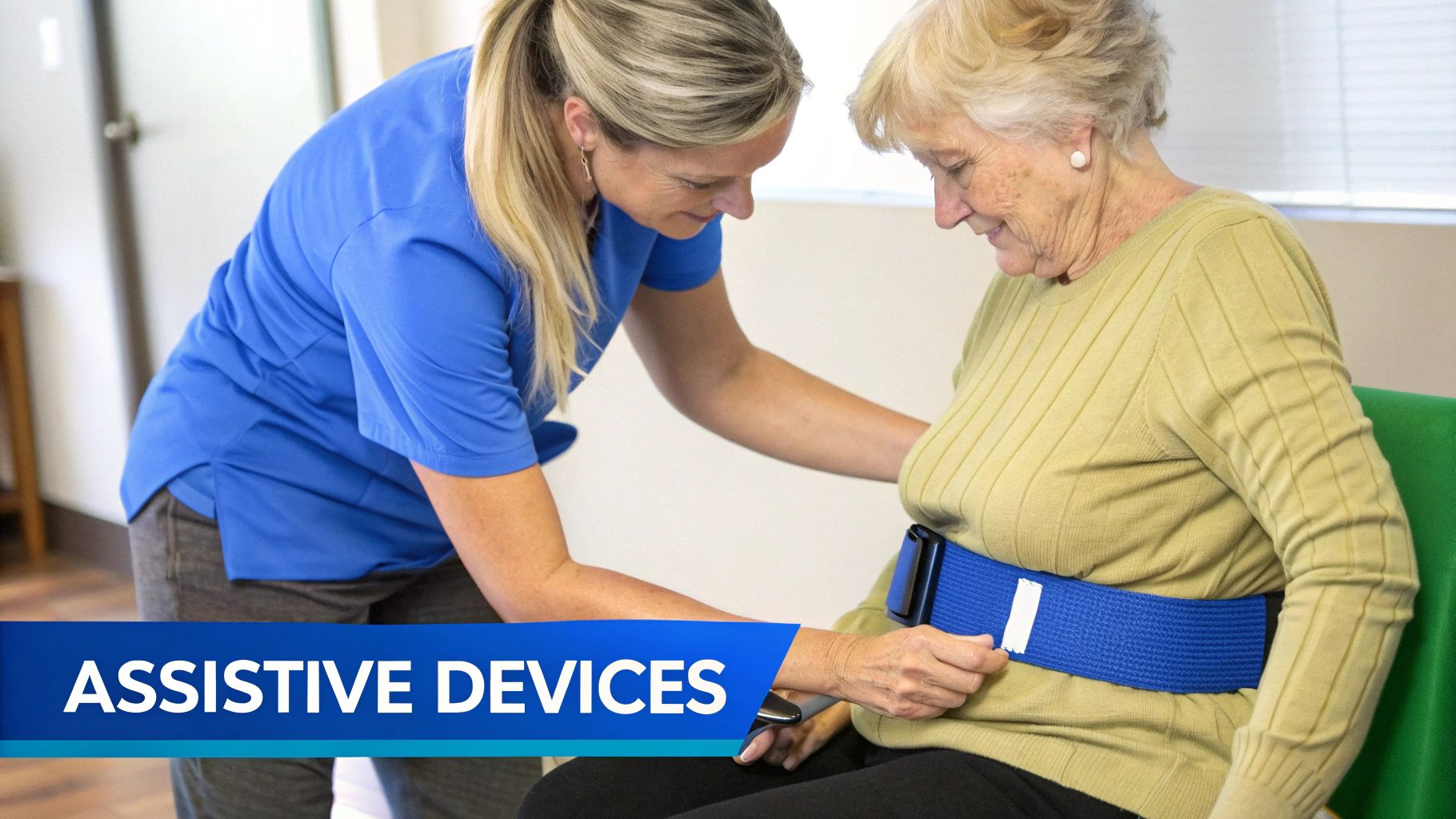
Relying on sheer physical strength for every transfer is a recipe for disaster. One of the core principles of modern safe patient handling techniques is to work smarter, not harder. This means embracing assistive devices as essential tools of the trade, not just as a last resort.
Using a device isn't a sign of weakness; it's the mark of a smart, safety-conscious caregiver. These tools are specifically designed to reduce the physical strain of moving someone, making transfers smoother, safer, and more dignified for everyone involved.
The Power of a Gait Belt
One of the most common—and misunderstood—tools is the gait belt, sometimes called a transfer belt. Let's be crystal clear: a gait belt is not for lifting. Its true purpose is to give you a secure handhold and offer stability to the person you're helping.
Imagine you're helping someone unsteady get to their feet. Instead of grabbing their arms or clothing, which can be unstable and even cause bruising, you secure a gait belt snugly around their waist. This gives you a firm, safe place to grip, allowing you to guide their movement and provide steady support.
- How to Use It: Fasten the belt over their clothing at the waist. It should be snug enough not to slide around but not so tight that it's uncomfortable. A good rule of thumb is being able to fit two fingers between the belt and the person.
- Where to Grip: Always use an underhand grip on the back of the belt. This position gives you far better leverage and control than grabbing from the top.
Making Moves Frictionless with Slide Sheets
Repositioning someone in bed can be a high-strain task. It often involves a lot of pulling and tugging that’s uncomfortable for them and risky for your back. This is where a slide sheet is a game-changer.
Made from a special low-friction material, a slide sheet lets you move a person with minimal effort. Think of it like sliding a heavy box across a slippery floor instead of dragging it across a carpet. By placing the sheet underneath them, you can easily slide them up in bed, turn them on their side, or help with a lateral transfer without any jarring movements.
When a Mechanical Lift Is the Only Safe Choice
Sometimes, manual assistance just isn't safe, even with tools like belts and sheets. If a person cannot bear any weight or is significantly heavier than you, a mechanical lift is the only appropriate and safe option.
Using a device like a Hoyer lift is the gold standard for a "minimal-lift" or "no-lift" policy, which is the safest approach for everyone. These lifts use hydraulic or electric power to do all the heavy work, reducing the risk of injury to nearly zero. Embracing this technology is a critical part of modern, professional caregiving.
The data is overwhelmingly clear. Implementing Safe Patient Handling and Mobility (SPHM) programs with mechanical lifts is one of the most effective ways to reduce caregiver injuries.
Studies show these programs can slash injury frequency by as much as 71% and decrease lost workdays by over 80%. You can read the full findings from OSHA to see just how much these programs protect caregivers. These aren't just tools; they're essential safety equipment. For a detailed breakdown of different equipment, check out our guide on mobility aids for the elderly.
Common Questions About Safe Patient Handling
Even with the best training, caregiving in the real world throws curveballs. Unexpected situations pop up all the time, leaving you wondering if you're making the right call. Let's tackle some of the most common "what-if" scenarios and practical questions that caregivers face every single day.
Having clear answers ready before you need them is the key to navigating those tricky moments with confidence. These insights will help you react safely and effectively, protecting both yourself and the person you're caring for.
What Should I Do if a Patient Starts to Fall?
Your first instinct might be to grab them and haul them back up, but that’s a surprisingly dangerous move that can injure both of you. The safest response isn't to stop the fall—it's to control their descent to the floor.
The moment you feel them losing balance, widen your stance to create a stable base for yourself. Immediately bend at your knees and hips, keeping your back as straight as possible, and guide them gently downward. Your only job in that moment is to protect their head and ease them to the floor.
Never try to hold their full weight. Once they're safely on the floor, check for any injuries before even thinking about helping them up. If you have any doubt about your ability to lift them safely, it's time to call for assistance.
How Do I Transfer Someone Much Heavier Than Me?
The short answer? You don't do it with brute force. Ever. Attempting to manually lift someone significantly heavier is probably the fastest way to get a back injury. This is precisely why assistive equipment and safe patient handling techniques are so non-negotiable.
For anyone who can't bear their own weight, a mechanical lift (like a Hoyer lift) is the only truly safe option. If they can partially assist, your plan still needs to include tools like a slide board, a gait belt for stability, and ideally, a second person to help you.
The golden rule is to never let your own muscles be the primary tool for lifting a much heavier person. Assess the situation honestly and always use the right equipment or get help. It’s not just the safe approach—it’s the professional one.
Do Safe Handling Techniques Protect the Patient, Too?
Absolutely. In fact, it’s just as much about their safety and comfort as it is about yours. Improperly pulling or dragging someone can cause incredibly painful skin tears, bruises, and even dislocated joints, especially in older adults with fragile skin. Smooth, controlled movements are essential to prevent this.
A secure transfer also dramatically reduces the patient's risk of falling, which remains a major cause of serious injury and hospitalization. Beyond the physical, though, is the psychological comfort. A well-executed, confident transfer builds an immense amount of trust and calms the anxiety they might feel about moving. When they feel secure, they're more likely to relax and help with the transfer, making it easier on everyone.
Where Can I Find Hands-On Training in New Jersey?
Reading guides like this is a great start, but nothing can replace hands-on practice with an expert. For caregivers in New Jersey, several fantastic local resources can provide that personalized training.
- County Offices on Aging: Your local County Office on Aging or the Aging and Disability Resource Connection (ADRC) is a great first call. They often host caregiver support programs, workshops, and training sessions.
- Home Health Agencies: If your loved one already receives services from a home health agency, their physical or occupational therapist is an invaluable resource. Don't hesitate to ask them for hands-on training tailored to your loved one’s specific needs and your home's layout.
- Support Organizations: Groups like the American Red Cross sometimes offer caregiver courses that specifically cover mobility assistance and safe transfer techniques.
At NJ Caregiving, we understand that providing safe, compassionate, and skilled care is your top priority. If you need professional support or hands-on guidance in Princeton or Mercer County, our team of experienced caregivers is here to help. Learn more about our in-home care services at njcaregiving.com.
