

The biggest difference between a guardianship and a power of attorney comes down to choice versus a court order. A Power of Attorney (POA) is a proactive legal tool you create, giving you the power to choose a trusted agent to act on your behalf. In contrast, guardianship is a reactive, court-imposed process that happens when someone is deemed incapacitated without a POA already in place, ultimately stripping them of their autonomy.
Navigating Legal Authority in New Jersey
When you're planning for a loved one's future, especially when in-home care is on the horizon, getting a handle on your legal options is critical. Two key documents, a Power of Attorney and a guardianship, seem to do the same thing—let one person make decisions for another—but they couldn't be more different. They spring from completely different circumstances and have huge implications for personal freedom, cost, and family stress.
Think of a Power of Attorney as an act of foresight. It’s a legal document someone (the "principal") creates while they are still mentally sharp. This document hands over authority to a trusted person (the "agent") to make specific financial or healthcare decisions if needed.
On the other hand, a guardianship is a legal remedy of last resort. It's what happens when someone has already lost the capacity to make decisions for themselves and never put a POA in place. A family member then has to go to the New Jersey Superior Court to have the person declared legally incapacitated so a guardian can be appointed to manage their affairs.
A Power of Attorney is proactive—you set it up while you still have capacity. Guardianship is reactive—a court orders it after capacity is already gone. Both are meant to protect vulnerable individuals, but guardianship means significant court oversight and a profound loss of personal control.
For New Jersey families trying to sort through these complex issues, exploring comprehensive elder law strategies can offer a clearer path for long-term care and financial planning. The goal is always to protect your loved one and honor their wishes with dignity.
Guardianship vs Power of Attorney A Quick Comparison
I've put together this table to highlight the fundamental differences. It really shows why proactive planning with a Power of Attorney is almost always the preferred choice for families in New Jersey.
| Attribute | Power of Attorney (POA) | Guardianship |
|---|---|---|
| Initiation | Created voluntarily by the individual (principal) while competent. | Initiated through a court petition after incapacity is proven. |
| Timing | Proactive; established before incapacity occurs. | Reactive; established after incapacity is confirmed by a court. |
| Control | The principal chooses their agent and defines the scope of their powers. | A judge appoints the guardian and determines their authority. |
| Autonomy | The principal retains all their legal rights and can revoke the POA. | The individual (ward) loses significant legal rights and autonomy. |
| Oversight | A private arrangement with no ongoing court supervision required. | Requires ongoing court supervision, including annual reports. |
| Cost | Relatively low cost, typically a one-time attorney fee. | Expensive, involving court fees, multiple attorneys, and ongoing costs. |

As you can see, the differences aren't just technical—they have a real-world impact on a person's life and a family's finances. Planning ahead with a POA keeps the individual in the driver's seat, while guardianship puts the court in control.
The Role of a Power of Attorney in Proactive Planning
A Power of Attorney (POA) isn't just another legal form; it's your way of staying in the driver's seat of your own life. Unlike guardianship, which is a court-imposed solution after a crisis, a POA is all about proactive planning. It lets you decide who will speak for you when you no longer can.

This document is built on trust. You, the “principal,” handpick a trusted person—your “agent”—to make decisions for you. The key is that you make this choice while you are still of sound mind, ensuring your values and wishes are the blueprint for any future decisions.
This proactive approach is the fundamental difference between a POA and guardianship. With a POA, you’re in control. With guardianship, the court steps in and chooses for you after you’ve been deemed incapacitated. Right now, U.S. courts are managing about 1.3 million adult guardianship cases, controlling at least $50 billion in assets. As our population ages, these numbers are only going up, making proactive planning more critical than ever.
Defining Your Agent's Authority
When you set up a Power of Attorney in New Jersey, you have total control over how much power your agent gets. It's not an all-or-nothing deal. You can grant them broad authority or restrict their powers to very specific duties.
For anyone thinking about long-term planning, two types of POAs are absolutely essential:
- Durable Power of Attorney for Finances: This lets your agent handle your money matters—things like paying bills, managing investments, filing taxes, or dealing with real estate. The "durable" part is crucial; it means the document stays valid even if you become incapacitated.
- Medical Power of Attorney (Healthcare Proxy): This authorizes your agent to make critical health decisions on your behalf if you can't. This includes everything from choosing doctors and consenting to treatments to accessing your medical records.
For families planning for in-home care, a well-drafted POA is a lifesaver. It allows your agent to manage care-related finances, navigate complicated Medicaid applications, and make quick medical decisions without the stress and delays of going through the court system.
A Power of Attorney is your voice, legally documented. It ensures that the person you trust most is empowered to act on your behalf, following your instructions, when you need it most. This avoids the public, costly, and emotionally draining court process of guardianship.
The Importance of Acting Early
There’s a limited window to create a Power of Attorney. You have to sign it while you are mentally competent and fully grasp the authority you’re giving away. Once an accident happens or an illness like dementia sets in, that opportunity is gone for good.
This is why it's so important to have these conversations and get the paperwork done now, not later. By putting a POA in place, you give your family a clear plan, which helps minimize arguments and ensures the care you receive is exactly what you would have wanted.
Check out our detailed resources on the necessary medical and financial power of attorney forms to get started.
Navigating the Guardianship Process in Court
When proactive planning with a Power of Attorney hasn’t happened, families are often left with only one path forward: guardianship. This isn’t a simple arrangement you make at a kitchen table. It’s a formal, often emotionally draining court proceeding that begins when someone is believed to be incapacitated and can no longer manage their own affairs.
The process kicks off when a concerned family member or friend, known as the petitioner, files a formal request with the New Jersey Superior Court. This single filing sets a complex legal journey in motion. The court’s primary role is to determine if the individual—referred to as the "alleged incapacitated person"—truly lacks the mental capacity for self-governance. It’s not a decision made lightly, as it involves a significant loss of personal rights and freedoms.
To ensure fairness, the court appoints an independent attorney to represent the individual, protecting their rights throughout the hearing. The petitioner then has the tough job of proving incapacity, and the legal standard for doing so is quite high.
Proving Incapacity in Court
In New Jersey, a petitioner must demonstrate incapacity by clear and convincing evidence. This is a rigorous standard, much more demanding than the "preponderance of the evidence" used in many civil cases. It falls just short of the "beyond a reasonable doubt" standard required in criminal trials.
To meet this burden, the petitioner has to present a comprehensive case, which must include:
- Physician Affidavits: Certifications from at least two physicians are required. These documents must detail the medical diagnosis, prognosis, and a clear assessment of the individual's inability to manage their personal and financial affairs.
- Testimony: Witnesses, including family members, caregivers, and medical experts, may need to testify about the person's cognitive state and decision-making abilities.
- A Court-Appointed Attorney's Report: This attorney meets with the alleged incapacitated person, reviews their medical records, and reports their findings and recommendations directly back to the judge.
If the judge is convinced that the individual is incapacitated, they will issue a court order appointing a guardian. This guardian is then granted the legal authority to make critical life decisions, from where the person will live and what medical care they'll receive to how their money is spent.
Guardianship is fundamentally a court-enforced measure that removes an individual's rights, a stark contrast to a Power of Attorney which delegates authority without surrendering autonomy.
The entire legal process can be lengthy and public, creating significant stress for families. For those looking for more detailed guidance, our article on how to get legal guardianship of a parent provides a helpful step-by-step overview.
The Scope of a Guardian's Power
A court can establish different types of guardianship based on an individual's specific needs. A "guardian of the person" handles healthcare and personal decisions, while a "guardian of the estate" manages finances. In many situations, a judge will appoint a plenary (or general) guardian to oversee both. This court-supervised role requires meticulous record-keeping and annual reports to the court.
This process really highlights the critical difference between guardianship and power of attorney. Guardianship is a public, costly, and restrictive legal intervention that should be a last resort. For a deeper understanding of guardianship legal frameworks, including how they can vary, you might explore resources on Texas guardianship law.
It's also worth noting how differently this measure is applied across the country. Guardianship rates among adults with disabilities can vary dramatically by state, from as low as 5.5% to as high as 89.0%. These numbers show just how much the approach to this last-resort measure can differ from one state to the next.
Comparing Guardianship and Power of Attorney Side-By-Side
To really understand the weight of your decision, you have to look beyond simple definitions. It's about digging into the practical, real-world impact these two legal tools have on autonomy, cost, and even family dynamics for those of us in New Jersey. This comparison is designed to show you exactly why one path is all about planning ahead, while the other is a reaction to a crisis.
At its core, the difference between guardianship and a power of attorney comes down to the source of power. A POA is a private choice, one person giving authority to another. Guardianship, on the other hand, is a public action where the court steps in and removes an individual's rights.
Origin and Timing
When each document comes to life says everything about its purpose. A Power of Attorney is a forward-thinking tool. An individual—the principal—has to create and sign it while they still have the mental clarity to fully understand what they're doing. It’s an act of foresight, preparing for a "what if" scenario down the road.
In sharp contrast, a guardianship is purely reactive. It only comes into play after someone has already lost the ability to make decisions for themselves, prompting a petition to the court. This is a critical distinction: a POA is an expression of personal freedom, while guardianship is a legal intervention that happens only after that freedom is gone.
A Power of Attorney is your plan, put into motion on your terms. Guardianship is the court's plan, put into motion when you no longer have a say. This shift from personal choice to a judicial order is the single most important difference between them.
Level of Autonomy and Control
The effect on personal rights is where the difference feels most profound. When you create a POA, you stay in the driver's seat. You personally choose your agent, you define their exact powers, and you can tear up the document anytime you want, as long as you're still competent. Your legal rights are completely untouched.
Guardianship, however, leads to a major loss of personal freedom. A judge—not the individual—decides who will act as the guardian. Once the court declares a person incapacitated, they legally lose the right to make their own medical, financial, and personal choices. Those rights are handed over to the guardian, and only a judge can ever restore them.
Court Involvement and Oversight
Another huge point of difference is how much the courts are involved. A Power of Attorney is a private document. Once it's properly signed and executed, it works without any court supervision. Banks and doctors will honor it, but there are no mandatory check-ins or reports to file with a judge.
The guardianship process, however, is managed entirely by the court system from start to finish. This visual gives a good overview of the steps involved.
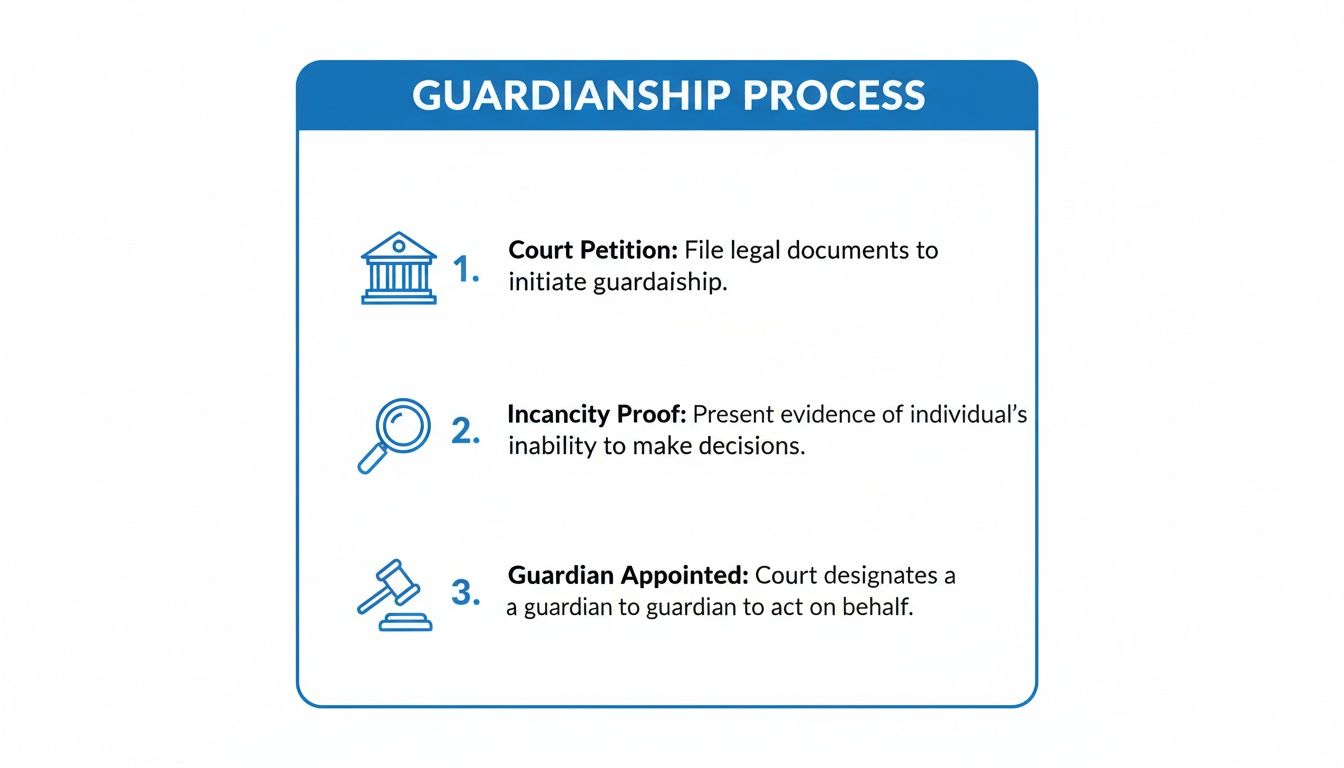
As the infographic shows, the court's involvement is constant and required, from the first petition to the final appointment. A guardian works under the court's supervision, often needing to file detailed annual reports on the person's finances and well-being. This oversight is there for protection, but it adds a layer of bureaucracy and expense that a POA completely avoids.
Financial and Emotional Costs
The financial gap between these two options is massive. Drawing up a Power of Attorney typically involves a one-time fee to an elder law attorney—a predictable and relatively small investment in your future.
Guardianship proceedings are known for being incredibly expensive. The bills pile up quickly and often include:
- Court Filing Fees: Just to get the process started.
- Petitioner's Attorney Fees: The family member asking for guardianship needs their own lawyer.
- Court-Appointed Attorney Fees: The court assigns a lawyer to represent the person alleged to be incapacitated, and their estate usually has to pay for it.
- Ongoing Costs: Guardians may have to post a bond and pay for the preparation of annual court reports.
These costs can easily spiral into thousands of dollars, eating away at the very assets the guardianship was meant to protect. Beyond the money, the emotional cost of a public court hearing—where a loved one's mental state is debated—can be heartbreaking for a family. The planned, private nature of a POA helps families sidestep this kind of public conflict and stress.
Real-World Scenarios for New Jersey Families
Sometimes, legal documents and court hearings can feel a bit abstract. The best way to grasp the difference between a Power of Attorney and a Guardianship is to see how they play out for real New Jersey families. These stories show how one simple choice—planning ahead versus waiting for a crisis—can completely change a family's future.
Each scenario walks through a common situation, from helping a parent manage bills to dealing with a sudden health emergency. The idea is to show you the practical, day-to-day impact of these legal tools.
Scenario 1: Proactive Planning for Peace of Mind
Meet Eleanor, an 82-year-old widow living in Trenton. She’s still sharp and lives on her own, but she worries about who would pay her property taxes or manage her care if her health took a turn. She sits down with her daughter, Maria, and they decide to visit an elder law attorney.
Eleanor signs a Durable Power of Attorney for Finances and a Medical Power of Attorney, naming Maria as her agent. The documents are clear and direct, giving Maria the authority to handle bills, talk to Social Security, and make healthcare decisions if Eleanor ever can't.
A year later, Eleanor has a bad fall and needs a few months of in-home physical therapy. Because the POA is already in place, Maria steps in seamlessly. She arranges a home care aide, pays for the service right from Eleanor’s bank account, and coordinates with her mom's doctors—all without ever setting foot in a courtroom.
The Takeaway: Planning ahead with a POA let Eleanor choose who would make decisions for her. It gave Maria the immediate legal power she needed to act, ensuring her mom’s care continued without a hitch and that her wishes were honored without delay or extra costs.
Scenario 2: The Unexpected Health Crisis
Now, let's look at David, a 78-year-old from Hamilton who suffers a major stroke. He never got around to creating a Power of Attorney, thinking he had plenty of time. Now, he’s unable to communicate his wishes or manage his own finances, leaving his family scrambling.
His son, Mark, quickly finds out his father’s bank won't speak with him, and the hospital needs consent for a critical procedure. Mark has zero legal authority to make these calls. To get control of his dad's care and finances, he's forced to petition the New Jersey Superior Court for guardianship.
The process is a nightmare. Mark has to hire a lawyer, pay court filing fees, and get affidavits from two separate doctors to prove his father is incapacitated. The court appoints another lawyer to represent David, and a formal hearing is scheduled. The whole ordeal takes over three months and costs the family more than $6,000 in legal fees, eating into the money that was supposed to be for David’s care.
A Power of Attorney is a private key you give to someone you trust. Guardianship is a public, court-supervised process that becomes necessary only when that key was never created. The latter is not only more expensive but also far more emotionally taxing for everyone involved.
The Takeaway: With no POA, David’s family was thrown into a stressful, reactive, and expensive court process. The guardianship delayed critical decisions, created a huge financial burden, and turned a private family matter into a public legal case.
Scenario 3: Securing Medicaid for Long-Term Care
Finally, there’s Sarah. Her 85-year-old mother, Helen, has advancing dementia and needs 24/7 in-home care. Thankfully, years ago, Helen signed a comprehensive Durable Power of Attorney and named Sarah as her agent.
The cost of full-time care is steep, so Sarah needs to apply for New Jersey Medicaid on her mother’s behalf. The application is notoriously difficult, requiring access to years of financial records and the authority to move assets and deal with state agencies.
Because Sarah holds a well-drafted POA, she has all the legal power she needs. She can gather bank statements, liquidate specific assets to meet Medicaid's strict financial limits, and navigate the entire lengthy application. She successfully gets her mother approved for Medicaid benefits to pay for in-home care, making sure Helen can stay safely and comfortably in her own home.
Had there been no POA, Sarah would have first had to go through the guardianship process. A guardian’s power to manage and transfer assets is often limited, requiring court approval for major financial moves. This would have caused months of delays and could have forced Helen into a nursing facility while they waited for a judge's permission to do the Medicaid planning.
The Takeaway: A solid POA is a critical tool for long-term care planning. It gives the agent the flexibility needed to handle complex financial hurdles like Medicaid eligibility, protecting both a parent’s well-being and their life savings without getting tangled up in court oversight.
How to Make the Right Choice for Your Loved Ones
When you're weighing guardianship against a power of attorney, the decision really boils down to one powerful idea: foresight. Planning ahead is always the better path, and the choice you make now will shape how your family handles future care—either with dignity and ease or with conflict and stress.
A Power of Attorney (POA) is, without a doubt, the best way to protect your independence. When you create this document while you're still of sound mind, you stay in the driver's seat. You get to hand-pick the person you trust most to manage your affairs, making sure your wishes for your finances and healthcare are followed to the letter, no court intervention needed. It’s a private, cost-effective solution that avoids the emotional and financial turmoil of a public guardianship hearing.
Taking the First Step
Bringing up these topics with family can feel heavy, but it helps to frame the conversation as an act of love and responsibility. This isn't about planning for the worst-case scenario; it's about ensuring the best possible outcome for everyone involved.
Start by just talking about the importance of having a plan in place. Explain that a POA gives the family the ability to act quickly and decisively in a crisis, steering clear of the delays, public exposure, and steep costs that come with going to court. That simple talk is the first step. For more guidance on what comes next, our guide to long-term care planning is a great resource.
When you’re ready to make it official, it's absolutely crucial to work with a qualified New Jersey elder law attorney. They won't just draft a legally solid document; they'll tailor it to fit your unique family dynamics and financial picture.
Getting these legal documents sorted out is the cornerstone of a smooth, respectful in-home care experience. It frees your family from a legal nightmare so they can focus on what truly matters: your health and well-being.
At the end of the day, choosing a Power of Attorney is a gift to your loved ones. It eliminates guesswork, prevents arguments, and protects your legacy as someone who made their own choices. This one act of preparation ensures your wishes remain the guiding force, no matter what the future holds.
Frequently Asked Questions
When you're trying to figure out the best way to care for a loved one, legal terms like Power of Attorney and guardianship can feel overwhelming. It’s completely normal to have a lot of questions. Let’s walk through some of the most common concerns we hear from New Jersey families.
Can We Create a Power of Attorney After a Dementia Diagnosis?
This is a really common and time-sensitive question. A dementia diagnosis itself doesn't automatically mean someone can't sign a Power of Attorney. The real deciding factor is their mental capacity at the moment they sign the document.
In New Jersey, the person must have what's called testamentary capacity. In simple terms, this means they need to understand what a POA is and the authority they are giving to someone else. If they are in the earlier stages and have clear moments where they understand the document's purpose, it might still be possible.
But if the disease has progressed to the point where they can no longer grasp these concepts, then it's unfortunately too late. This is why we always stress how important it is to have these conversations and get legal documents in place before a health crisis makes it impossible.
What if the Agent Named in the POA Cannot Serve?
This is a classic "what if" scenario and one that a good estate plan should always anticipate. A well-prepared Power of Attorney will name not just a primary agent, but also one or more successor agents.
If the first person you named can't serve—maybe due to their own health issues, death, or just personal reasons—the next person on the list automatically steps into the role.
Without successor agents, the POA document becomes useless if the primary agent isn't available. If your loved one is already incapacitated at that point, you're left with no other option but to go through the courts to establish guardianship.
What Is the Cost Difference Between a POA and Guardianship in NJ?
The financial difference between these two paths is huge. Getting a Power of Attorney drafted is usually a one-time, flat-fee service from an elder law attorney. This might cost anywhere from a few hundred to a couple of thousand dollars, often as part of a complete estate plan.
Guardianship, on the other hand, is a full-blown court proceeding, and the costs add up quickly. You're looking at:
- Court Filing Fees to get the process started.
- Your Attorney's Fees to represent you.
- Court-Appointed Attorney's Fees for the person who needs the guardian.
It's not unusual for the initial costs of a guardianship to exceed $5,000. And that doesn't even include the ongoing costs of filing annual reports and accountings with the court. A little bit of planning with a POA can save a family thousands of dollars and an incredible amount of stress down the road.
At NJ Caregiving, we know these decisions are tough and often come during an emotional time. Our job is to provide the compassionate, expert in-home care your loved one needs, so you can focus on being a family. Contact us today to see how we can support you.