
When you're looking for in-home care, figuring out whether you need a Certified Nursing Assistant (CNA) or a Home Health Aide (HHA) is one of the most important first steps. The core difference really boils down to their level of training and what they're legally allowed to do.
Think of it this way: a CNA has more formal, medically-oriented training designed for people with more complex health needs. An HHA, on the other hand, is an expert in providing personal care, companionship, and the day-to-day support that helps someone live safely and comfortably at home.
Choosing The Right In-Home Caregiver In NJ
Understanding the specific roles of a CNA versus a Home Health Aide is key to making a confident choice for your family. Both are dedicated professionals who provide compassionate support, but their qualifications and responsibilities are tailored to meet very different situations. This guide will walk you through a detailed comparison to help you match the right professional to your loved one’s needs.

Let's start with a quick-glance table to highlight the main distinctions right away.
Quick Comparison CNA vs HHA At A Glance
This table breaks down the primary differences between Certified Nursing Assistants and Home Health Aides, giving you a clear, side-by-side snapshot.
| Attribute | Certified Nursing Assistant (CNA) | Home Health Aide (HHA) |
|---|---|---|
| Primary Focus | Clinical support and basic medical tasks under nurse supervision. | Personal care, companionship, and assistance with daily living. |
| Training Level | More extensive; requires state-approved certification and exam. | State-mandated training focused on non-medical, personal care. |
| Scope of Practice | Can monitor vital signs, assist with medical equipment, and document health changes. | Focuses on bathing, dressing, meal prep, and light housekeeping. |
| Typical Setting | Hospitals, nursing homes, and rehabilitation centers; also in-home care. | Primarily in private residences, fostering one-on-one relationships. |
| Best For | Patients with chronic conditions, post-surgery recovery, or unstable health. | Seniors needing help to age in place safely and combat loneliness. |
The most significant differentiator is the CNA's ability to perform medically related tasks. If your loved one requires regular monitoring of vital signs or assistance with medical equipment, a CNA is legally and professionally qualified for that role.
Making the right choice from the start ensures your loved one gets care that's not just kind and compassionate, but also perfectly suited to their specific health situation. For a deeper dive into what an HHA can do, you can explore our resources to find the right home health aides for you and see how their skills align with your family's needs.
A Day in the Life: Defining Roles and Responsibilities
To really understand the difference between a CNA vs a home health aide, it helps to picture what their average day looks like. While both roles are built on compassionate care, their daily routines are worlds apart, shaped by different skill sets and legal boundaries.
A Certified Nursing Assistant's day is often more clinical. They work under the direct supervision of a registered nurse, even in a home setting.
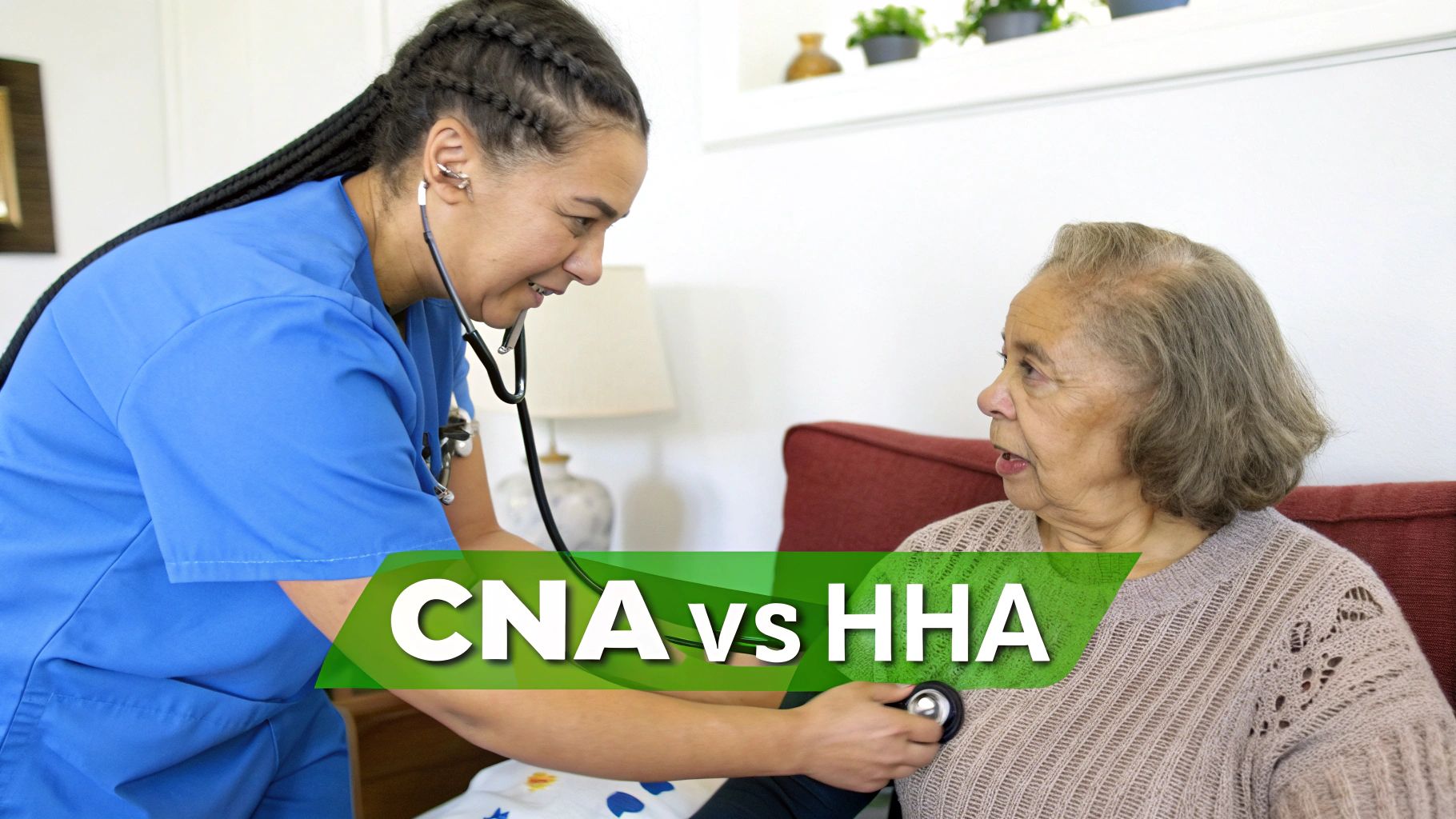
This structure means a big part of their time is spent on tasks that bridge the gap between personal care and hands-on medical support.
The Clinical Focus of a CNA
Let's imagine an elderly man is back home, recovering from a hospital stay for pneumonia. A CNA’s role here is multifaceted and medically focused.
Their daily checklist might look something like this:
- Monitoring Vital Signs: They’ll regularly check and record his blood pressure, heart rate, and oxygen levels to make sure he's on the right track.
- Assisting with Medical Equipment: This could mean helping with a nebulizer treatment or ensuring the oxygen tank settings are correct, just as the nurse prescribed.
- Mobility and Rehabilitation Support: The CNA might guide him through prescribed physical therapy exercises to help him regain strength.
- Documentation: Every change matters. The CNA will meticulously note things like increased coughing or a slight fever and report them immediately to the supervising nurse.
This clinical oversight is really the heart of the CNA role. They act as the eyes and ears of the nursing team right inside the home, trained to spot and report crucial health changes.
A CNA's day is guided by a specific care plan developed by a nurse. Their ability to handle basic medical tasks makes them indispensable for clients with unstable health conditions, chronic illnesses, or those in post-operative recovery.
The Holistic Approach of a Home Health Aide
On the flip side, a Home Health Aide’s day revolves around creating a safe, comfortable, and supportive living space. Their role is entirely non-medical, focusing on the client’s overall well-being and independence. To get a better feel for the practicalities, you can explore the day-to-day life of a Healthcare Assistant, a role that shares many similarities with an HHA.
An HHA caring for a senior with mild dementia and some mobility challenges would have a completely different set of priorities.
Their day is built around personal support:
- Personal Care Assistance: They help with bathing, dressing, and grooming, preserving hygiene and, just as importantly, dignity.
- Meal Preparation: This involves cooking nutritious meals that fit specific dietary needs, like low-sodium or diabetic-friendly options.
- Companionship and Engagement: An HHA provides crucial social interaction. They might play a card game, chat over tea, or go for short walks to fight loneliness and keep the mind active.
- Light Housekeeping: They help keep the home safe and tidy by doing laundry, washing dishes, and making sure walkways are clear of hazards.
The goal of an HHA is to make daily life smoother and more enjoyable. They empower an individual to age in place safely and with a much higher quality of life. Their focus is on the person, not just the condition.
Comparing Training, Certification, and Scope of Practice
When you're trying to decide between a CNA and a home health aide, the biggest differences come down to their training, certification, and what they are legally allowed to do. These aren't minor details; they directly shape the kind of care your loved one can receive, especially here in New Jersey.
The journey to become either a CNA or an HHA is structured and deliberate, designed to produce professionals with very specific, and very different, skills.
A Certified Nursing Assistant goes through a much more intense, medically-focused training program. This formal education is precisely why they can handle tasks that lean into the medical side of care.
On the other hand, a Home Health Aide’s training is all about creating a safe, comfortable, and independent environment at home. Their education is laser-focused on personal care, good communication, and managing the routines of daily life.
The Rigorous Path of a CNA
To earn their certification in New Jersey, a CNA candidate has to complete a state-approved program that mixes classroom instruction with real, hands-on clinical training. Typically, this involves 100 to 160 hours of combined learning.
After that, they must pass a tough competency exam—which nationally has about a 75% pass rate—to prove they're ready. This entire process prepares CNAs to perform tasks like measuring vital signs, assisting with certain medical procedures, and supporting a patient’s rehabilitation, all under the supervision of a licensed nurse.
The Focused Training of a Home Health Aide
The training for a Home Health Aide in New Jersey is also regulated by the state, but it’s tailored specifically for non-medical support inside the home. The curriculum is built around the skills needed to help clients with their activities of daily living (ADLs).
Key areas of HHA training include:
- Personal Care Techniques: Learning the right way to help with bathing, dressing, and grooming to protect a client’s dignity and safety.
- Safety and Emergency Protocols: Training in infection control, knowing how to spot signs of distress, and responding to common household emergencies.
- Nutrition and Meal Preparation: Understanding dietary needs and restrictions to prepare meals that are both safe and healthy.
- Communication Skills: Developing techniques to communicate effectively with clients, including those with cognitive challenges, and their families.
If you want to dig into the details, our guide on New Jersey home health aide requirements breaks down exactly what the training involves. This focused education makes HHAs experts at fostering a secure and supportive home life.
The most critical distinction is their ‘scope of practice.’ A CNA is legally permitted and trained to perform tasks like taking vital signs, managing catheters, and assisting with medical equipment under a nurse's direction. An HHA is legally prohibited from performing these clinical tasks; their role is strictly non-medical, focusing on personal care and companionship.
This legal line in the sand is often the deciding factor for families. If your loved one's needs are primarily medical in nature, a CNA is the only appropriate and legally compliant choice.
Where They Work Makes All the Difference
The easiest way to understand the real difference between a CNA and a home health aide is to look at where they typically work. The professional environment says a lot about their training, their day-to-day tasks, and the kind of care they provide.
You’ll almost always find a Certified Nursing Assistant in a more structured, clinical setting. Think hospitals, skilled nursing facilities, or rehabilitation centers. They are a crucial part of a larger medical team, working directly under the supervision of registered nurses and other healthcare professionals.
This team-based structure is essential. A CNA’s duties often tie directly into a patient’s medical care plan, which requires constant communication, clear protocols, and professional oversight.
HHA in the Home, CNA in the Clinic
The split between these two roles is pretty clear: one is geared for institutional care, the other for private, in-home support. As the name suggests, a Home Health Aide (HHA) works almost exclusively inside a client's own home. This setting is all about one-on-one, personalized care that focuses on daily living activities and companionship.
The core difference comes down to the environment and the level of independence. A CNA operates within the procedural framework of a medical facility. An HHA, on the other hand, has to adapt to the unique rhythms and needs of an individual household.
The work setting is a direct reflection of their training. CNAs thrive in clinical environments where their medical skills are needed, while HHAs excel at creating a supportive, safe, and comfortable atmosphere in a client's home.
This distinction is also crystal clear when you look at national employment statistics. HHAs are overwhelmingly found providing care in private homes, while CNAs are concentrated in institutional facilities.
For a clearer picture, let's break down where these professionals are most often employed.
Typical Work Settings CNA vs HHA
| Work Setting | Primary Professional | Key Focus |
|---|---|---|
| Hospitals | CNA | Assisting with patient care, vital signs, and mobility under RN supervision. |
| Nursing Homes | CNA | Providing long-term care, daily living assistance, and health monitoring. |
| Client's Private Home | HHA | Personalized daily living support, companionship, and household management. |
| Assisted Living Facilities | Both | A mix of roles; CNAs handle more clinical tasks, HHAs focus on personal care. |
| Home Healthcare Agencies | HHA | Providing agency-managed care services within a client's residence. |
As the data shows, the numbers back this up. For example, roughly 448,000 nursing assistants work in nursing homes and another 396,060 in hospitals. In contrast, only about 81,640 nursing assistants work in home healthcare services—underscoring that home-based care is truly the HHA's domain. You can explore more detailed statistics on these employment trends to see the full workforce distribution.
Ultimately, choosing between them boils down to a simple question: Does your loved one need care in a setting that provides clinical oversight, or do they need dedicated support to live safely and comfortably at home? Your answer will point you directly to the right professional.
Navigating Costs and Insurance Coverage in NJ
Let's talk about the financial side of things. Choosing between a CNA and a Home Health Aide often comes down to cost, and it's a critical piece of the puzzle for any family. The price tag usually reflects the level of training and the types of tasks a caregiver can perform.
In New Jersey, a Certified Nursing Assistant will typically have a higher hourly rate than a Home Health Aide. That difference is directly tied to a CNA’s advanced medical training and their ability to handle more clinical duties.
For your family, this means the first step is a realistic look at your budget alongside your loved one’s actual needs. If the main goal is companionship and help with daily personal tasks, an HHA is a much more cost-effective choice. But if you’re dealing with medical equipment, wound care, or unstable health conditions, the higher cost of a CNA is a necessary investment in safety and proper medical support.
How to Pay for In-Home Care
Figuring out how to pay for care can feel overwhelming, but there are several paths you can take to manage the expense. Most families use a combination of government programs, private insurance, or paying directly.
- Medicare Coverage: Medicare might cover part-time, skilled care from a CNA, but only if a doctor orders it as medically necessary and the patient is certified as "homebound." It's important to know that Medicare generally does not cover long-term personal care from an HHA if that's the only help needed.
- NJ Medicaid: For those who qualify, New Jersey's Medicaid programs like Managed Long Term Services and Supports (MLTSS) can be a huge help. They can cover extensive in-home care services from both HHAs and CNAs, but eligibility is based on strict medical and financial requirements.
- Private Pay: Many families choose to pay for care directly out-of-pocket. This route offers the most freedom and flexibility to choose your caregiver and set a schedule without needing to jump through insurance hoops.
- Long-Term Care Insurance: If your loved one has a policy, it can be a lifesaver. These plans are designed specifically to cover these kinds of care costs. For a closer look at how these policies work, you can find helpful information on long-term care insurance.
When you’re weighing the costs, always come back to one core principle: match the service to the need. Paying for a CNA when only HHA-level care is required is an easy way to burn through your budget. On the flip side, hiring an HHA for a medically complex situation can jeopardize your loved one's safety and isn't a sustainable plan.
A little planning goes a long way. To really get a handle on your options, it helps to understand how to pay for home care in more detail. This knowledge will empower you to build a care plan you can actually afford for the long haul. A good home care agency can also be an invaluable resource, guiding you through these financial pathways.
How to Make the Right Choice for Your Family
Deciding between a Certified Nursing Assistant (CNA) and a Home Health Aide (HHA) really comes down to one thing: a realistic look at what your loved one truly needs day-to-day. This isn't just about picking a caregiver; it's about matching the right skills and legal scope of practice to your family's specific situation.
The decision boils down to a single question: are the care needs medical or non-medical?
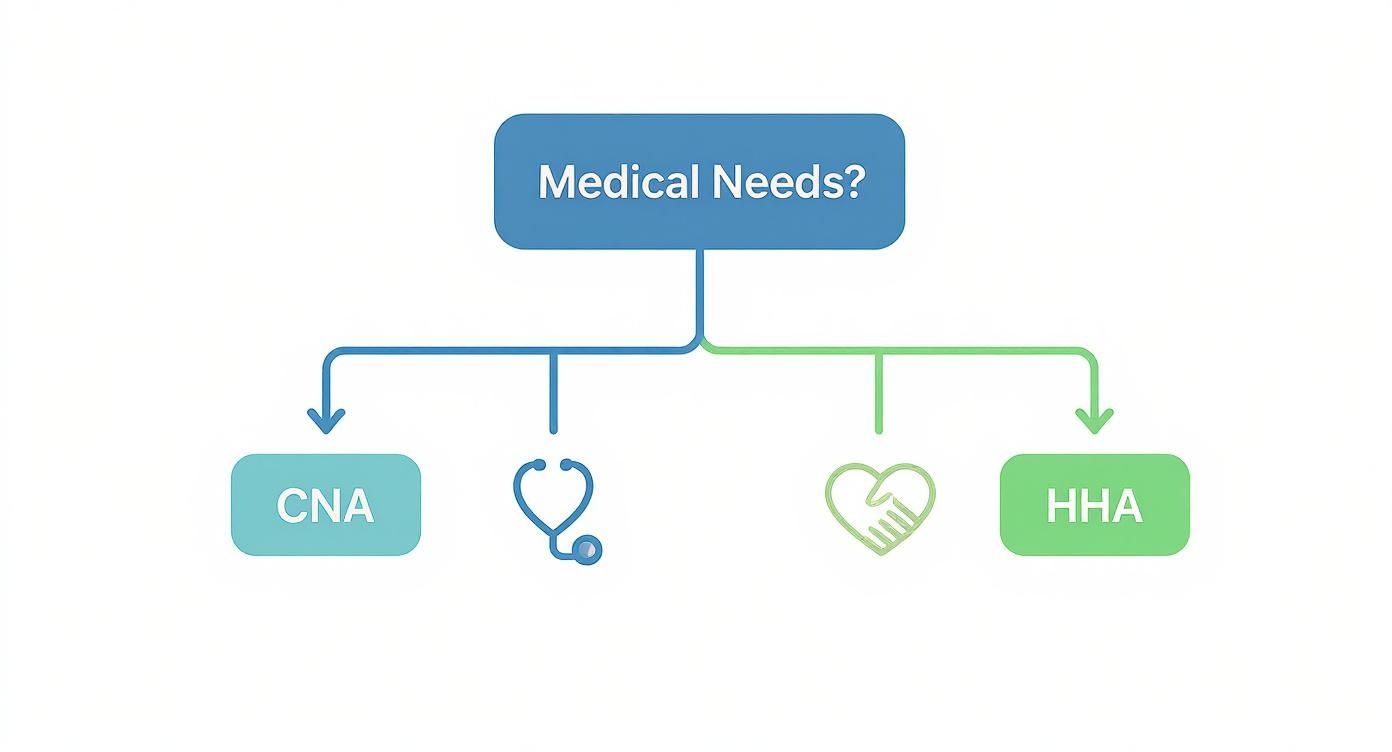
As you can see, any significant medical requirement points you directly toward a CNA. If the focus is on personal support and companionship, a Home Health Aide is your answer.
Thinking Through Real-Life Situations
To bring this to life, let’s consider two common scenarios. A CNA is the only appropriate choice for someone coming home after surgery. They’ll likely need help with wound care, regular monitoring of vital signs, and maybe assistance with medical equipment like an oxygen machine. In this case, a CNA's clinical training is non-negotiable for a safe recovery.
On the other hand, an HHA would be a perfect fit for a senior who is generally healthy but is getting lonely and finds it harder to manage bathing, cooking, and light housekeeping. Here, the focus is on companionship and personal support to boost their quality of life and help them stay independent at home.
The simplest way to decide is to list the tasks your loved one can no longer perform safely on their own. If those tasks require clinical skills, you need a CNA. If they involve personal care and help around the house, an HHA is the right choice.
Key Questions to Ask Yourself
Before you start making calls, run through these questions. Your answers will point you in the right direction.
- Does my loved one need someone to track vital signs like blood pressure or pulse?
- Do they need help with medical equipment or devices like a catheter?
- Are they recovering from a recent hospital stay or surgery?
- Is their main need for companionship and help with daily activities like getting dressed or making meals?
- Do their care needs seem to change often, suggesting that clinical oversight is a good idea?
Answering these honestly will make the path forward much clearer. For a final, professional opinion, talking with a reputable New Jersey home care agency is always the best next step. They can help you make a perfect match.
Your In-Home Care Questions, Answered
Choosing between a CNA and a Home Health Aide often brings up a few key questions. Let's walk through some of the most common concerns we hear from families in New Jersey as they arrange care.
Can a Home Health Aide handle any medical tasks?
Simply put, no. A Home Health Aide's role is entirely non-medical. They are legally not allowed to perform clinical duties like giving medication, changing sterile bandages, or even taking vital signs.
Their expertise lies in supporting daily life—things like bathing, dressing, meal preparation, and providing companionship.
Think of an HHA as a specialist in the activities of daily living. They are trained to notice changes in a client's condition and report them to a supervisor, but they can't step in with any hands-on medical care.
How do we switch from an HHA to a CNA if we need more help?
This is a very common scenario, and with a good agency, it's a straightforward process. When your loved one's health needs change, the first step is always to let your home care agency know.
They'll arrange for a reassessment, usually with a registered nurse, to develop a new plan of care. This updated plan will detail the specific clinical tasks that are now required, making the need for a CNA official. A quality agency will manage the transition seamlessly, coordinating schedules and making sure everyone is properly introduced.
Will a CNA still help with things like companionship and housekeeping?
Yes, but it's important to understand their primary focus. A CNA’s main job is clinical. While they absolutely provide emotional support and can help with light tasks like tidying up a client's room, their priority is always health monitoring and skilled medical support.
If what you really need is dedicated companionship or more involved housekeeping, an HHA is a much better fit and more cost-effective. A CNA’s time and skills are best reserved for the specialized tasks they are trained to perform.
At NJ Caregiving, we focus on finding the perfect caregiver for your family's unique situation. Our goal is to provide peace of mind and ensure your loved one enjoys the highest quality of life possible. Learn more about our compassionate in-home care services in New Jersey.
