

Staying active is a cornerstone of healthy aging, but what happens when mobility challenges, recovery from surgery, or chronic conditions make traditional exercise difficult? The answer isn't to stop moving; it's to adapt. This guide is dedicated to a powerful, often overlooked solution: bed exercises for seniors. These aren't just simple stretches; they are targeted movements designed to build strength, improve circulation, enhance flexibility, and boost independence, all from the safety and comfort of your bed.
Forget the idea that a bed is only for rest. We'll show you how it can become your personal fitness space, helping you maintain vitality and quality of life, one gentle movement at a time. This article provides a comprehensive roundup of seven essential exercises, from Ankle Pumps and Circles to Supine Spinal Rotations and even seated movements.
Each entry includes clear, step-by-step instructions and practical safety tips to ensure you can perform them effectively. Our goal is to empower you to take control of your well-being today, proving that meaningful physical activity is accessible to everyone, regardless of mobility limitations. Let's transform your daily routine into an opportunity for strength and renewal.
1. Ankle Pumps and Circles
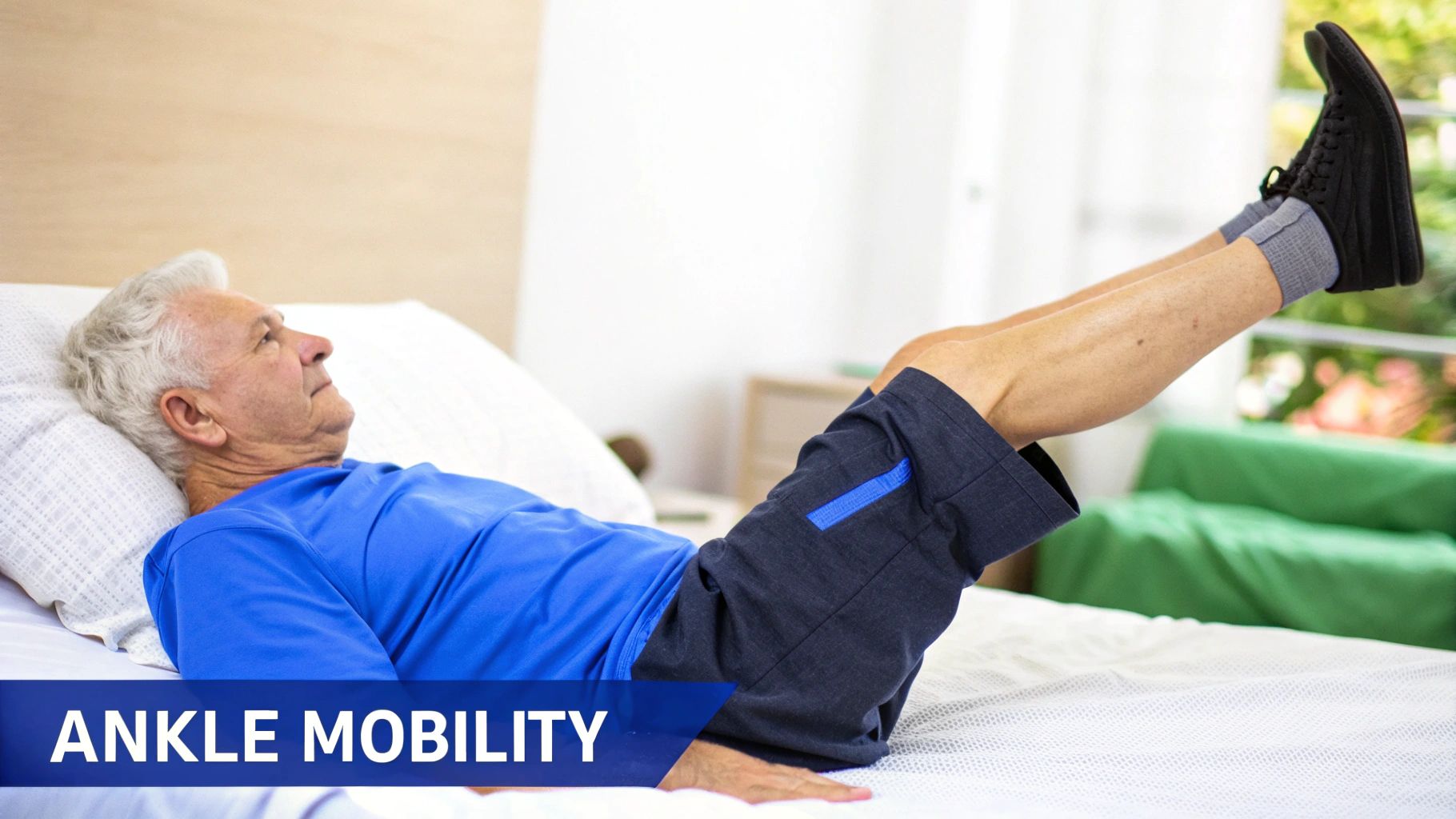
Ankle pumps and circles are fundamental bed exercises for seniors that serve as a gentle starting point for physical activity. This simple yet powerful movement involves flexing and rotating the ankles to stimulate blood flow, which is crucial for individuals who spend significant time in bed or seated. By engaging the muscles in the lower legs, this exercise helps prevent blood from pooling, reducing the risk of deep vein thrombosis (DVT) and swelling.
The mechanics are straightforward: ankle pumps involve pointing the toes away from the body (plantarflexion) and then flexing them back toward the shins (dorsiflexion). Ankle circles involve slowly rotating the foot clockwise and then counterclockwise. These movements maintain the joint's range of motion, prevent stiffness, and can alleviate discomfort associated with inactivity.
Why This Exercise is Essential
This exercise is a cornerstone of recovery and maintenance programs for seniors with limited mobility. Healthcare professionals often recommend it immediately following surgery, such as a hip or knee replacement, to kickstart circulation and prevent post-operative complications. It's also a standard practice in nursing homes and rehabilitation centers to help residents maintain lower limb health directly from their beds.
How to Perform Ankle Pumps and Circles
Follow these steps for safe and effective execution:
- Starting Position: Lie comfortably on your back with your legs extended. You can place a small pillow under your knees for comfort, but ensure your heels can move freely.
- Ankle Pumps: Slowly point the toes of one foot away from you, as if pressing a gas pedal. Hold for 3-5 seconds. Then, slowly flex the foot, pulling your toes back toward your shin. Hold for another 3-5 seconds. This completes one repetition.
- Ankle Circles: Keeping your leg still, rotate your foot clockwise in a large, slow circle. After completing your target repetitions, reverse the direction and rotate it counterclockwise.
- Repetitions: Aim for 10-15 repetitions of both pumps and circles for each foot. Switch to the other foot and repeat the sequence.
Tips for Maximum Benefit
- Consistency is Key: Perform this exercise 2-3 times daily, such as in the morning upon waking, midday, and before sleep.
- Move with Intention: Avoid rushing. A slow, deliberate pace ensures you move through the full range of motion and properly engage the muscles.
- Elevate for Swelling: If you experience swelling (edema) in your ankles or feet, perform the exercises with your legs elevated on a pillow to help fluid return to the body.
- Breathe Deeply: Coordinate your movements with deep, steady breaths. Inhale as you flex your foot toward you and exhale as you point it away to enhance circulation and relaxation.
2. Supine Marching (Knee to Chest)
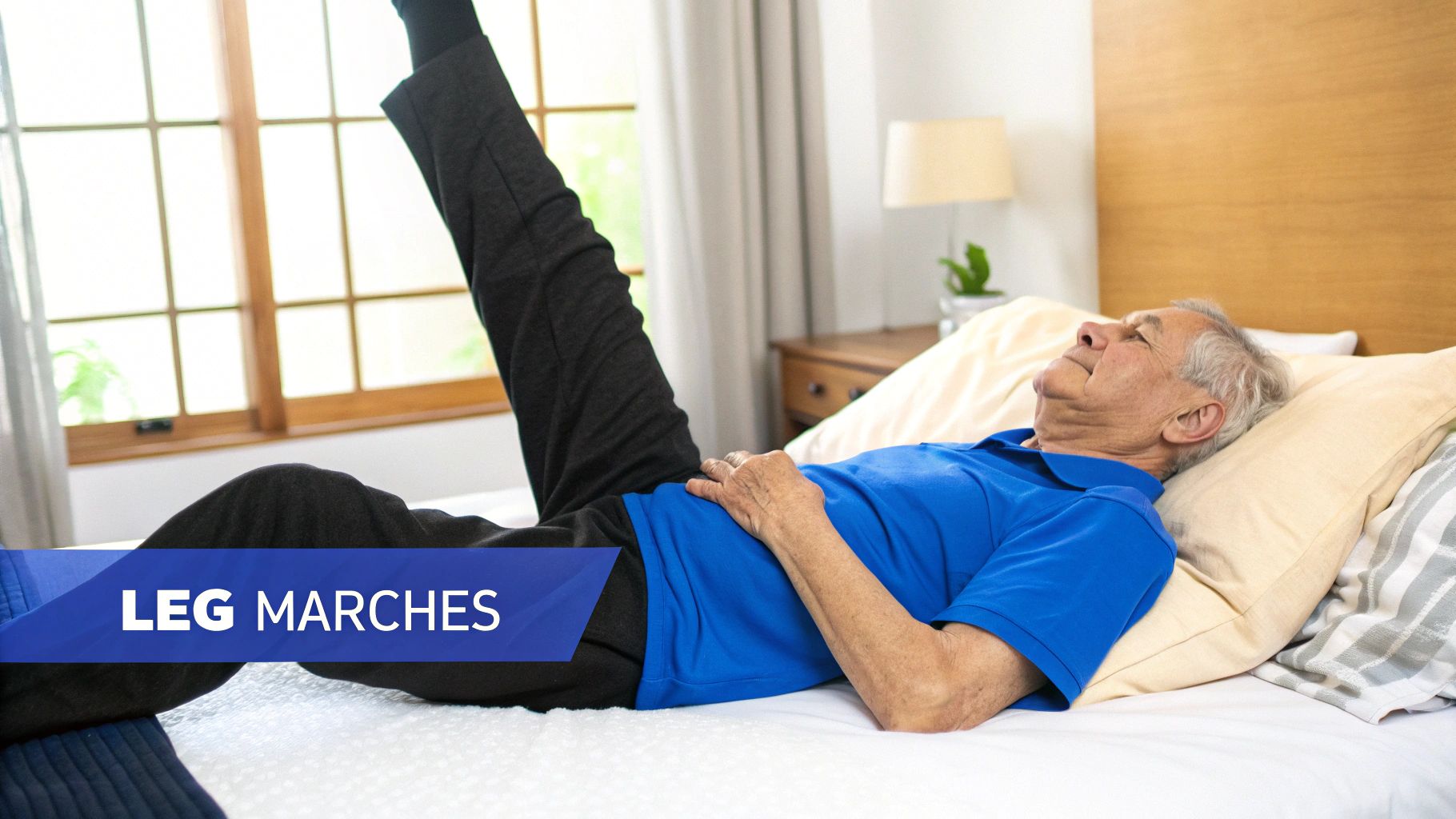
Supine marching is a foundational bed exercise for seniors designed to strengthen core and lower body muscles from a safe, reclined position. It involves alternately lifting each knee toward the chest in a slow, controlled marching motion. This exercise directly targets the hip flexors and abdominal muscles, which are vital for daily movements like getting out of bed, standing up from a chair, and maintaining a stable walking gait.
By mimicking the mechanics of walking without the impact of weight-bearing, supine marching improves lower body circulation and helps maintain functional mobility. It is an excellent low-impact option that builds strength and coordination, making it a key component of many senior fitness and rehabilitation programs.
Why This Exercise is Essential
This movement is particularly beneficial for seniors looking to improve their balance and prevent falls. Rehabilitation centers frequently use this exercise to help individuals regain walking ability after extended periods of bed rest or hospitalization. It is also easily integrated into daily care routines by home health aides to help elderly clients maintain lower body strength and prevent muscle atrophy.
How to Perform Supine Marching
Follow these steps for safe and effective execution:
- Starting Position: Lie on your back with your knees bent and feet flat on the mattress, about hip-width apart. Keep your arms resting by your sides.
- Engage Your Core: Gently tighten your abdominal muscles to press your lower back lightly into the bed. This stabilizes your spine throughout the movement.
- Lift Your Knee: Exhale as you slowly lift one knee toward your chest, moving only as far as is comfortable. Your foot will lift off the bed.
- Lower and Repeat: Inhale as you slowly lower your foot back to the starting position. Repeat the movement with the opposite leg. This completes one repetition.
- Repetitions: Aim for 8-12 repetitions for each leg.
Tips for Maximum Benefit
- Maintain Control: Avoid using momentum. The movement should be slow and deliberate to properly engage the core and hip flexor muscles.
- Keep Your Back Stable: Ensure your lower back remains in gentle contact with the mattress. If you feel it arching, reduce the height you lift your knee.
- Start Small: If lifting your knee is too challenging, begin by simply sliding your heel toward your buttocks and then straightening it back out.
- Breathe Consistently: Coordinate your breathing with the movement. Exhale on the effort (lifting the knee) and inhale as you lower it.
3. Bed Bridge (Glute Bridges)
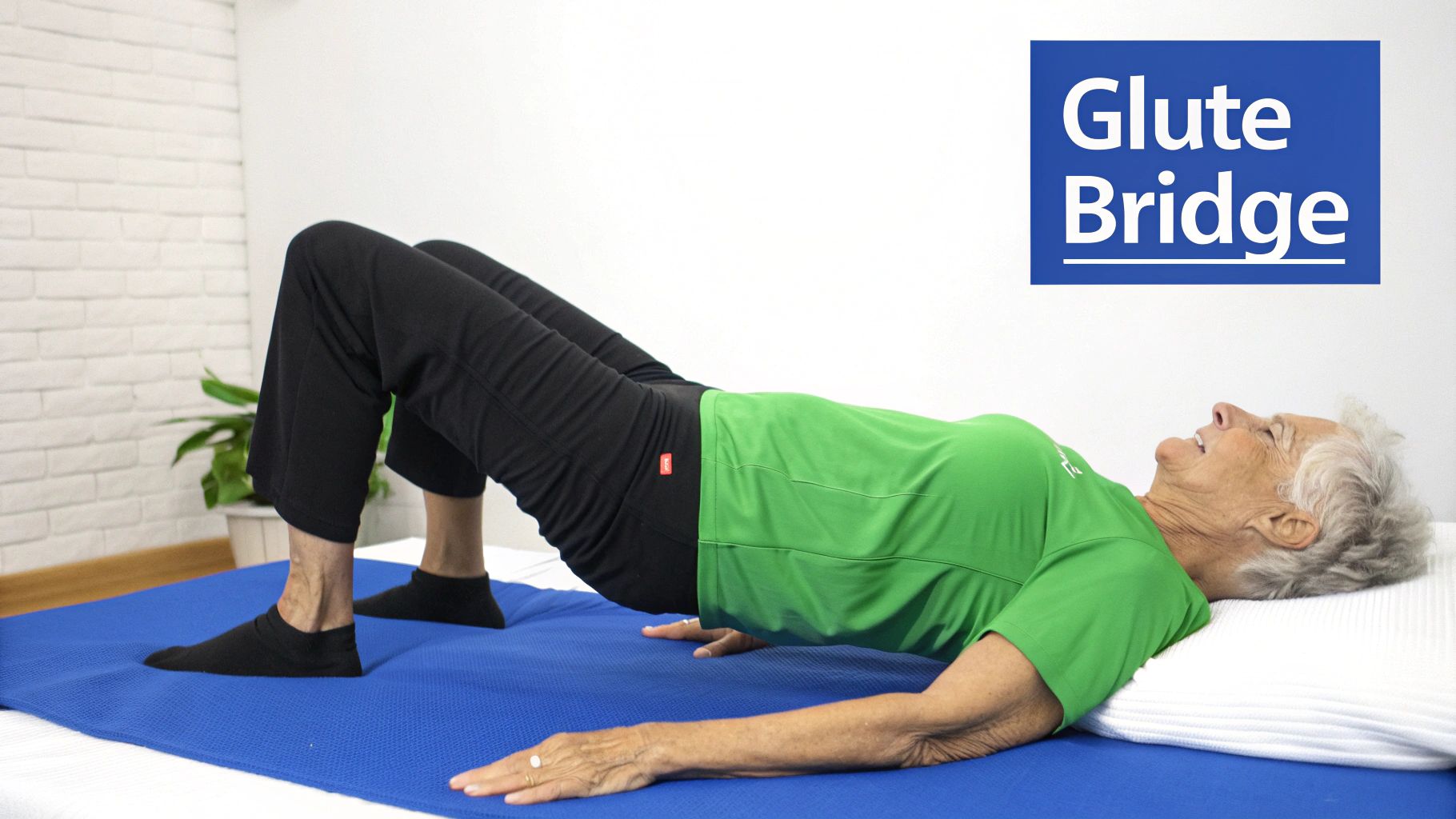
The bed bridge, also known as a glute bridge, is a foundational strengthening exercise for seniors that can be performed comfortably in bed. It targets the posterior chain muscles, including the glutes (buttocks), hamstrings, and lower back. Strengthening these muscles is critical for essential daily activities like standing up from a chair, walking with stability, and maintaining proper posture, making this one of the most functional bed exercises for seniors. The softer surface of a mattress provides a supportive yet challenging environment, making it more accessible than the floor version.
This movement involves lying on your back with knees bent and feet flat on the bed, then lifting the hips toward the ceiling. By activating the core and glutes, the bed bridge helps build the strength necessary for bed mobility, such as repositioning or getting out of bed. It also plays a vital role in supporting the spine and alleviating lower back pain often associated with prolonged sitting or lying down.
Why This Exercise is Essential
Physical therapists frequently prescribe bed bridges for seniors managing chronic lower back issues or recovering from hospitalization. Geriatric exercise programs feature it as a staple for building core strength and stability, which directly contributes to fall prevention. Occupational therapists also use this exercise to help older adults regain the functional strength needed for independent bed mobility and transfers, a key aspect of aging in place. Its ability to strengthen major muscle groups without stressing the joints makes it invaluable.
How to Perform Bed Bridges
Follow these steps for safe and effective execution:
- Starting Position: Lie on your back with your knees bent and feet flat on the mattress, about hip-width apart. Rest your arms by your sides with your palms facing down for stability.
- Lift Your Hips: Engage your core by pulling your belly button toward your spine. Press through your heels and squeeze your glutes to lift your hips off the bed until your body forms a straight line from your shoulders to your knees.
- Hold and Lower: Hold the top position for 2-3 seconds, continuing to squeeze your glutes. Slowly and with control, lower your hips back down to the starting position. This completes one repetition.
- Repetitions: Start with 5-10 repetitions and gradually work your way up to a set of 15-20 as you build strength.
Tips for Maximum Benefit
- Focus on the Glutes: Initiate the movement by squeezing your buttocks, not by arching your lower back. This ensures you are targeting the correct muscles.
- Controlled Movements: Avoid dropping your hips quickly. A slow, controlled descent is just as important as the lift for building muscle strength.
- Engage Your Core: Keep your abdominal muscles tight throughout the exercise to protect your spine and enhance stability.
- Neck Comfort: If you feel any strain in your neck, place a small, folded towel under your head for support.
- Progress Gradually: Building core and glute strength is a key part of maintaining balance. For more ways to improve stability, check out these essential fall prevention exercises for seniors.
4. Seated Bed Exercises (Seated Twists and Arm Raises)
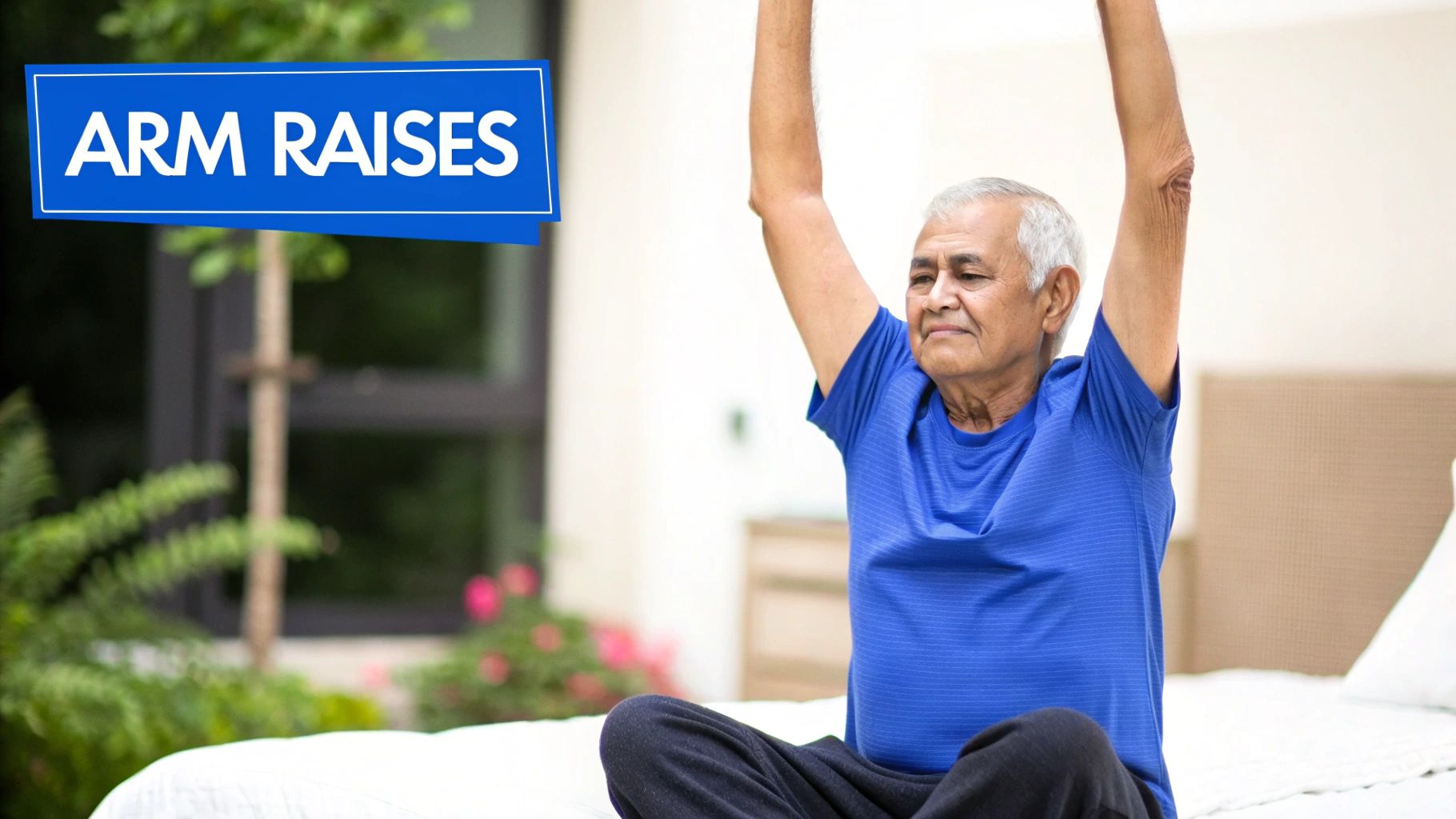
Seated bed exercises serve as a crucial bridge between lying down and standing activities, making them ideal for seniors who can sit up independently but may not be ready for weight-bearing movements. This category includes gentle spinal twists to improve back flexibility and overhead arm raises to maintain shoulder mobility and upper body strength. These movements engage the core, improve posture, and prepare the body for more functional daily tasks.
By performing exercises from a stable, seated position on the edge of the bed, seniors can safely work on their physical fitness with a reduced risk of falling. These exercises are particularly beneficial for building the foundational strength and flexibility needed for activities like getting in and out of a chair, reaching for objects on a high shelf, and maintaining an upright posture throughout the day.
Why This Exercise is Essential
Seated bed exercises are fundamental in senior fitness and rehabilitation programs. Occupational therapists often use seated arm raises to assess and improve a senior's ability to perform activities of daily living, such as dressing and grooming. Assisted living facilities frequently incorporate seated twists into morning group activities to alleviate back stiffness and energize residents for the day. Their adaptability makes them a core component of at-home fitness plans for older adults.
How to Perform Seated Twists and Arm Raises
Follow these steps for safe and effective execution:
- Starting Position: Sit upright on the edge of your bed with your back straight and your feet planted firmly on the floor, hip-width apart. Engage your core muscles to support your spine.
- Seated Twists: Place your hands on your opposite shoulders, creating an "X" across your chest. Slowly and gently rotate your upper body to the right, keeping your hips stationary. Hold for 3-5 seconds, then return to the center and rotate to the left.
- Arm Raises: Start with your arms resting at your sides, palms facing inward. Slowly lift both arms straight up overhead, reaching as high as is comfortable without straining. Hold for 2-3 seconds, then slowly lower them back down.
- Repetitions: Aim for 8-12 repetitions of both the twists (to each side) and the arm raises.
Tips for Maximum Benefit
- Prioritize Stability: Sit close to the edge of the bed so your feet can be flat on the floor, creating a stable base. If you feel unsteady, use the bed frame or headboard for support.
- Breathe Consistently: Never hold your breath. Exhale as you twist or raise your arms, and inhale as you return to the starting position.
- Move with Control: Avoid jerky or rapid movements. Focus on a slow, controlled motion to maximize muscle engagement and prevent injury.
- Morning Routine: Perform seated twists in the morning to help loosen a stiff back and improve spinal mobility for the day ahead.
5. Leg Slides (Abduction and Adduction)
Leg slides are an excellent low-impact bed exercise for seniors designed to strengthen the hip muscles, specifically the inner and outer thighs (adductors and abductors). This movement involves gently sliding one leg out to the side and back to the center while lying down. Because the leg remains in contact with the bed, the exercise minimizes stress on the hip and knee joints, making it a safe choice for individuals with arthritis or those recovering from surgery.
The controlled sliding motion builds foundational strength in the muscles responsible for stability when walking and standing. Maintaining hip mobility and strength is critical for preventing falls, improving balance, and ensuring seniors can confidently perform daily activities like getting in and out of a chair or car.
Why This Exercise is Essential
This exercise is a staple in rehabilitation settings, particularly for post-operative hip replacement patients who need to reactivate their muscles without bearing weight. Physical therapists often incorporate leg slides into in-home physical therapy programs for seniors to restore function safely. It is also commonly used in long-term care facilities to help residents with limited ambulation maintain lower body strength and prevent muscle atrophy.
How to Perform Leg Slides
Follow these steps for safe and effective execution:
- Starting Position: Lie on your back with both legs extended. Keep your feet relaxed and your toes pointing toward the ceiling.
- Abduction (Outward Slide): Keeping your knee straight and your toes pointed up, slowly slide one leg out to the side. Move only as far as you can without straining or rotating your hip.
- Adduction (Inward Slide): Gently engage your inner thigh muscles to slowly slide the leg back to the starting position next to your other leg. This completes one repetition.
- Repetitions: Aim for 10-15 repetitions on one leg before switching to the other side.
Tips for Maximum Benefit
- Focus on Control: The key to this exercise is slow, controlled movement. Avoid using momentum to swing your leg.
- Engage Your Core: Lightly tighten your abdominal muscles to keep your pelvis and lower back stable and prevent it from arching.
- Reduce Friction: If the bed sheet creates too much resistance, place a plastic bag or a smooth piece of cardboard under your heel to help it slide more easily.
- Stay in a Pain-Free Range: Only slide your leg as far as is comfortable. As your strength and mobility improve, you can gradually increase the range of motion.
6. Supine Spinal Rotation (Knee Rolls)
Supine spinal rotation, often called knee rolls, is one of the most effective bed exercises for seniors seeking to alleviate back stiffness and improve core stability. This gentle twisting motion involves lying on the back and slowly rotating the lower body from side to side. It directly targets the lumbar spine, obliques, and hip muscles, promoting flexibility and releasing built-up tension.
The mechanics are simple yet profound. By keeping the shoulders anchored to the bed while the knees lower to one side, the exercise creates a safe, controlled spinal twist. This movement helps hydrate the spinal discs, enhances the range of motion needed for daily activities like rolling over or getting out of bed, and can significantly reduce lower back discomfort common in older adults.
Why This Exercise is Essential
This exercise is a staple in physical therapy and restorative yoga for its ability to safely mobilize the spine. Geriatric specialists and back pain clinics often prescribe knee rolls as a foundational movement to manage chronic lower back pain and maintain functional mobility. It is particularly beneficial in the morning to ease stiffness accumulated overnight, making subsequent movements less challenging.
How to Perform Supine Spinal Rotation
Follow these steps for a safe and restorative stretch:
- Starting Position: Lie on your back with your knees bent and feet flat on the mattress, about hip-width apart. Extend your arms out to the sides at shoulder height, with palms facing down to create a stable base.
- The Movement: Keeping your shoulders flat on the bed, slowly and gently lower both knees together to one side. Move only as far as is comfortable without straining.
- The Hold: Hold the stretch for 10-30 seconds, breathing deeply into your side and lower back. For an enhanced stretch, you can slowly turn your head to look in the opposite direction of your knees.
- Repetitions: Gently return your knees to the center and repeat on the other side. Aim for 3-5 repetitions on each side.
Tips for Maximum Benefit
- Shoulders Down: Your primary goal is to keep both shoulders in contact with the bed. If a shoulder lifts, you have rotated too far.
- Slow and Steady: This is a mobility stretch, not a strength exercise. Avoid any bouncing or rapid movements to prevent muscle strain.
- Pillow Support: If you feel discomfort in your hips or knees, place a thin pillow or folded blanket between your knees for added cushioning and alignment.
- Mindful Breathing: Inhale as your knees are at the center and exhale as you slowly lower them to the side. Deep breathing helps relax the muscles and deepen the stretch.
7. Resistance Band Exercises in Bed
Resistance band exercises are an excellent way for seniors to build and maintain muscle strength directly from the comfort of their bed. These exercises use elastic bands to provide adjustable resistance, creating a safe and effective alternative to free weights. By performing movements like chest presses, rows, and leg extensions while lying or sitting in bed, seniors can target major muscle groups without the risk of falls or the need for bulky equipment.
The principle is simple: the band's elasticity creates tension, forcing muscles to work harder through a full range of motion. This progressive resistance is ideal for individuals with varying strength levels, as different colored bands offer different levels of difficulty. This adaptability makes resistance bands a cornerstone of many bed exercises for seniors, allowing for a customized full-body workout that improves strength, endurance, and functional mobility.
Why This Exercise is Essential
This form of exercise is highly valued in physical therapy and rehabilitation settings, especially for post-operative or bed-bound patients. Brands like TheraBand have developed specific protocols for bed-based recovery, and AARP fitness programs often include them as a go-to for at-home strength training. Because they are lightweight, portable, and low-impact, resistance bands provide a practical way to combat muscle atrophy associated with prolonged inactivity.
How to Perform Resistance Band Exercises
Follow these steps for a few fundamental movements:
- Starting Position: Sit upright in bed with your back supported or lie flat, depending on the exercise. Ensure the band is securely anchored or held.
- Seated Row: While sitting, loop the band around your feet or a secure part of the bed frame. Hold the ends and pull back, squeezing your shoulder blades together.
- Chest Press: While lying on your back, wrap the band across your upper back and under your arms. Hold an end in each hand and press your hands forward toward the ceiling.
- Leg Extension: While sitting, loop the band around one foot and hold the ends. Slowly extend that leg straight out against the band's resistance.
- Repetitions: Aim for 8-12 repetitions for each exercise. Complete a set before moving to the next exercise or switching limbs.
Tips for Maximum Benefit
- Start Light: Begin with the lightest resistance band (often yellow or tan) and progress only when you can complete your reps with good form.
- Secure Anchor: Always ensure the band is anchored securely to a sturdy object like the bed frame to prevent it from snapping back.
- Slow and Controlled: Perform each movement slowly and deliberately. Avoid using momentum and focus on feeling the muscle contract.
- Inspect Your Bands: Before each use, check the bands for any nicks, tears, or weak spots to prevent them from breaking during an exercise.
- Rest and Recover: Perform these strengthening exercises 2-3 times per week on non-consecutive days to allow your muscles time to recover. For a comprehensive routine, you can explore more bed exercises for the elderly to complement your resistance band workout.
7 Bed Exercises for Seniors Comparison
| Exercise | Implementation Complexity 🔄 | Resource Requirements 💡 | Expected Outcomes 📊 | Ideal Use Cases 💡 | Key Advantages ⭐ / ⚡ |
|---|---|---|---|---|---|
| Ankle Pumps and Circles | Very low 🔄 | None (bodyweight only) | Improves circulation & ankle mobility 📊 | Bedridden seniors, post-surgery recovery | Prevents DVT, very safe ⭐, low risk of injury ⚡ |
| Supine Marching (Knee to Chest) | Low to moderate 🔄 | None, optional resistance band | Strengthens hip flexors & core 📊 | Seniors regaining walking ability, low mobility | Functional movement mimicry ⭐, scalable difficulty |
| Bed Bridge (Glute Bridges) | Moderate 🔄 | None | Strengthens glutes, lower back, balance 📊 | Seniors with back pain, improving bed mobility | Effective strength builder ⭐, improves posture ⚡ |
| Seated Bed Exercises (Twists & Arm Raises) | Moderate 🔄 | Optional light weights or bands | Enhances upper body & spinal mobility 📊 | Seniors who can sit, working on upper body strength | Combines core & arm mobility ⭐, can use weights ⚡ |
| Leg Slides (Abduction & Adduction) | Low 🔄 | None | Improves hip strength & mobility 📊 | Seniors with hip stiffness or post-hip procedures | Gentle joint-friendly strengthening ⚡, easy to modify |
| Supine Spinal Rotation (Knee Rolls) | Low 🔄 | None | Increases spinal flexibility & reduces stiffness 📊 | Seniors with back stiffness, needing gentle stretching | Low injury risk ⭐, enhances bed mobility |
| Resistance Band Exercises in Bed | Moderate to high 🔄 | Resistance bands, secure anchor point | Builds full body muscle strength 📊 | Bed-bound seniors wanting strength maintenance | Progressive resistance ⭐, versatile & portable ⚡ |
Your Next Step: Integrating Movement into Your Daily Routine
You have now explored a versatile collection of movements, from gentle Ankle Pumps to strengthening Bed Bridges, that transform your bed into a personal fitness space. This article has provided a comprehensive toolkit of seven distinct bed exercises for seniors, each designed to enhance mobility, build foundational strength, and boost your confidence from the moment you wake up. The power of these exercises lies not in their complexity but in their consistency.
The journey to improved physical well-being is built one small, intentional movement at a time. The most important takeaway is that progress begins with a single, manageable step. You don't need to master every exercise overnight; the goal is to create a sustainable habit that works for you.
Creating Your Personal Bed Exercise Routine
To truly benefit from this guide, it's time to put knowledge into practice. Integrating these movements into your daily life is the key to unlocking long-term benefits like better balance, reduced stiffness, and greater independence.
Here are some actionable next steps to get you started:
- Start Small and Build Gradually: Choose just two or three exercises that feel comfortable and enjoyable. Perhaps start with Ankle Circles to wake up your joints and Supine Marching to activate your core. Perform them for a few minutes each morning.
- Schedule Your Movement: Just as you would schedule a doctor's appointment, set aside a specific time for your exercises. Linking them to an existing habit, like right after waking up or before settling down for the night, can make them easier to remember.
- Listen to Your Body: This is the golden rule of safe exercise. Your body will give you signals. Gentle stretching and muscle fatigue are normal, but sharp or persistent pain is a sign to stop and consult a professional. Never push through discomfort.
- Track Your Progress: Keep a simple notebook to jot down which exercises you did and how many repetitions you completed. Seeing your progress over a week or a month can be a powerful motivator to keep going.
The Lasting Impact of Consistent, Gentle Movement
Mastering these simple bed exercises for seniors is about more than just physical fitness; it's about reclaiming a sense of control over your health and well-being. By committing to this gentle routine, you are investing in your future. You are actively working to maintain the strength needed for daily activities, from getting out of a chair with ease to enjoying a walk with loved ones.
This proactive approach to health empowers you to age with grace, strength, and vitality. Each leg slide and spinal twist is a testament to your commitment to an active and independent life. Embrace this opportunity to nurture your body and celebrate every small victory along the way. Your journey toward enhanced mobility starts now, right from the comfort of your own bed.
Ready to take the next step with personalized support? At NJ Caregiving, our compassionate caregivers are trained to assist with daily routines, including gentle exercise programs, to ensure safety and provide encouragement. Contact NJ Caregiving today to learn how we can create a customized care plan that integrates these beneficial movements into your daily life.