

When a parent can no longer make sound decisions about their health or finances due to cognitive decline or a serious illness, pursuing legal guardianship is a formal, court-driven process. It’s a significant step, but it often becomes necessary when other measures, like a Power of Attorney, just aren't enough to protect them.
Knowing When Guardianship Is the Right Path
Making the choice to seek legal guardianship for your parent is one of the toughest decisions you’ll ever face. It’s not something you arrive at lightly. It usually comes after a painful pattern of events makes it clear they can no longer safely manage their own life. This isn't about a few forgotten appointments; it’s about a level of incapacity that puts your parent in real danger.
The realization often dawns in a series of unsettling moments. Maybe your mom, who is in the early stages of dementia, has started making major financial blunders—paying the same utility bill three times or getting tangled up in obvious phone scams. Or perhaps your dad, frail from a long illness, can no longer understand or agree to vital medical treatments, putting his health at risk.
These aren't just simple signs of getting older. They are red flags indicating a loss of legal capacity.
Understanding Legal Incapacity
In the eyes of the court, incapacity is the central issue. It means someone genuinely lacks the mental ability to make or communicate responsible decisions about their own health, safety, or finances. Before a judge will even consider appointing a guardian, they need to see clear and convincing evidence that your parent meets this legal standard.
The bar is set high, and for a very good reason. Guardianship strips an individual of their most basic rights—like deciding where they want to live or how they spend their own money. Because of this, the court requires more than just proof of old age or quirky behavior.
Think about these real-world situations that often lead families down this path:
- A parent with Alzheimer's disease who keeps wandering away from home and getting lost.
- An elderly individual refusing life-saving medical care because of delusions brought on by a psychiatric condition.
- A parent being financially drained by a new "friend" or a predatory caregiver, completely unable to see the manipulation.
When a Power of Attorney Is Not Enough
Many families wisely start with a Power of Attorney (POA). This document lets your parent designate someone to make decisions for them. A POA is a fantastic tool, but it comes with some serious limitations. For it to be valid, your parent must have signed it while they were still mentally competent.
If their cognitive decline has already progressed too far, it's simply too late to create a POA. Even if one is in place, a parent can revoke it—even if that decision is completely against their own best interests. If your parent is actively refusing help or being negatively influenced by someone else, a POA can become useless. This is when guardianship becomes the only remaining shield.
Here's the crucial difference: A Power of Attorney is a choice made by your parent when they still have capacity. Guardianship is a protective measure put in place by the court after that capacity is gone.
This formal process, sometimes called 'adult guardianship,' is most often started by an adult child. When a parent can't manage their personal or financial life, a family member steps up. Research from National Core Indicators backs this up, showing that approximately 81.3% of guardians are family members. This really highlights how often adult children find themselves taking on this critical role. You can explore more data on adult guardianship trends and find additional insights on their website.
Preparing Your Petition for Guardianship

Before you ever set foot in a courthouse, the real work of building your guardianship case begins. A strong petition is more than just paperwork; it’s about telling a clear, persuasive story that’s backed up by solid proof. This prep phase is absolutely critical—it lays the groundwork for everything that follows.
Your main job here is to clearly show why your parent can no longer make decisions for themselves and why a guardian is necessary. This means gathering very specific documents that leave no room for doubt. I've seen too many cases get delayed or denied simply because this step was rushed.
Gathering Compelling Medical Evidence
The absolute foundation of any guardianship case is the medical evaluation. A judge will lean heavily on what doctors have to say about your parent's condition. You’ll need to get one or two signed certifications from physicians who have examined your parent recently.
These reports need to be detailed. It's not enough for a doctor to just write down a diagnosis like "dementia." A powerful report will explain how that condition affects their ability to make decisions—for example, explaining how memory loss makes it impossible for them to manage their own medications or understand a bank statement.
A judge is looking for concrete details, like:
- Cognitive Assessment Results: Scores from tests like the Mini-Mental State Examination (MMSE) that give a measurable sense of the impairment.
- Functional Limitations: A clear breakdown of the daily tasks your parent can no longer safely do on their own.
- Prognosis: The doctor's professional opinion on whether the condition is likely to get better or worse.
The key takeaway is this: the medical evidence has to draw a direct line from the diagnosis to your parent's inability to manage their own life. The court needs to see not just that they are ill, but that the illness makes them incapable of making safe decisions.
Assembling Financial Documentation
Along with medical proof, you also have to show why a guardian is needed to protect your parent's finances and property. This means you need to pull together all the key financial records. You're trying to show a pattern of poor management, confusion, or vulnerability that puts them at risk.
Let's say your father has started making strange, large withdrawals from his checking account. Showing the judge several months of bank statements that highlight this activity is far more convincing than just saying it's happening. The evidence needs to paint the picture for them.
Key financial documents to gather include:
- Bank and investment account statements
- Social Security or pension letters
- Recent bills, especially any showing late fees or missed payments
- Copies of property deeds, car titles, or any existing trusts
This financial snapshot is particularly important if you're also worried about your parent's eligibility for programs like Medicaid. Having a guardian manage finances properly can be a crucial part of long-term care planning. It's a complex area, but you can learn more about the specific Medicaid spend-down rules in New Jersey to see how it all connects.
Unifying the Family Front
This is one of the most powerful—and often forgotten—parts of the process: getting the family on the same page. A contested guardianship can turn into a long, expensive, and emotionally painful fight. If you can build a consensus among siblings and other close relatives, it makes a world of difference.
Try to hold a family meeting. Lay out your concerns, show them the evidence you’ve gathered, and explain why you feel guardianship is the only option left. Be ready for tough questions and make sure you truly listen to everyone's point of view.
If your siblings are in agreement, having them sign consents to your appointment as guardian can make the court process incredibly smooth. A judge is far more likely to approve a petition that has the family's unanimous support. If you hit a snag and disagreements pop up, it’s much better to tackle them early on through conversation or even professional mediation before a small conflict blows up the entire case.
Breaking Down the Court Process
Once your documents are in order, the next phase involves the court system. I know this part can feel intimidating, but think of it as a series of structured, logical steps. The legal path to guardianship is designed to be thorough, ensuring everyone involved—especially your parent—is protected.
The need for this process is only growing. As our population ages, situations requiring guardianship are becoming more common. In fact, it's projected that by 2030, the population of adults over 65 will have increased by 50% or more compared to the year 2000. This demographic shift highlights just how vital a clear, fair legal framework is. You can learn more about the evolution of these family-focused laws if you're curious about the history.
Let's walk through what you can expect.
Filing the Official Petition
Your first real step into the legal process is filing a document called an "Order to Show Cause and Verified Complaint." You'll file this with the Superior Court in the county where your parent resides.
This isn't just a form; it’s the cornerstone of your case. In it, you lay out why you believe your parent is incapacitated and why you are the right person to serve as their guardian. All the physician certifications and other evidence you’ve collected get attached right here. This petition essentially asks the court to set a hearing date, so getting it right is crucial.
Below, you can see a visual of this foundational first step—submitting your petition to the court.
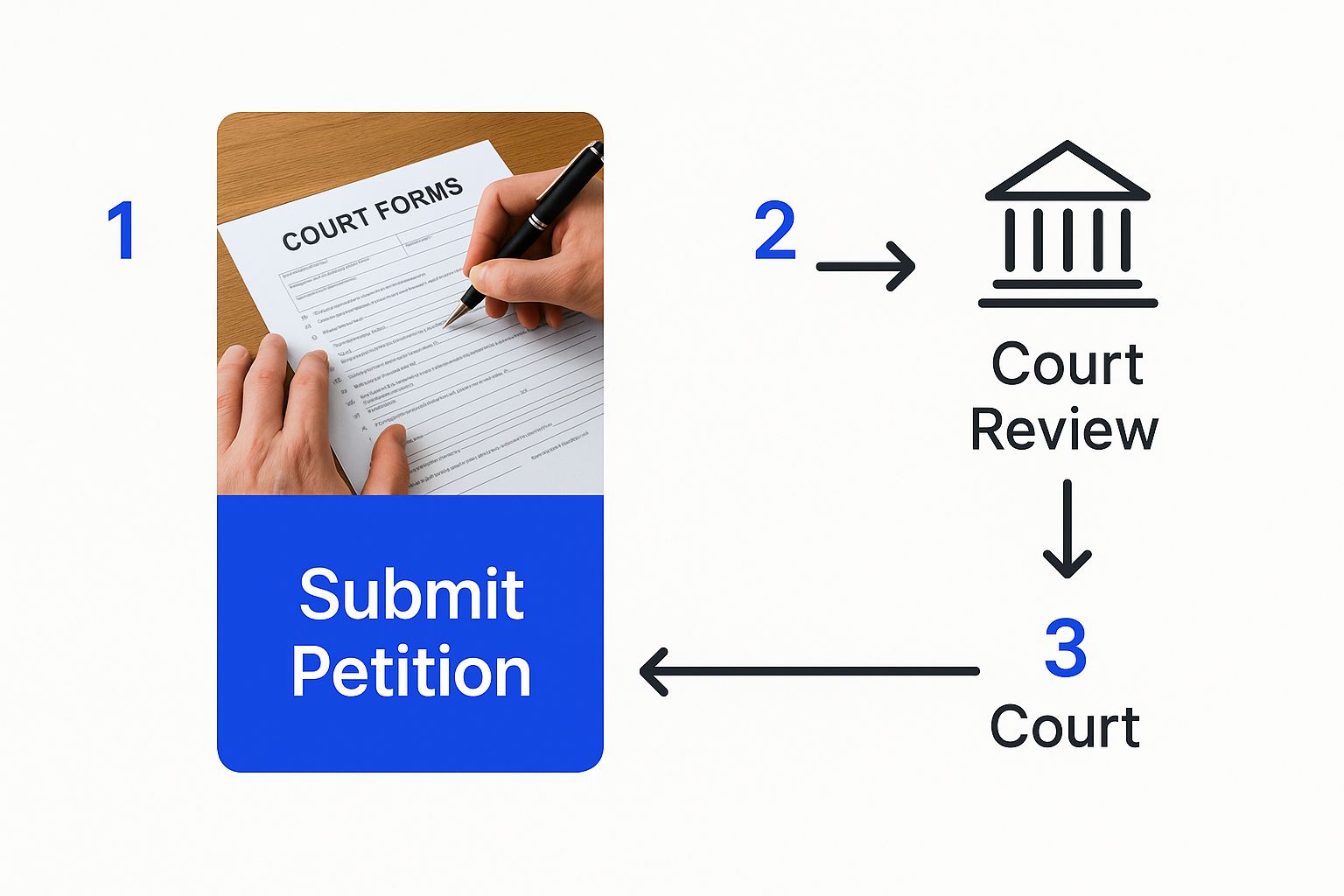
This simple act is what officially puts your case on the court's radar and sets everything else in motion.
Serving Notice to All Interested Parties
After filing, you can't just sit back and wait. The law demands that you formally "serve notice" to your parent and any other relevant individuals. This is a non-negotiable step that ensures transparency and gives everyone a chance to be heard. It's all about due process.
So, who gets notified?
- Your Parent: The court papers must be personally delivered to them.
- Next of Kin: This usually means their spouse, all of their children (your siblings), and sometimes even grandchildren.
- Caregivers: Any facility where your parent lives or anyone currently in charge of their care needs to be officially informed.
This isn't just a formality. It’s a critical safeguard that prevents someone from trying to gain guardianship in secret and gives family members a legal opportunity to either support or contest the action.
The Court-Appointed Evaluation
Next, the court will appoint an independent attorney to represent your parent's interests. It's important to understand their role: they aren't there to fight you. They work for the court, acting as a neutral investigator.
This attorney will meet with your parent, review the medical records you provided, and interview you, doctors, and other family members. Their mission is to create an unbiased report for the judge that answers two fundamental questions:
- Is your parent genuinely incapacitated?
- If they are, are you a suitable and appropriate choice for a guardian?
This independent evaluation is one of the most important parts of the process, as it gives the judge a balanced, 360-degree view of the situation.
A crucial piece of advice: The court-appointed attorney represents your parent and the court—not you. Be completely transparent, honest, and cooperative. Being defensive or hiding information will only work against you.
To help you visualize the entire journey, here's a quick summary of the key stages involved.
Key Stages of the Guardianship Process
This table breaks down the main phases you'll encounter, from the initial paperwork to the final court order.
| Stage | Key Action | Primary Goal |
|---|---|---|
| Petition Filing | Submitting the Verified Complaint & supporting documents. | To formally ask the court to consider the guardianship. |
| Serving Notice | Legally notifying your parent and all next of kin. | To ensure due process and transparency for all parties. |
| Court-Appointed Counsel | An independent attorney is assigned to represent your parent. | To provide an unbiased investigation and report to the judge. |
| The Hearing | Presenting your case and evidence before a judge. | To obtain a final ruling on incapacitation and your appointment. |
| Final Judgment | The judge issues a court order and Letters of Guardianship. | To officially grant you legal authority to act on your parent's behalf. |
Each stage builds on the last, moving the case methodically toward a resolution that serves your parent's best interests.
The Final Court Hearing
Everything leads up to the final hearing, where the judge makes their decision. Your parent has the right to be there, though the court may waive this if attending would be harmful to their health.
During the hearing, the judge will consider all the evidence—your petition, the doctor's reports, and the findings from the court-appointed attorney. They will almost certainly ask you questions directly. Your job is to be clear, honest, and always focus on what's best for your parent.
Be ready to talk about:
- Your relationship with your parent.
- Specific, real-world examples of their struggles to manage their affairs.
- Your plan for handling their finances and personal care.
- Why less restrictive measures, like a Power of Attorney, are no longer enough.
The judge needs "clear and convincing evidence" to grant guardianship. If they agree that your parent is incapacitated and that you're the right person for the job, they will issue an official court order and Letters of Guardianship. This is the legal document that gives you the authority you've been seeking.
Fulfilling Your Duties as a Legal Guardian

The moment the judge's order is signed, a new chapter begins. Securing legal guardianship isn’t the finish line; it’s the start of a profound, legally binding responsibility to your parent. That court order grants you authority, but it also comes with a strict set of duties designed to protect them at every turn.
Think of it less as "helping out" and more as a formal commitment with serious legal weight. The court will hold you accountable for every decision, so understanding exactly what’s expected is your first and most important task. You are now the steward of your parent's life, and the law demands the highest degree of care and integrity.
Guardian of the Person vs. Guardian of the Estate
The court can appoint a guardian for two very different roles, and you might be assigned one or both. It's crucial to know the difference, as your legal responsibilities are defined by the specific authority granted in the court order.
What Is a Guardian of the Person?
This role is all about your parent's personal well-being. It's deeply personal and involves making the choices that shape their daily life and health.
Your duties could include:
- Deciding where your parent lives—whether it's at home with support, in an assisted living community, or a skilled nursing facility.
- Making all healthcare decisions, from routine check-ups to consenting to major surgery or end-of-life care.
- Ensuring they have the right nutrition, clean clothing, and proper personal care.
- Arranging for social activities and companionship to maintain their quality of life.
What Is a Guardian of the Estate?
This role is purely financial. As a Guardian of the Estate, you are responsible for managing and protecting your parent's assets, income, and property. This requires meticulous attention to detail and sound financial judgment.
Your duties here often involve:
- Collecting all income, like Social Security checks, pension payments, or investment dividends.
- Paying all their bills, including the mortgage, utilities, medical costs, and taxes.
- Making smart investment decisions to preserve and grow their assets.
- Protecting their property from loss, theft, or financial abuse.
Often, a judge will appoint the same person to handle both roles. But if the finances are particularly complex or there's friction within the family, the court might name one person for personal care and a neutral professional—like an attorney or accountant—to manage the estate.
The "Best Interest" Standard and Respecting Autonomy
Every single action you take as a guardian must follow a legal principle called the “best interest” standard. This means your own convenience, preferences, or financial gain can never factor into your decisions. The only question you should ever ask is, "What is truly best for my parent?"
This standard requires you to stand in your parent's shoes. You have to consider their lifelong values, wishes, and beliefs when making choices on their behalf. For example, if your father always said he wanted to stay in his own home, your first duty is to exhaust every possible option for safe in-home care before even thinking about a facility—even if it's harder for you.
A huge part of this is fostering as much independence as possible. Guardianship isn't about controlling every little thing. The goal is to protect your parent, not strip away their dignity and autonomy.
Whenever you can, involve your parent in the decision-making process. If they can still express what they’d like for dinner or which sweater they want to wear, you should honor that choice. The law requires you to act in the "least restrictive" way, always respecting their freedom to the greatest extent their condition allows.
Rigorous Financial Reporting to the Court
If you’re named Guardian of the Estate, you become a fiduciary. This is one of the highest standards of trust recognized by the law, and the court enforces it with very strict reporting rules.
Within 90 days of your appointment, you must file a complete Inventory of Assets. This is a detailed, itemized list of everything your parent owns—from their house and bank accounts to stocks, bonds, and even valuable personal property like jewelry.
From then on, you’ll submit an Annual Accounting to the court every single year. This isn't just a simple spreadsheet. It's a formal, in-depth report that tracks every penny that came in and went out of your parent’s accounts for the last 12 months. You’ll need to back it all up with bank statements, receipts, and canceled checks.
The court examines these reports carefully to make sure you're managing the money properly. Keeping flawless records from day one is absolutely essential to fulfill this duty and avoid serious legal consequences. You can get more context on the day-to-day tasks in our guide on understanding broader caregiver responsibilities.
Overcoming Common Guardianship Challenges
Let's be honest: the path to securing legal guardianship for a parent is rarely a straight line. Even when you’ve done all your homework, you’re almost guaranteed to run into emotional, financial, and family hurdles.
Knowing what these roadblocks are ahead of time gives you a huge advantage. It lets you walk in with a strategy instead of getting blindsided when things get tough.
Whether it’s a sibling who just doesn’t see the problem or your parent actively resisting your help, these challenges are deeply personal and can feel overwhelming. Let’s break down the most common obstacles I see in my practice and talk about real ways to navigate them.
Managing Family Disagreements
Few things can bring a guardianship proceeding to a grinding halt faster than family conflict. It’s incredibly common for siblings to disagree, usually because of different views on how much a parent has declined, old family tensions bubbling up, or anxiety about money.
One sibling might be in total denial about how serious things are, while another might be questioning your motives for stepping up.
Your best tool here is open, honest communication. Try to get everyone on the same page before you ever set foot in a courthouse.
- Lay out the facts: Share the doctor's reports, the unpaid bills, the concerning emails. Sometimes, seeing the hard evidence is what it takes for a family member to move past denial.
- Really listen to their concerns: Your siblings' feelings are valid, even if you see things differently. Make them feel heard by acknowledging their perspective before you explain yours.
- Bring in a neutral party: If you’re just talking in circles, a professional mediator who specializes in elder care can be a lifesaver. It’s often much cheaper and less destructive than a full-blown court battle.
A united family front not only makes the legal process smoother but, more importantly, it means your parent gets consistent, loving support from everyone.
When Your Parent Resists Guardianship
This is one of the toughest, most heartbreaking situations you can face. Your parent might feel like you're trying to strip away their independence. Their resistance can be anything from simply saying "no" to actively fighting you in court.
It's a painful scenario. But you have to hold onto the reason you started this journey in the first place—to keep them safe.
Legally, your parent has every right to object. The court will even appoint an attorney to represent their wishes, and the judge will take what they say very seriously.
Your goal isn't to "win" against your parent. It's to show the court—with clear and compelling evidence—that their resistance is a symptom of their incapacitation and that they are no longer able to make safe decisions for themselves.
Lead with compassion. Reassure them that you’re trying to help and protect them, not control them. Sometimes it helps to frame it as taking the burden of stressful decisions off their shoulders. They might not understand right now, but your actions are coming from a place of love and necessity.
Facing the Financial Costs
Pursuing guardianship isn't cheap, and the expenses can pile up fast. It's crucial to have a realistic picture of the costs involved so you can plan for them. For many families, the financial strain is a real hurdle when they’re trying to figure out how to get legal guardianship of a parent without going broke.
Here’s a look at the typical expenses:
- Attorney Fees: This is usually the biggest cost. Most elder law attorneys bill by the hour, and if the case is contested (meaning someone is fighting it), the price tag will jump significantly.
- Court Filing Fees: Every county court charges a fee just to file the initial paperwork.
- Physician Evaluation Costs: You'll need to pay for the medical certifications that the court requires.
- Bond Premiums: If you're appointed guardian of the estate, the court will likely make you buy a surety bond. This is basically an insurance policy to protect your parent’s assets.
These costs are a major concern, especially when your parent's own money is needed for their day-to-day care. Smart financial planning is key. In many situations, having a guardian in place is the first step toward protecting assets from nursing home costs and creating long-term financial stability for your loved one.
Answering Your Questions About Parental Guardianship
When you’re considering guardianship, you’re bound to have questions. It’s a complicated and emotional path, and getting straight answers can make all the difference. Let’s tackle some of the most common things families ask.
How Long Does This Process Usually Take?
One of the first things on everyone’s mind is the timeline. There's no single answer, of course, as every family's situation is different. But you should prepare for the process to take at least a few months from start to finish.
In a straightforward case—where the family is on the same page and the medical reports are clear—you might see a resolution in as little as two to three months. But if there are disagreements among family members, if your parent objects to the guardianship, or if the court system is just plain busy, it could easily stretch out to six months or even longer. Patience is key here.
Guardianship vs. Power of Attorney: What Is the Difference?
This is a big one, and it causes a lot of confusion. The main difference between a Power of Attorney (POA) and a guardianship comes down to when the decision is made and by whom.
-
Power of Attorney: This is something your parent sets up while they still have the mental capacity to make their own choices. They proactively name someone to act on their behalf if they can't in the future. It’s their decision.
-
Guardianship: This is what happens when a court steps in after a person has lost the ability to make sound decisions for themselves. It’s necessary when there was never a POA in place, or the existing one isn't working.
Here’s the simplest way to think about it: A POA is granted by your parent. A guardianship is granted by a judge. One is a choice made in advance; the other is a protective step taken when that choice is no longer possible.
Do I Absolutely Need to Hire a Lawyer?
While you technically can file for guardianship on your own, it’s not something I would ever recommend. The legal standards are incredibly specific, the paperwork is dense, and one small mistake can get your entire case thrown out.
An experienced elder law attorney brings so much more to the table than just filling out forms. They know how to build a strong petition, they can guide you through the maze of court procedures, and they will effectively represent your parent’s best interests. When someone’s fundamental rights are on the line, investing in good legal help is the smartest move you can make.
What Are the Typical Costs Involved?
It's essential to have a clear picture of the financial side before you start. The costs for obtaining guardianship can vary quite a bit, but they usually break down into a few key categories.
You should probably budget for expenses like:
- Attorney Fees: This will be your biggest expense, and it’s typically billed by the hour. A simple, uncontested case might cost a few thousand dollars, but that number can go up significantly if things get complicated.
- Court Filing Fees: Every county in New Jersey has a fee for filing the initial petition, usually a couple of hundred dollars.
- Professional Evaluation Fees: You'll need to pay the doctors who provide the medical certifications the court requires.
- Court-Appointed Attorney Fees: The court will appoint an independent lawyer just for your parent, and that lawyer's fees are typically paid out of your parent’s funds.
Navigating these complexities can feel like a lot to handle, but you don't have to do it by yourself. If you need support caring for your parent at home, the compassionate team at NJ Caregiving is here to help. Learn more about our in-home care services.