

Think of NJ Medicaid Waiver Programs as a key that unlocks long-term care services right in your own home or community, instead of in a nursing home. These programs work by "waiving" certain federal Medicaid rules, which lets New Jersey direct funds to services like personal care, home modifications, and caregiver support for seniors and people with disabilities. It’s an approach that champions independence and, frankly, just makes more sense for a lot of families.
What NJ Medicaid Waiver Programs Actually Do

Let's imagine the standard Medicaid system has a default setting for long-term care, and that setting is usually a nursing home. While that’s the right fit for some, it’s not the only—or often the best—option for everyone. Many people can live full, healthy lives at home with just a little extra help.
This is exactly where NJ Medicaid Waiver Programs step in. They offer a vital alternative pathway, essentially changing that default setting. The idea is simple but incredibly powerful: it's better for a person’s well-being, and often more cost-effective, to provide care in their own familiar surroundings.
The Core Purpose of a Waiver
The main goal of these programs is to provide Home and Community-Based Services (HCBS). By "waiving" the requirement for institutional care, New Jersey can use Medicaid funds in a much more flexible way. This empowers people who would otherwise need a nursing home level of care to stay right where they want to be.
This model delivers on several key fronts:
- Promotes Independence: It allows people to keep a greater sense of autonomy and stay connected to their neighborhoods and communities.
- Offers Personalized Care: The services are shaped around an individual's specific needs, all within their own home.
- Supports Family Caregivers: Many programs include services like respite care, giving family members a much-needed break to recharge.
Waiver programs are built around the idea of providing in-home support to avoid nursing home care, making it a practical reality for thousands of families.
A Cost-Effective and Compassionate Approach
Beyond the obvious personal benefits, this model is also a smart financial strategy. Providing care at home can dramatically lower state healthcare costs compared to the high price tag of institutional care.
A pioneering example was New Jersey's HIV/AIDS waiver program, launched back in 1987. It showed that community-based care could work wonders. With average monthly costs around $2,400 per person, it was significantly more affordable than hospital-based care.
This early success story helped prove that community-based care wasn't just a compassionate choice, but a financially sound one that delivered equal or better health outcomes. You can dig into the history and learn more about these waiver program findings.
At the end of the day, these waivers are about giving people a choice—the choice to live safely and with dignity at home.
Exploring New Jersey's Main Waiver Programs

Trying to understand the different NJ Medicaid waiver programs can feel like trying to navigate a maze in the dark. The good news is, New Jersey has worked hard to simplify this landscape by bringing many older, separate waivers under one main umbrella program.
Think of it less as a web of confusing side streets and more as a single, coordinated highway. It's built specifically to get seniors and adults with physical disabilities the support they need to stay safe and comfortable at home.
The main program you’ll hear about again and again is Managed Long-Term Services and Supports (MLTSS). This is the system designed to streamline everything through a single managed care organization (MCO), making the process much smoother for families.
The Heart of the System: Managed Long-Term Services and Supports (MLTSS)
MLTSS is the primary way New Jersey delivers home and community-based care. Instead of forcing you to juggle multiple applications for different kinds of help, MLTSS bundles them all into one comprehensive benefits package. This integrated approach makes sure that every part of a person’s care—from medical needs to personal support—is handled together.
The program is designed for two main groups:
- Seniors aged 65 and older who meet the financial and clinical requirements.
- Adults aged 21 and over with physical disabilities who need a nursing home level of care but can be safely supported in their community.
The move to MLTSS shows just how committed New Jersey is to prioritizing home-based care. When the program first launched back in 2014, only 29% of Medicaid long-term care recipients got their services at home. Fast forward to 2018, and that number had skyrocketed to 61%—a massive shift that proves the state's dedication to helping people age in place. You can discover more insights about NJ's long-term care rebalancing and this incredible progress.
One of the best parts of MLTSS is the dedicated Care Manager. This person acts as your guide and main point of contact, helping you figure out your needs, create a personalized care plan, and find the right service providers.
Having this single point of contact is a game-changer for families who feel lost or overwhelmed. The Care Manager’s job is to make sure all the pieces fit together perfectly, from arranging a personal care aide to coordinating home modifications.
Support for Individuals with Developmental Disabilities
While MLTSS is the go-to for a huge number of people, it isn't the only path. New Jersey also runs specific waiver programs for individuals with intellectual and developmental disabilities (I/DD). These are managed separately by the Division of Developmental Disabilities (DDD).
To help you get a clear picture of the options, here is a quick summary of the key waiver programs available in New Jersey.
Overview of Key NJ Medicaid Waiver Programs
| Waiver Program Name | Target Population | Primary Service Focus |
|---|---|---|
| Managed Long-Term Services & Supports (MLTSS) | Seniors (65+) and adults (21+) with physical disabilities. | Comprehensive in-home care, including personal care, respite, home modifications, and care management to prevent nursing home placement. |
| Community Care Program (CCP) | Adults with intellectual and developmental disabilities (I/DD). | A wide range of services for independent living, such as supported employment, behavioral supports, and community integration. |
| Supports Program | Adults with I/DD who don't need the intensive support of the CCP. | A more limited but essential set of services to help individuals live with their families or in other community settings. |
As you can see, the DDD waivers are designed for the unique, lifelong needs of individuals with developmental disabilities, offering a different set of supports than what you’d find in MLTSS. The application process for DDD services is also entirely separate, starting with establishing eligibility directly through the Division. This ensures the support provided is specialized and just right for the people it serves.
How to Qualify for In-Home Care Support
Figuring out the rules for NJ Medicaid waiver programs can feel like the biggest hurdle for families. It’s often like trying to solve a puzzle without all the pieces. But when you boil it down, eligibility really comes down to two key questions, and you need a "yes" for both.
First, does the person need a level of care similar to what they’d get in a nursing home? And second, do they meet New Jersey's strict financial limits on income and assets? Let's break this puzzle down, piece by piece, so you can move forward with confidence.
The First Key: Functional Eligibility
Before anyone even looks at a bank statement, an applicant has to be assessed to determine their actual need for care. This is what's known as establishing functional eligibility.
A nurse or another qualified professional will evaluate your loved one's ability to handle basic Activities of Daily Living (ADLs). These are the fundamental self-care tasks we all do every day, often without a second thought:
- Bathing and showering
- Getting dressed and grooming
- Eating or feeding oneself
- Getting around, like walking or moving from a bed to a chair
- Using the toilet
If someone needs significant help with several of these ADLs, they're generally considered to need a nursing home level of care. This assessment is the first gate you have to pass through, confirming that their needs are substantial enough to qualify for a waiver program's long-term support.
The Second Key: Financial Eligibility
Once the need for care is confirmed, the focus shifts to finances. This is where many families get tripped up because the rules can be incredibly confusing. To qualify for long-term care Medicaid in New Jersey, a person has to meet specific limits on both their monthly income and their total countable assets.
These numbers change from time to time, but they serve as a critical benchmark. Trying to sort through these figures on your own is a major source of stress. We’ve put together a detailed guide to help you get a deeper understanding—you can review our full breakdown of Medicaid home care eligibility.
It's so important to remember that not all assets are counted toward the limit. Things like your primary home, one car, and personal belongings are typically exempt. The state is focused on countable assets like cash in the bank, stocks, and any second properties.
Let's take a look at the general financial guidelines for 2024 to give you a clearer picture.
NJ Medicaid Financial Eligibility At-a-Glance
This table provides a simplified look at the general income and asset limits for individuals and couples seeking long-term care Medicaid in New Jersey.
| Applicant Type | Monthly Income Limit (Approximate) | Asset/Resource Limit |
|---|---|---|
| Individual Applicant | $2,829 | $2,000 |
| Married, Both Spouses Applying | $5,658 | $3,000 |
| Married, One Spouse Applying | $2,829 (for the applicant) | See Spousal Rules Below |
As you can see, the requirements are pretty strict. These numbers often lead to the next big question: what happens if one spouse needs care but the other is still healthy and living at home?
Special Protections for a Healthy Spouse
Thankfully, New Jersey has "spousal impoverishment" rules to prevent the healthy spouse (often called the "community spouse") from losing everything just to get their partner the care they desperately need. This is where the Community Spouse Resource Allowance (CSRA) comes into play.
These rules allow the community spouse to keep a significant portion of the couple's combined assets. In 2024, the community spouse can hold onto up to $154,140 in assets, completely separate from the $2,000 the applicant spouse is allowed. This is a crucial protection that ensures the at-home spouse has the financial stability to maintain their household.
For families who are just over the income or asset limits, there are still paths forward. A strategy known as "spending down" allows you to pay for approved medical or care-related expenses to lower your countable assets to the eligible level. This requires very careful planning, and it's always a good idea to work with an elder law attorney or a Medicaid planning specialist to make sure it's done right.
Your Step-by-Step Application Guide
Starting the application for NJ Medicaid waiver programs can feel like a huge undertaking. But like any long journey, having a good map makes all the difference. We can break the whole process down into three main phases, each with its own set of tasks.
The journey doesn't begin with paperwork. It starts with a phone call. Your first stop is your local county's Aging and Disability Resource Connection (ADRC) or the County Board of Social Services. Making that initial contact is key—it gets you on their radar and officially kicks things off.
From that point forward, you’ll move through a clear sequence of financial, clinical, and planning stages. Each step is designed to build a complete picture of your loved one's needs to make sure the right support is put in place.

This process really highlights the two sides of eligibility: both your family's financial situation and your loved one's health needs have to be approved to move forward.
Phase 1: The Financial Application
The first big step is submitting the NJ FamilyCare application. This is where they determine financial eligibility, and it's easily the most document-heavy part of the process. You'll need to provide a very detailed financial history.
Think of this phase like putting together a detailed financial scrapbook. You’ll need to pull together several years of records to show that you meet New Jersey's strict income and asset limits.
You'll typically need to gather documents like:
- Bank statements (often going back five years)
- Proof of all income (Social Security, pension statements, etc.)
- Deeds to any property owned
- Life insurance policies
- Vehicle registrations
Being organized is your best friend here. Making a checklist and gathering these documents ahead of time can seriously speed things up. For a more detailed look at this stage, check out our complete guide on how to apply for Medicaid.
Phase 2: The Clinical Assessment
Once your financial application is in and being reviewed, the process moves over to the clinical side. This step is all about the applicant's health and their ability to handle daily activities on their own.
A registered nurse will schedule a visit, usually right at the applicant's home, to conduct a full evaluation. They will assess the need for help with Activities of Daily Living (ADLs)—things like bathing, dressing, and getting around—to confirm that a nursing home level of care is medically necessary.
This in-person evaluation isn't a test you can pass or fail. It’s a conversation meant to understand the specific challenges you or your loved one faces every single day. Be open and honest about the struggles to ensure the assessment truly reflects the need for support.
The nurse’s findings are then documented and submitted to determine if the applicant meets the clinical requirements for long-term care services. This assessment becomes the foundation for the entire care plan.
Phase 3: Creating Your Care Plan
After you've gotten both financial and clinical approval, you finally move into the most personalized phase: developing the care plan. At this point, you'll be assigned a Care Manager from a Managed Care Organization (MCO).
This Care Manager is your go-to person and advocate within the system. Their job is to work directly with you and your family to design a Person-Centered Plan of Care. This plan will spell out the specific services needed to help your loved one remain safely at home.
This plan might include services such as:
- Personal Care Assistance: Help with daily tasks like bathing and preparing meals.
- Respite Care: Giving family caregivers a much-needed break.
- Home Modifications: Installing safety features like grab bars or wheelchair ramps.
- Assistive Technology: Devices that can help with mobility and communication.
Once this plan is finalized and approved, services can officially begin. It marks the successful end of your application journey and the beginning of getting the care your family needs.
What Services You Can Actually Receive
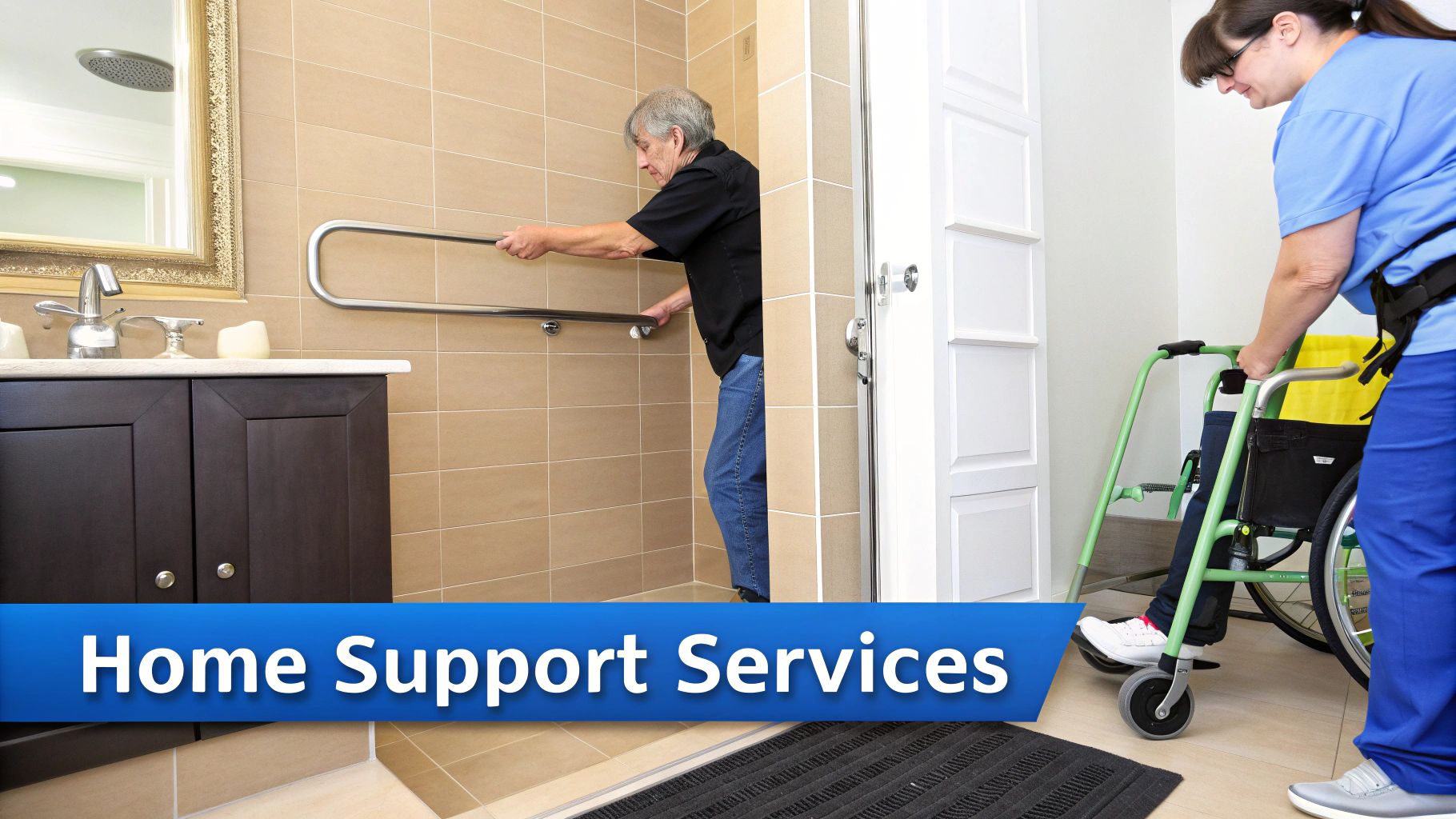
So, you’ve been approved for one of the NJ Medicaid waiver programs. It's a huge step. But the big question is, what does this support actually look like day-to-day?
These programs are about so much more than just basic medical care. They’re designed to create a complete support system that makes living at home safe, comfortable, and sustainable for the long haul. The real goal is to provide practical, real-world help that tackles the challenges of daily living, building a safety net right inside the familiar walls of home.
Core In-Home Support Services
The foundation of most waiver programs is Personal Care Assistance (PCA). This is hands-on help from a certified home health aide who can assist with what we call Activities of Daily Living (ADLs).
Think about a senior who has trouble with mobility. A personal care assistant can be there to help them get safely out of bed in the morning, assist with bathing and getting dressed, and make sure they have nutritious meals. This direct support is the bedrock of keeping someone independent at home, ensuring their essential personal needs are met with dignity.
Another critical piece of the puzzle is Respite Care. This service isn't for the person receiving care—it's for the family caregivers who provide that unpaid, around-the-clock support. Respite offers temporary relief, giving a family member a much-needed break to run errands, go to their own appointments, or simply rest and recharge. It’s a key tool in preventing caregiver burnout, which is a major reason why families sometimes have to consider moving a loved one into a facility.
Think of respite care as a support system for the support system. By looking after the well-being of the family caregiver, the entire structure of in-home care becomes stronger and more sustainable. It’s an acknowledgment that caregivers need care, too.
For a deeper dive into the types of support available, check out our guide on Medicaid for home health care for more details on how these services work.
Adapting the Home for Safety and Independence
Waiver programs also understand that the physical environment plays a huge role in keeping someone safe. That’s why they often cover Home Modifications and Assistive Technology—services designed to adapt the living space to a person's specific needs.
This can mean anything from small but impactful changes to incorporating helpful new devices.
- Structural Modifications: This could be installing a wheelchair ramp to get rid of the daily struggle with stairs, widening doorways for easier access, or adding grab bars in the bathroom to prevent dangerous falls.
- Assistive Technology: This includes devices like a Personal Emergency Response System (PERS), which allows someone to call for help with the push of a button, or specialized communication aids.
These adaptations empower people to move around their own homes more freely and safely, reducing their reliance on others for basic mobility.
Finally, everything is coordinated by a dedicated Case Manager. This professional is your go-to person. They work with you and your family to develop the initial care plan and provide ongoing oversight to make sure everything is working as it should. They are your primary point of contact and advocate, ensuring the entire system of care works together seamlessly.
Common Questions About NJ Medicaid Waivers
Once you start digging into NJ Medicaid waiver programs, the practical, real-world questions quickly follow. After you get the basics down, you start to wonder how it all applies to your family and your specific situation.
Let's walk through some of the most common questions we hear from families planning for in-home care. Getting clear, straightforward answers is the first step toward making confident decisions for your loved one.
Can I Choose My Own Caregiver?
This is one of the first things people ask, and the answer is a resounding yes in most cases. New Jersey's system, particularly the Managed Long-Term Services and Supports (MLTSS) program, is built on a model of participant-directed care.
What does that mean for you? It means you have a significant say in who provides your support. You can often hire a trusted friend, a neighbor, or even a family member (like an adult child) to be your paid caregiver. This brings an incredible level of comfort, knowing the person helping you is someone you already know and trust.
There are just a few ground rules to remember:
- Spouses are usually excluded. In most situations, you cannot hire your spouse as your paid caregiver through these programs.
- Other family members are often eligible. Adult children, siblings, and other relatives are frequently approved.
- You don't have to be an employer. A state-contracted Fiscal Intermediary agency handles all the messy stuff—payroll, taxes, and paperwork. They make sure your chosen caregiver is paid correctly and on time, so you can focus on what matters: your care.
This option, often called the "Personal Preference Program" (PPP), is a powerful part of NJ Medicaid waiver programs because it truly puts you in the driver's seat.
What Happens If My Application Is Denied?
Getting a denial letter in the mail is tough, but it's so important to know that it's not the end of the road. You have a legal right to appeal the decision.
Think of a denial not as a final "no," but as a request for more information or a chance to clarify things. The very first thing to do is read the denial notice carefully. It will spell out exactly why the decision was made, and it usually boils down to one of two things:
- Financial Denial: The state believes your income or assets are over the limit. This might be due to missing paperwork or a simple misunderstanding of your finances.
- Clinical Denial: The in-home assessment concluded that you don't meet the "nursing home level of care" requirement needed to qualify.
Once you know the reason, you can start building your case. You must request a Fair Hearing within the deadline listed on your letter. This is your formal opportunity to present new evidence—like more detailed medical records or updated financial statements—to argue why the original decision was incorrect.
How Long Does the Application Process Take?
Patience is key here. While everyone's situation is different, the entire process can take anywhere from 30 to 90 days. In more complex cases, it can sometimes stretch even longer.
What causes the delays? The single biggest factor is how quickly you can gather all the required financial documents. Because New Jersey has a five-year "look-back" period, you'll need to pull together years of bank statements and other records, which can take time.
The most common hold-up in the Medicaid application process is incomplete paperwork. The best way to keep things moving is to be incredibly organized and double-check that you've sent in every single document the County Board of Social Services asks for.
Other things that can affect the timeline include the complexity of your finances, the current caseload at your local county office, and how quickly the in-home clinical assessment can be scheduled. Staying on top of communication and responding quickly to any requests will always help.
Is There a Waiting List for These Programs?
For families who need help right away, this is a critical question. The good news is that for New Jersey's main waiver program, MLTSS, the answer is no. MLTSS is an entitlement program.
In simple terms, this means that if you meet all the clinical and financial requirements, you are entitled to receive services. You won’t be put on a waiting list. This is a huge benefit, as waiting lists in other states can sometimes last for years.
It is important to know, however, that some of the state's more specialized waivers, like those for individuals with intellectual and developmental disabilities (DDD waivers), might have enrollment caps or waiting lists for certain services. But for most seniors and adults with physical disabilities seeking in-home care through MLTSS, if you're approved, your services will begin.
Of course, beyond the waiver programs themselves, many families have questions about other types of support. It's common to wonder about things like how insurance covers electric wheelchairs and other essential equipment that helps maintain independence at home.
Navigating the ins and outs of NJ Medicaid waivers can feel overwhelming, but you don’t have to do it alone. The team at NJ Caregiving is here to guide you through every step, from figuring out eligibility to building a care plan that works for your family. Contact us today to see how we can help. https://njcaregiving.com
