
When it comes to senior care, the decision often boils down to a fundamental choice: stay at home or move into a facility. For many families, the answer is clear. Choosing home instead of senior care isn't just a logistical decision; it's an emotional one, deeply rooted in the desire to preserve a loved one's independence and connection to their own life.
It’s about allowing them to age with dignity in the place they built, surrounded by a lifetime of memories, rather than having to adapt to the structured, and often impersonal, setting of a residential facility. This choice is about prioritizing personalized, one-on-one attention over the communal living model that defines traditional senior care.
Why Families Choose Home Instead of Senior Care
The pull toward in-home care often comes from a powerful need to maintain normalcy and control. Aging in place means seniors can stick to their established routines, stay connected with neighbors and their local community, and live in a space that is truly their own. This isn't just a sentimental preference; it reflects a major shift in how we approach elder care.
In fact, nearly 9 out of 10 seniors say they want to age in place, a preference that has dramatically increased the demand for home-based support. This isn't just anecdotal. The global senior in-home care market is projected to skyrocket to USD 2,695.7 million by 2035, a number that confirms a clear move toward care models that champion independence. You can explore more on the senior in-home care market's growth to see just how significant this trend is.
The Core Appeal of Aging at Home
So, what’s the real draw? The biggest benefit of choosing home instead of senior care is the sheer level of personalized attention. In a facility, staff-to-resident ratios can be stretched thin, with caregivers attending to multiple people at once. In-home care, on the other hand, provides a dedicated caregiver focused solely on your loved one’s needs, which allows for a much deeper, more trusting relationship to form.
Familiarity is another huge factor. For seniors, especially those navigating cognitive decline from conditions like dementia, being in a familiar environment can drastically reduce stress, confusion, and anxiety. They’re surrounded by their own belongings, they get to sleep in their own bed, and they can welcome family and friends whenever they please, free from the visiting hours and rules of a facility.
In-Home Care vs Facility Care At a Glance
When you’re weighing these two very different paths, it helps to break them down side-by-side. The table below gives you a quick snapshot of how each option stacks up across the factors that matter most to families: daily life, cost, and social connection.
| Factor | In-Home Care | Facility-Based Care |
|---|---|---|
| Living Environment | The comfort of their own home, surrounded by personal belongings and memories. | A private or semi-private room in a communal, structured setting. |
| Personal Autonomy | A high degree of independence; schedules and routines are highly flexible. | Daily life is more structured with set times for meals and activities. |
| Caregiver Attention | One-on-one, dedicated support from a consistent caregiver. | Care is provided by rotating staff who are shared among multiple residents. |
| Social Interaction | Opportunities with family, neighbors, and planned community outings. | A built-in community with organized group activities and daily peer interaction. |
Seeing the differences laid out like this can help clarify which environment truly aligns with your loved one’s personality, needs, and desires for their later years.
A Day in the Life: In-Home Care vs. a Senior Facility
Choosing between in-home care and moving to a facility isn't just a logistical decision—it's about picking a lifestyle that will genuinely help your loved one thrive. The day-to-day reality in each setting is worlds apart, shaping everything from their sense of independence to their social connections. Getting to the heart of these differences is the only way to make a choice that truly fits their personality.
When a family decides to bring care into the home, they're really choosing to protect a lifetime of familiar routines. Mornings can still mean coffee on the back porch, afternoons can be spent tending to the garden, and evenings can unfold just as they always have. This isn't just about comfort; it's about holding onto a sense of self.
On the other hand, life in a senior care facility is organized and predictable. While it offers safety and a ready-made social scene, daily life runs on a schedule. Meals, activities, and social events are planned, which is great for someone who thrives on structure but can feel confining for an independent spirit.
Autonomy and Personal Routines
The biggest difference, hands down, is personal freedom. At home, your loved one sets the pace, and the caregiver is there to support it. They aren't trying to fit into someone else's timetable.
This simple flowchart breaks down the fundamental choice between staying put or moving out.
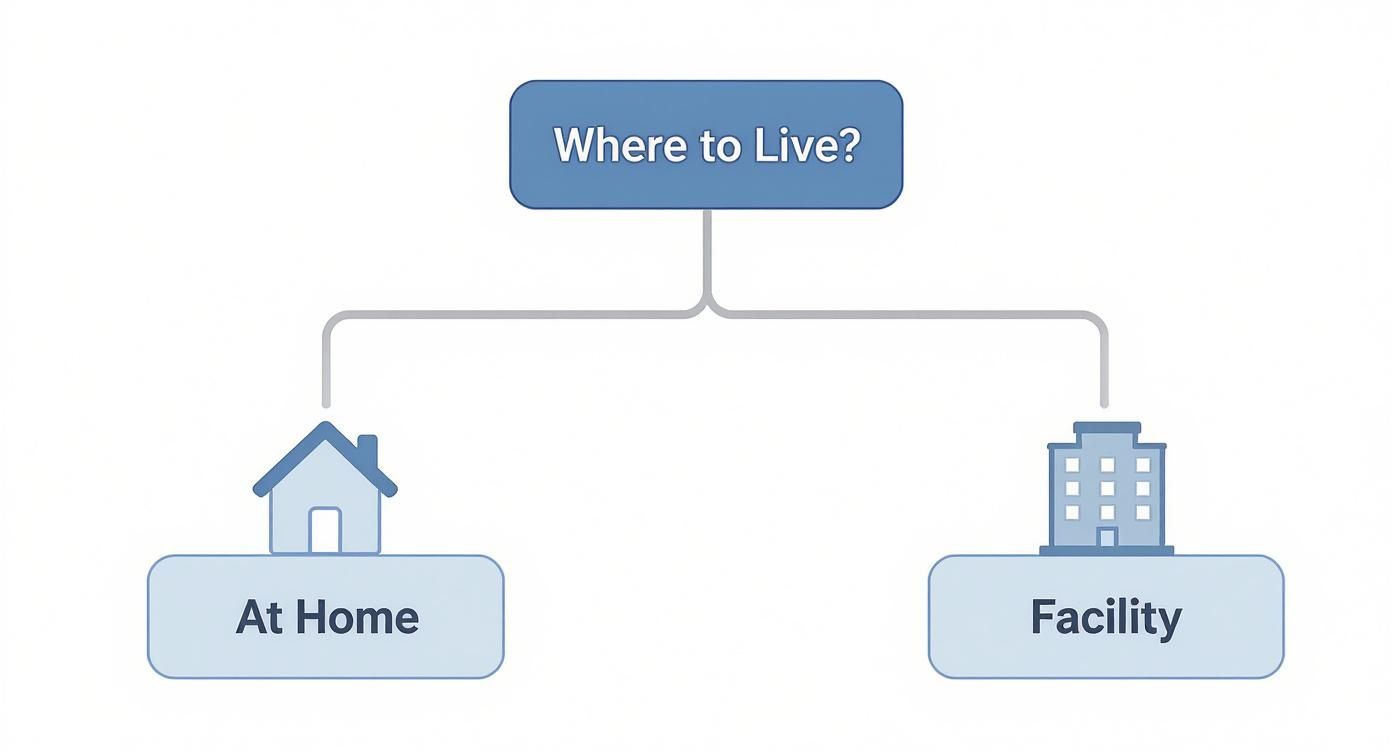
As you can see, that first decision—home or facility—steers every other aspect of daily life and the type of care they'll receive.
Think about something as simple as lunch. At home, they can eat at noon or 2 p.m., ask for their favorite soup, or even help the caregiver prepare it. In a facility, meals are typically served at set times in a dining hall with a pre-planned menu. Those small choices get taken away.
The core difference lies in who adapts to whom. In-home care adapts to the senior's established lifestyle, while in a facility, the senior adapts to the community's established structure.
For seniors who find deep comfort in their personal habits and the four walls of their own home, holding onto these small, daily choices makes a huge difference in their overall happiness and sense of control.
Social Interaction and Community Life
Socialization is another area where the two paths diverge sharply. Senior living facilities are designed to be communities, offering built-in opportunities to interact through planned activities, classes, and shared spaces. For an outgoing person who has become isolated, this can be a fantastic solution.
But the social life that comes with staying at home is often more personal and self-directed. It’s built around existing relationships with neighbors, friends from the local community center, and family who can drop by anytime.
Here’s a quick look at how the social dynamics differ:
- Socializing at Home: It’s about spontaneous visits from grandkids, chats with the mailman, or having a caregiver provide a ride to a weekly card game. Social circles are maintained, not replaced.
- Socializing in a Facility: It’s more structured, with things like bingo nights, group exercise classes, and movie showings. Social circles are newly formed with other residents.
For a senior who is more of an introvert or has a strong, established local network, the constant group activities of a facility might feel more like an obligation than a joy. But for someone who has lost those connections over time, the built-in community of a facility could be a true lifeline. Diving deeper into home care vs assisted living can help you weigh which environment better matches different social temperaments.
Ultimately, the right choice comes down to your loved one’s personality. Do they light up in a busy, group-oriented setting? Or is their happiness tied to the quiet independence and familiar comforts of their own home and neighborhood? Answering that question is the first step toward making a compassionate, sustainable decision.
Analyzing the Financial Realities of Senior Care
When it’s time to decide on care, the conversation almost always turns to cost. For most families, this is the biggest and most stressful piece of the puzzle. There's a common belief that facilities are always the more expensive route, but the truth is a lot more complicated.
The best financial choice really hinges on one thing: the level of care your loved one actually needs.
Choosing home instead of senior care in a facility usually means you’re paying by the hour. This can be a fantastic, budget-friendly option if your family member just needs a hand for a few hours each day—maybe with making meals, getting around the house, or just for some companionship. But if those needs start to grow, the hourly costs can add up surprisingly fast.
On the other hand, assisted living or nursing homes typically charge a flat monthly fee. This fee rolls up room, board, meals, and a certain amount of care into one predictable cost. That big number can feel like a shock at first, but if someone needs round-the-clock supervision or significant medical help, it can actually be more affordable than 24/7 in-home care.
Breaking Down the Costs: In-Home vs. Facility
To really compare apples to apples, you have to get clear on what you’re paying for. The cost structures are fundamentally different, and both can have hidden expenses you don't see coming.
Looking at the numbers head-on usually reveals a tipping point where one option clearly becomes the smarter financial choice.
What You're Paying for with In-Home Care:
- Hourly Caregiver Rate: This is your main expense. The rate will change depending on the agency and the type of care needed, from basic companionship to more skilled assistance.
- Agency Fees: Good agencies build in costs that cover essential background checks, training, insurance, and managing schedules for their caregivers.
- Ongoing Household Expenses: Remember, you’ll still be covering the mortgage or rent, utilities, groceries, and all the usual costs of maintaining a home.
What You're Paying for with Facility-Based Care:
- Monthly All-Inclusive Fee: This single payment covers the apartment or room, utilities, three meals a day, and basic housekeeping.
- Tiered Care Levels: Most facilities have different "levels" of care. If your loved one needs help with medication, dressing, or bathing, you'll likely pay more.
- Ancillary Charges: Keep an eye out for extras. Things like transportation to appointments, on-site salon services, or special activities can add to the monthly bill.
The real question isn't just, "Which one is cheaper?" It's, "At what point does the cost of one option overtake the other, based on my loved one's specific needs?"
Navigating Payment Options in New Jersey
Figuring out how to pay for senior care can feel like a monumental task. Thankfully, New Jersey has several programs in place to help families, especially those with limited income and assets.
For many families here in Mercer County, the most important program to know about is New Jersey's Medicaid Managed Long Term Services and Supports (MLTSS). This program is specifically designed to give eligible seniors the choice to receive care where they feel most comfortable—including at home.
MLTSS can cover a surprisingly wide range of services to make aging in place possible. It can help pay for personal care assistance, give family caregivers a much-needed break with respite care, and even cover home modifications for safety. The whole point is to create a support system that makes choosing home instead of senior care a real, financially viable option.
To qualify for MLTSS, an individual must meet certain financial requirements and also undergo a clinical assessment to determine their care needs. The application process can be a bit of a maze, which is why partnering with a local agency that knows the ins and outs is so valuable.
For a clearer picture of your options, you can find a detailed guide on how to pay for home care that explores the different paths available for New Jersey residents. Getting the right information can take the mystery out of the payment process and help your family access the support you deserve.
Evaluating Safety and Complex Medical Needs
When you're weighing care options, nothing is more important than safety and how well complex health needs can be managed. For many families I talk to, this is the single biggest deciding factor. It often comes down to one question: Can a familiar home be made as safe as a facility built specifically for senior living?
The reality is, both have their strengths, and the "better" choice really depends on the person. A facility offers a highly controlled environment with safety features already built-in and staff available 24/7, which brings a lot of peace of mind. On the other hand, the home instead of senior care model allows you to build a safety plan from the ground up, completely personalized to your loved one’s habits, their home’s layout, and specific medical needs.
Proactive Fall Prevention and Home Modifications
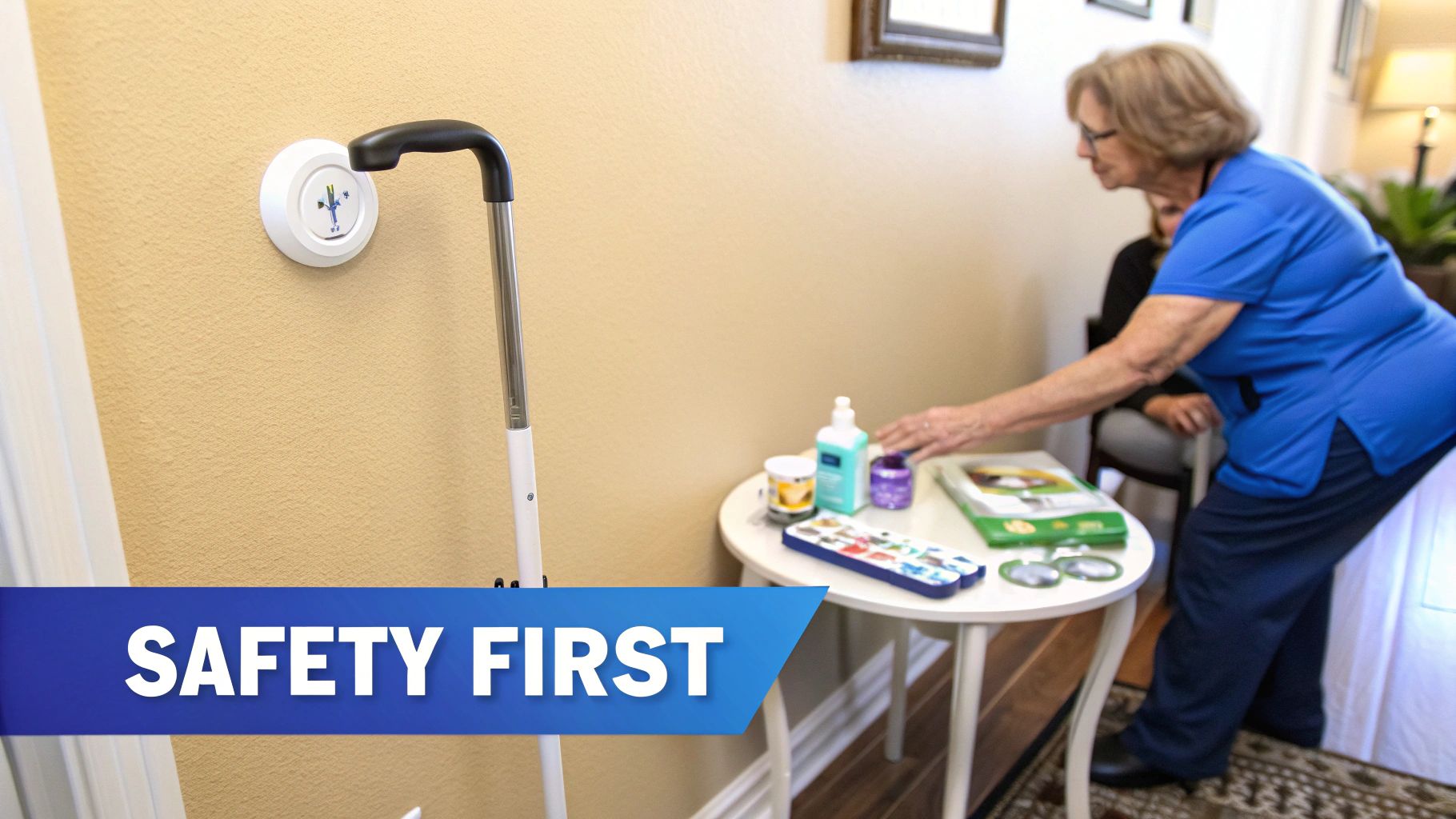
Falls are a huge risk for older adults, so preventing them is priority number one, no matter the setting. Facilities are designed with this in mind—you’ll see grab bars, non-slip floors, and no-step layouts everywhere. But these are standardized solutions; they don't account for how your mom navigates her own living room or kitchen.
This is where in-home care really shines. A professional can conduct a home safety assessment to pinpoint risks tied directly to your loved one's daily routine. From there, you can make targeted modifications that have a real impact. Simple changes like converting bathtubs to walk-in showers for enhanced accessibility, adding a ramp for the front steps, or just improving hallway lighting can make all the difference.
The key difference is customization versus standardization. A facility offers a safe baseline for everyone, while in-home care creates a safe environment specifically for one person.
Managing Medications and Medical Oversight
Getting medications right is another critical piece of the safety puzzle. In a facility, trained staff handle administration on a strict schedule, which significantly cuts down on the risk of error, especially for those with complicated regimens. It's a solid system that provides a strong safety net.
But don't assume that choosing home instead of senior care means you're on your own. Medication management can be handled just as effectively with the right support. A dedicated caregiver can provide reminders, organize medications, and watch for any side effects. For more complex needs, skilled professionals can come right to the home. Services like skilled nursing at home bring registered nurses to the doorstep to manage things like injections, wound care, and other clinical tasks. You get that high level of medical oversight blended with personalized, one-on-one attention.
Addressing Specialized Needs Like Dementia Care
When a loved one is living with dementia or Alzheimer's, the need for safety and constant supervision becomes even more critical. Specialized memory care units in facilities are built to be secure, preventing wandering and offering structured activities designed to soothe and engage residents. That 24/7 staffing is a cornerstone of their approach.
However, the familiarity of home can be incredibly therapeutic for someone with dementia. Being in their own space often reduces stress and agitation. An in-home caregiver with specialized dementia training can create a consistent routine, use familiar activities to engage them, and secure the home against wandering. This one-on-one relationship allows the caregiver to truly learn an individual’s triggers and what calms them, offering a level of personalized emotional support that’s hard to match in a larger group setting.
A Practical Guide to Starting In-Home Care
Making the move to in-home care is a big decision, one that often brings a mix of relief and a whole new set of questions. Once you've decided that keeping your loved one at home—home instead of senior care in a facility—is the best path forward, it’s time to start planning. A thoughtful transition makes all the difference in ensuring they get the right support while holding onto their dignity and independence.
This journey doesn't start with calling agencies. It begins with a real, honest conversation with your loved one and the rest of the family. The best transitions happen when everyone feels included and their voice is heard.
Step 1: Figure Out Exactly What’s Needed
Before you can find the right help, you need a crystal-clear picture of what kind of help is required. This isn't just about medical diagnoses; it's about understanding the whole person—their daily habits, what makes them happy, and their emotional state.
Sit down and make a detailed list covering every part of their day. Think in terms of specific tasks and pinpoint the times when support is most crucial.
- Activities of Daily Living (ADLs): Make a note of any trouble with bathing, getting dressed, personal grooming, eating, or just moving around safely.
- Instrumental Activities (IADLs): Where are the challenges? Is it preparing meals, remembering medications, keeping the house tidy, getting to appointments, or managing bills?
- Social and Emotional Needs: Loneliness can be a huge issue. Consider their need for companionship, help with hobbies, or someone to join them on outings.
- Safety Concerns: Walk through the home and identify any risks, like loose rugs that could cause a fall. Also, note any memory issues that might require extra supervision.
This detailed list is your roadmap. It will be invaluable when you start talking to agencies and caregivers, helping you find a truly perfect fit.
Step 2: Choose the Right Home Care Agency
With your needs assessment in hand, you’re ready to find a professional partner. Choosing a reputable agency is one of the most important things you'll do. They’re the ones responsible for vetting, training, and managing the person who will be coming into your loved one’s home. Look for an agency that’s established in your community.
A great home care agency is more than just a scheduling service. They become part of your support system, offering advice and adjusting the care plan as your loved one's needs change over time.
When you start interviewing agencies, have your questions ready. You want to understand their standards and how they operate.
- Caregiver Screening and Training: How do you vet your caregivers? What kind of initial and ongoing training do they get, especially for conditions like dementia?
- Creating a Care Plan: What’s your process for putting together a personalized care plan, and how often do you revisit it?
- Handling Emergencies: What happens if a caregiver can't make their shift? What is your protocol for a medical emergency?
- Communication and Oversight: How do you supervise your caregivers? If we have feedback or a concern, who do we talk to and what does that process look like?
Step 3: Get Ready for a Smooth Transition
The final piece of the puzzle is preparing the home and the family for the caregiver’s arrival. Open communication is key to making this a positive change. Talk to your loved one about what to expect, framing the caregiver as a partner who’s there to help them stay independent, not to take it away.
As you step into this new role, remember that your own well-being matters, too. Juggling everything can be tough, so look into strategies for balancing work and family life to avoid burnout. Practical preparations also help, like gathering important medical information, clearing walkways to prevent falls, and setting up a comfortable spot for the caregiver. By doing this groundwork, you’re building a foundation of trust and setting everyone up for success from day one.
How Local Agencies Support Aging in Place
Making the decision to age at home is a huge first step. The next, and arguably most important, is finding a trusted partner to make it a reality. Local agencies are the engines that power successful aging in place, turning the wish to stay home into a real, sustainable plan. In Mercer County, providers like NJ Caregiving help families choose home instead of senior care by building a foundation of reliable, personalized support right in their own community.
Think of a local agency as a central hub for everything a senior needs to live safely and comfortably. They do so much more than just assign a caregiver. A great local provider really knows the ins and outs of towns like Princeton and Hamilton, connecting families with everything from the best meal delivery services to local community programs.
Crafting Truly Personalized Care Plans
What really sets a dedicated local agency apart is its commitment to creating care plans that reflect a person's life, not just their medical chart. The whole process starts with a deep dive into your loved one’s daily routines, their likes and dislikes, and what they hope to achieve. This isn't about checking boxes on a form; it's a genuine conversation.
The result is a detailed roadmap for support that can bend and flex as needs change. For instance, a care plan might include:
- Companionship and Social Engagement: Finding a caregiver who shares your mom’s love for gardening or can talk for hours about classic films.
- Nutritional Support: Helping with trips to the local grocery store and preparing meals that follow specific dietary guidelines.
- Post-Hospitalization Care: Providing specialized support to make sure recovery at home after a hospital stay is smooth and safe.
This kind of detail ensures the care isn't just provided—it's genuinely enriching.
A local agency’s strength lies in its ability to see the whole person. They build a support system around the individual’s life, ensuring care feels like a natural extension of their home, not an intrusion.
The Importance of Highly Trained Caregivers
The caregiver is the heart and soul of the in-home care experience, and reputable agencies invest heavily in their teams. You’ll find that the best ones have rigorous training programs covering essential skills in safety, personal care, and specialized support for conditions like dementia. This ensures every caregiver is equipped to handle both the practical and emotional sides of their role with confidence and compassion.
This commitment to quality is a hallmark of the top providers. Take Home Instead, a global leader in the field. They employ around 100,000 caregivers across more than 1,200 locations worldwide. After more than 28 years in business, their model proves just how crucial a well-supported and professionally trained workforce is for delivering consistent, high-quality care. This is the kind of dedication to professional development that allows families to place their full trust in the person looking after their loved one.
Your Questions About In-Home Senior Care, Answered
Deciding on the right care for a loved one is a huge step, and it’s natural to have questions. As more families look for ways to keep their loved ones at home, many find themselves asking the same things about how it all works, what it costs, and the quality of care. Let's clear up some of the most common questions about choosing home instead of senior care.
Getting straight answers helps you make decisions with confidence, knowing you’ve thought through what’s best for your family’s unique situation.
How Much In-Home Care Is Actually Needed?
This is one of the most common questions, and the honest answer is: it completely depends on the person. Some seniors just need a friendly face for a few hours a week to help with errands and provide some companionship. Others, especially those coming home from the hospital or managing a long-term illness, might need help for several hours every day.
For someone with advanced dementia or a high risk of falling, 24/7 care might be what it takes to keep them safe and sound. The best way to figure this out is to have a professional from a reputable agency come out for an assessment. They can help you pinpoint the exact level of support your loved one needs to live well at home.
The beauty of in-home care is its flexibility. Unlike the fixed structure of a facility, you can dial the care up or down as your loved one's needs change. You’re only paying for the support you actually use.
Can In-Home Care Handle Serious Medical Issues?
Absolutely. While a lot of in-home care is about non-medical support like personal care and companionship, many agencies also offer skilled nursing services. This means a registered nurse (RN) or licensed practical nurse (LPN) can provide medical care right in the home.
These skilled services often include things like:
- Wound Care: Making sure surgical sites are clean, properly dressed, and healing without infection.
- Medication Administration: This can include injections, IV management, and complex medication schedules.
- Health Monitoring: Keeping a close watch on vital signs and helping manage chronic conditions like diabetes or COPD.
It’s a way for people with serious health challenges to get the professional medical oversight they need, all without leaving the comfort of home.
What Happens If My Loved One Doesn't Like Their Caregiver?
This is a perfectly valid concern. A strong, positive relationship between a client and their caregiver is everything. Any good agency knows this and has a clear plan for when the personalities just don't click. If the first caregiver isn't the right fit, you should call the agency right away.
They’ll listen to your concerns and work to find a new caregiver who is a better match. The ultimate goal is to find someone your loved one feels completely comfortable and safe with. Don't ever hesitate to speak up—making sure that relationship is a good one is a top priority for any quality provider. This dedication to finding the right match is a major advantage when you choose home instead of senior care through a professional agency.
At NJ Caregiving, our mission is to help families in Mercer County create a home environment where their loved ones can be safe, supported, and happy. If you have more questions or you’re ready to talk about personalized care options in Princeton, Hamilton, or nearby towns, get in touch with us today. Let's work together to make aging at home a success.
