

When it comes down to it, the choice between home care and assisted living really hinges on two things: location and lifestyle.
Home care brings personalized, one-on-one support right to a senior's front door, letting them age comfortably in a place that’s already filled with memories. On the other hand, assisted living provides a community-based lifestyle, where housing, social life, and care services are all wrapped up together in a specialized residence.
Deciding Between In-Home and Community Care
Choosing the right care for a loved one is a huge decision, one that often involves finding a delicate balance between their independence and their need for support. Both home care and assisted living are designed to improve quality of life, but they serve very different needs and personalities.
Home care is often the perfect fit for someone who truly values their independence and the comfort of their own home but just needs a hand with daily tasks or managing specific health issues. Assisted living, however, is built for those who would thrive with a ready-made social circle, maintenance-free living, and the peace of mind that comes with having staff available 24/7.

Getting a handle on these basic differences is the first step. To make things a bit clearer, let's look at a quick side-by-side comparison. This overview can help frame the more detailed thinking you'll need to do to make a choice you feel good about.
Home Care vs Assisted Living At a Glance
The table below offers a high-level summary of how these two options stack up against each other across key areas.
| Characteristic | Home Care | Assisted Living |
|---|---|---|
| Location | The senior's private home or a family member's residence. | A dedicated community facility with private or semi-private apartments. |
| Level of Independence | High; seniors maintain their personal space and daily routines. | Moderate; residents have privacy but follow community schedules for meals and activities. |
| Social Environment | Primarily one-on-one interaction with a caregiver; social life depends on existing networks. | Built-in community with organized social events, group dining, and daily interaction with peers. |
| Cost Structure | Typically billed hourly; costs vary based on the number of hours and type of care needed. | Usually a bundled monthly fee covering rent, meals, utilities, and a base level of care. |
Think of this as your starting point. While the "at a glance" view is helpful, the best decision will come from digging into the specifics of your loved one's health, finances, and personal wishes.
The Reality of Aging in Place with Home Care

The pull of home care is powerful because it taps into a fundamental human desire: to live comfortably and securely in a place that’s truly our own. This idea, known as aging in place, allows people to hold onto their treasured routines, familiar surroundings, and personal identity while still getting the help they need. Getting a clear picture of what home care actually involves is the first step in weighing it against a move to assisted living.
It's a mistake to think of home care as a one-size-fits-all solution. In reality, it’s an entire spectrum of support that can be tailored to fit someone’s specific needs, from a little bit of help here and there to comprehensive, around-the-clock attention.
A Spectrum of Personalized Support
At its simplest, home care can provide companionship, which is a powerful tool against the loneliness and isolation that many older adults experience. A caregiver can be there for a friendly conversation, to share a hobby, or to provide a ride to appointments and errands, keeping social connections strong.
As a person's needs change, the care plan can easily grow to include help with Activities of Daily Living (ADLs). These are the basic, essential tasks of self-care, and support can include:
- Bathing and Grooming: Helping with personal hygiene to maintain comfort and dignity.
- Dressing: Assisting with choosing clothes and the physical task of getting dressed.
- Meal Preparation: Planning and cooking healthy meals that fit specific dietary needs.
- Mobility Assistance: Helping with moving safely around the house to prevent falls.
For those with more serious health concerns, home care can also bring skilled nursing services right to the front door. This level of care is handled by registered or licensed practical nurses who can administer medications, provide wound care, and monitor vital signs, all under a doctor's direction.
The preference for aging in place is undeniable and is a huge factor in the home care vs. assisted living discussion. It’s estimated that by 2025, a staggering 90% of seniors in the U.S. will want to stay in their own homes. This isn't just about comfort; it's often a more manageable financial choice, too.
Defining the Ideal Candidate for Home Care
Home care is often the perfect fit for seniors who deeply value their independence and have a strong emotional tie to their home and community. The best candidate is usually someone who needs personalized, one-on-one support rather than the built-in social structure of a community setting.
This option is most successful when the home is already safe or can be easily modified with safety features like grab bars or ramps. The real beauty of home care lies in its flexibility—you can arrange for a caregiver for just a few hours a week or have 24/7 live-in support. Ultimately, home care works by bringing the support directly to the senior, preserving their lifestyle and autonomy for as long as possible.
Life Inside an Assisted Living Community
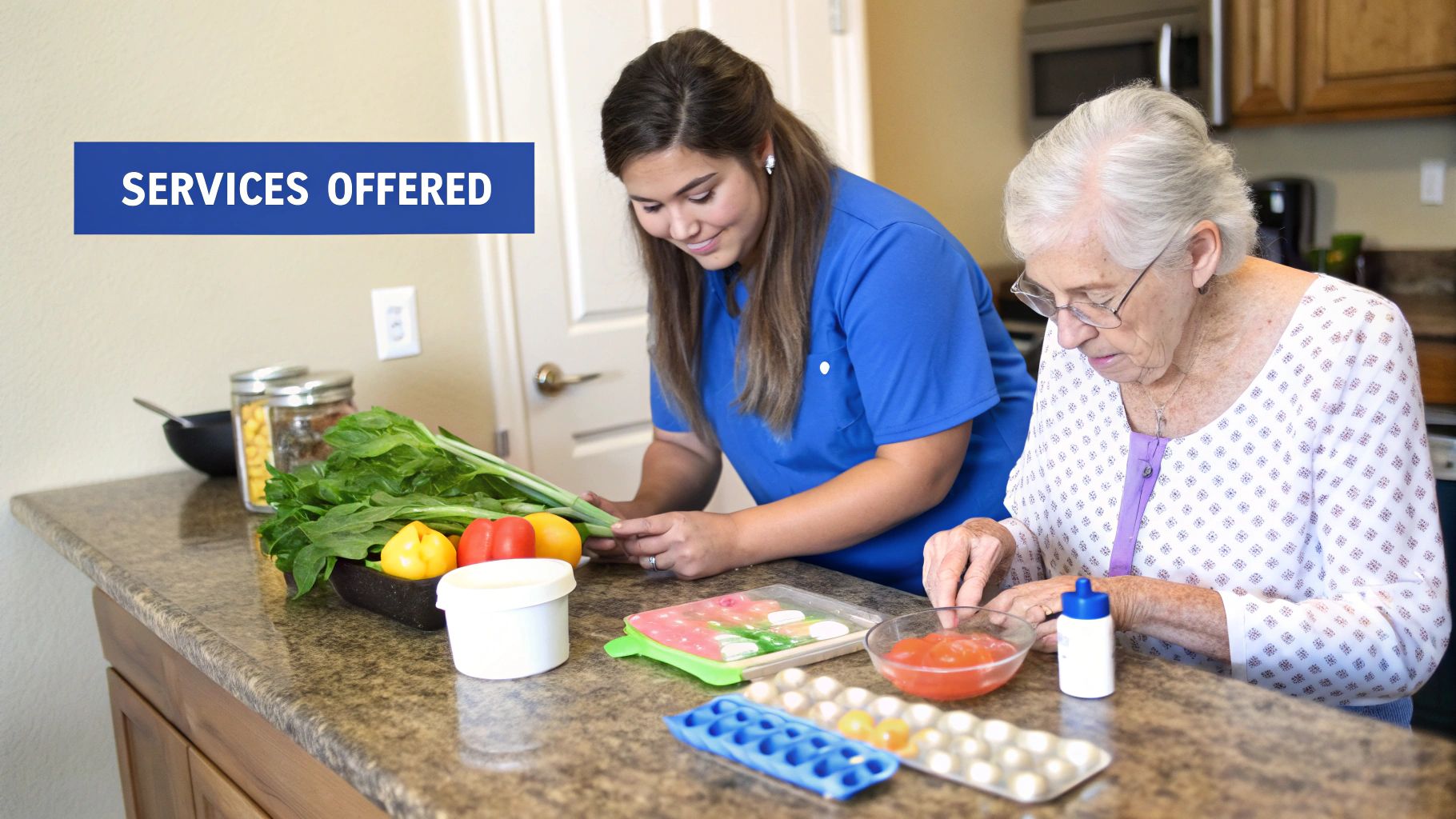
While home care brings support into a private home, assisted living flips the model by creating an entire environment built around that support. It’s a comprehensive approach that bundles housing, personalized care, and a vibrant social scene into a single package, offering a structured yet independent way of life.
For many seniors, the biggest change is the immediate access to a community. Instead of having to coordinate social outings or wait for family visits, life in an assisted living facility comes with a built-in social calendar. This design is a direct answer to the loneliness that can creep in with age, replacing isolation with daily chances to connect.
A Day in a Thriving Community
Life in assisted living is about so much more than just receiving help; it's about staying engaged and enjoying a new level of convenience. Residents get to live a maintenance-free lifestyle where daily chores like cooking, cleaning, and home repairs are handled by staff. This frees up a ton of time and energy for things they actually want to do.
A typical day might look something like this:
- Structured Activities: Kicking things off with a morning fitness class, joining a book club in the afternoon, or winding down with a scheduled movie night.
- Communal Dining: Enjoying chef-prepared meals in a restaurant-style dining room, which naturally becomes a social hub for catching up with neighbors.
- On-Site Amenities: Making use of a fitness center, library, or beauty salon without ever having to leave the building.
- Scheduled Transportation: Hopping on a group shuttle for shopping trips, doctor’s appointments, and local events.
The real magic of assisted living is how it blends independence with support. Residents have their own private apartments, but they also have the peace of mind that comes from knowing trained staff is available 24 hours a day for anything from an emergency to a simple medication reminder.
Who Flourishes in Assisted Living?
This kind of environment is often the perfect choice for seniors who are starting to feel the strain of keeping up a house or who are feeling more and more isolated. It's a great fit for someone who wants to stay active and engaged but needs reliable help with Activities of Daily Living (ADLs), like dressing, bathing, and managing medications.
It's also important to know that for seniors who need more specialized attention, particularly for cognitive decline, different options exist. You can explore the key distinctions between memory care vs assisted living to understand how communities tailor their environments for specific needs.
The global assisted living market is projected to hit $296,415.66 million by 2032, which really shows its growing importance in senior care. This growth is fueled by an aging population looking for customized support and a community-focused lifestyle.
A Nuanced Comparison of Cost and Care
When you're trying to decide between home care and assisted living, the conversation always seems to circle back to two things: cost and the level of care. It's a classic push-and-pull. Understanding how these two are connected is the key to feeling good about your final decision, because the way you pay for each is completely different and shapes the entire experience.
With home care, you're essentially paying à la carte, usually by the hour. Families pay only for the specific services they need, right when they need them. That could mean a few hours of companionship a week or it could scale all the way up to full-time, skilled nursing care around the clock.
Assisted living, on the other hand, works on a bundled model. You pay one all-inclusive monthly fee that covers just about everything: rent, utilities, several meals a day, housekeeping, and a baseline of personal care assistance.
Unpacking the Financial Details
At first glance, the hourly rate for home care can look like the more affordable option, especially if your loved one only needs a little bit of help. According to recent data, you can expect to pay an average of $28 to $30 per hour for a home health aide. But be warned—those costs can add up surprisingly fast as care needs grow.
Think about it: for someone who needs eight hours of support every day, the monthly bill can easily shoot past $7,000. And that's before you factor in all the usual household expenses like the mortgage or rent, groceries, utilities, and home maintenance, which don't just go away.
Assisted living communities offer a much more predictable financial road map. The national median cost comes in around $5,676 per month, though this will shift depending on where you live and the specific level of care needed. This bundled fee makes budgeting a whole lot simpler and often delivers more bang for your buck when someone requires a lot of support. If you're wondering how to manage the cost, it’s worth looking into what public programs can do. You can find out more about how much Medicaid pays for assisted living to see if that's a viable path for your family.
The core financial difference is this: With home care, you pay for time and specific services. With assisted living, you pay for an entire environment that includes housing, meals, social opportunities, and a safety net of available staff.
Below is a quick table to help you see how these two options stack up feature-by-feature.
Feature-by-Feature Breakdown: Home Care vs. Assisted Living
| Feature | Home Care | Assisted Living |
|---|---|---|
| Cost Structure | Hourly rate, "à la carte" services. | All-inclusive monthly fee. |
| Average Cost | $28 – $30/hour; can exceed $7,000/month for extensive care. | Median of $5,676/month. |
| Living Environment | The senior's own home, a familiar setting. | Private or semi-private apartment within a community. |
| Social Interaction | One-on-one with a caregiver; can be isolating. | Built-in community, daily activities, group dining. |
| Autonomy & Independence | Maximum independence and personal routine. | Structured daily schedule, less personal freedom. |
| Meals | Prepared by caregiver or family; requires grocery shopping. | 2-3 meals per day provided in a communal dining room. |
| Home Maintenance | Family's responsibility (lawn care, repairs, etc.). | Included in the monthly fee. |
| Safety | Requires home modifications (grab bars, alert systems). | Designed for senior safety with 24/7 staff and emergency alerts. |
This breakdown really shows that the "better" choice depends entirely on the individual's needs for independence, social life, and budget predictability.
Comparing Social Life and Independence
Beyond the numbers, the choice between home care and assisted living comes with major lifestyle trade-offs. This is especially true when it comes to social interaction and personal freedom. Each option strikes a very different balance between staying connected with others and maintaining your own independence.
This image really helps visualize the trade-offs you're making.
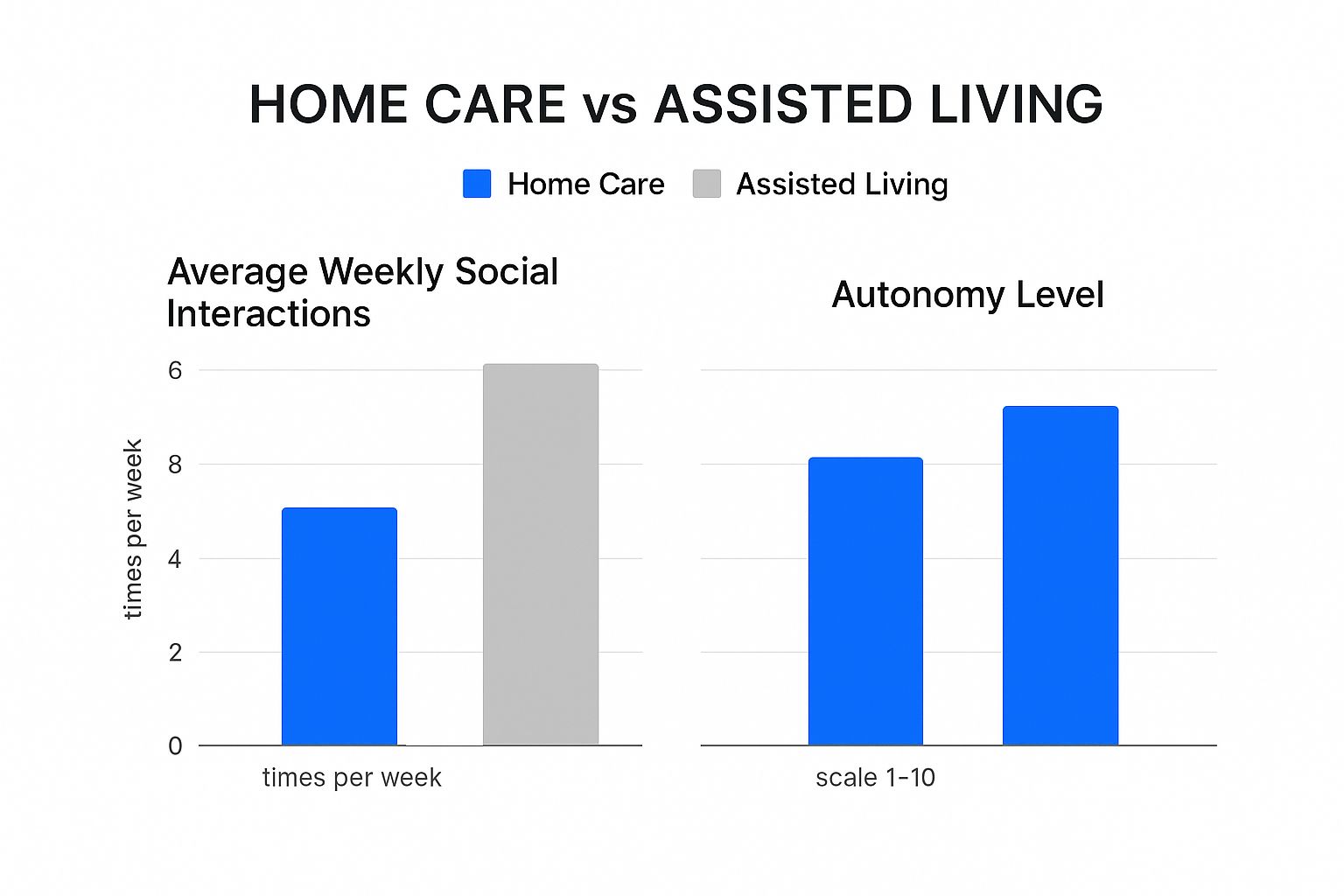
As you can see, home care puts personal autonomy at the forefront, but that can sometimes come at the cost of built-in social opportunities. Assisted living flips that script, offering a vibrant social scene in exchange for a bit less personal independence.
Medical Services and Safety
The kind of care and the safety measures in place also look very different in each setting, which is a critical factor depending on someone's health.
-
In-Home Care: Medical care is brought directly to you. A licensed nurse can come to the home to handle things like wound care or medication administration, but it has to be ordered by a doctor. Safety, however, is on the family. You'll likely need to make home modifications like installing grab bars, building a ramp, or getting an emergency alert system.
-
In an Assisted Living Community: You have staff available 24/7 to help with medication reminders and Activities of Daily Living (ADLs). They’re great at coordinating with outside doctors, but they don't typically provide complex medical treatments on-site. The huge plus here is safety—the entire building is designed for seniors, with things like emergency pull-cords, accessible layouts, and staff always on hand to respond immediately if something happens.
How to Choose the Right Path for Your Family
Moving from a side-by-side comparison to a real-world decision is where the rubber meets the road. When you're weighing home care versus assisted living, the right choice often becomes surprisingly clear once you match your loved one’s specific situation to what each option truly offers.
It’s not about which one is "better" in a general sense, but which is the best fit for their unique needs right now. Thinking through concrete scenarios can bring a lot of clarity. Instead of getting lost in a generic list of pros and cons, let’s look at how these choices actually play out in real life.
Applying Scenarios to Your Decision
To make this tangible, consider a couple of common situations families run into. Each scenario brings a different set of needs to the forefront, pointing toward one option over the other. See if one of these paths resonates with what your family is experiencing.
-
Scenario A: The Recovering Senior. Imagine a parent just discharged from the hospital after surgery. They’re motivated and mentally sharp but need temporary, skilled medical help with wound care and physical therapy. They could also use a hand with meals and bathing for a few weeks. In this case, home care is the ideal solution. It brings targeted, short-term skilled nursing and personal support directly into their own home. They get to recover in a familiar, comfortable environment without the upheaval of a full move.
-
Scenario B: The Lonely Homeowner. Now think about a senior who is still active and healthy but recently lost their spouse. They're finding that keeping up with home maintenance is becoming overwhelming. More importantly, they're feeling increasingly isolated as friends have moved away and driving at night is getting harder. Here, assisted living is a much better fit. It directly solves the core problems of loneliness and home upkeep by offering a built-in community, a full social calendar, and a completely maintenance-free lifestyle.
The key is to figure out the primary problem you're trying to solve. Is it a specific, temporary health need? Or is it a broader lifestyle challenge like social isolation or the burden of homeownership? Your answer will point you in the right direction.
Key Questions to Guide Your Family Discussion
Making a choice you feel good about starts with an honest conversation with your loved one and other family members. Use these questions as a starting point to make sure you've covered all the critical angles.
- What is their true level of social need? Is your loved one thriving with their current social circle, or are they showing signs of loneliness that a community environment could fix?
- What does their day-to-day health demand? Do they need intermittent skilled nursing that can be scheduled, or do they need the peace of mind that comes with knowing staff is available 24/7 for unpredictable needs?
- How safe is the current home? Can the house be easily and affordably modified with grab bars and ramps? Or would the extensive changes required make an already senior-safe community a smarter option?
- What does the budget realistically allow? Have you calculated the total cost of staying home—including the mortgage, utilities, food, and hourly care—and compared it to the predictable, all-inclusive monthly fee of assisted living?
These differences often show up in the demographics. For example, about 53% of assisted living residents are over 85 and are specifically looking for that community setting. Home care, on the other hand, often serves a slightly younger group dealing with chronic conditions—in fact, nearly 90% of recipients say they prefer to receive care in their own homes.
You can learn more about these assisted living statistics and trends on Caring.com. By thoughtfully working through these points, your family can move forward with clarity and confidence, knowing you've made a well-informed choice.
A Few Common Questions We Hear
When families are weighing home care against assisted living, a lot of practical questions pop up. It's completely normal. Getting straight answers is the best way to feel confident about the path you choose for your loved one. Let's dig into some of the most common things people ask.
Can You Combine Home Care with Assisted Living?
Yes, and it happens more often than you might think. While an assisted living community provides a great baseline of support, sometimes a resident needs more dedicated, one-on-one attention than the staff can realistically provide.
In those cases, families often hire a private home care aide to come right into the assisted living apartment. This is a fantastic solution for residents who have advanced dementia, need help with complex medical tasks, or just really benefit from consistent companionship. It essentially creates a hybrid model of care.
This approach gives you the best of both worlds: the social community and amenities of assisted living, plus the highly personal support of a dedicated in-home caregiver. Just make sure to check the facility's policy on outside caregivers and factor the extra cost into your budget.
This combination can be a great way to delay or even prevent a move to a more clinical setting, like a nursing home, even when care needs become more demanding.
How Do Medicare and Medicaid Cover These Options?
This is where things can get a bit confusing, because coverage for home care and assisted living is very different depending on the payer.
Medicare is pretty clear-cut: it generally does not pay for long-term custodial care. That means it won’t cover the non-medical help that makes up the bulk of both assisted living and home care services—things like bathing, getting dressed, or meal prep. What Medicare might cover is short-term, skilled home health care if it's ordered by a doctor, usually after a hospital stay.
Medicaid is a different story, as its rules are set state by state. Many states have what are called Home and Community-Based Services (HCBS) waiver programs. These are specifically designed to help pay for home care services to keep seniors out of more expensive nursing homes. Some states also offer financial help for assisted living, but the eligibility rules are often very strict. Your best bet is always to talk directly with your state's Medicaid office to see what's available.
What Happens When Care Needs Increase Over Time?
This is a fantastic question because a person's needs are rarely set in stone. Both home care and assisted living are built to adapt, but they do it in different ways.
With home care, the plan is completely flexible. You can scale the support up or down pretty easily by:
- Adding more caregiver hours each week.
- Bringing in someone for overnight assistance.
- Hiring a caregiver with more advanced credentials, like a licensed nurse.
Of course, there might be a point where 24/7 home care becomes too expensive or the home itself is no longer the safest environment.
In an assisted living community, residents can usually move to a higher level of care without having to pack their bags. Most places offer different care tiers, so you just pay for more support as needs change. Many are also part of a larger campus that includes memory care and skilled nursing, making any future transitions much smoother.
At NJ Caregiving, we know that every family’s journey is different. If you feel that one-on-one, compassionate in-home care is the right choice for your loved one, we’re here to help you build a plan that keeps them safe, independent, and happy at home. Learn more about our services at https://njcaregiving.com.
