
If you're looking to start a career in home care in New Jersey, your journey begins with one critical credential: the Certified Homemaker-Home Health Aide (CHHA). This isn't just another certificate to hang on the wall. It's the state-mandated license that proves you have the skills families can trust. Getting your home care aide certification is the single most important move you can make toward a stable, fulfilling career helping people live with dignity.
Why a CHHA Certification Is Your First Step
If you have a genuine passion for helping others, becoming a Certified Homemaker-Home Health Aide (CHHA) in New Jersey is the place to start. This certification is far more than a piece of paper—it’s your professional license. It opens doors to career opportunities and gives you the hands-on skills to provide incredible care, whether you're working in Princeton, Hamilton, or anywhere in between.
Differentiating Yourself in a Growing Field
Let's be honest: in a world where anyone can say they're a "caregiver," the official CHHA license makes you stand out. It’s a clear signal that you’ve completed a tough, state-approved training program covering all the essential skills. This formal training gives you the confidence to handle real-world challenges, from assisting with personal hygiene to knowing exactly what to do in a medical emergency.
Families and home care agencies specifically look for certified professionals. Why? Because they know what that certification represents. It ensures you’re trained in:
- Patient safety and emergency response
- Best practices for infection control and hygiene
- Proper techniques for mobility assistance and transfers
- Fundamentals of nutrition and meal preparation
- Effective communication with clients and their families
This level of skill doesn’t just protect the client; it empowers you to do your job with absolute professionalism, making you a top candidate for any position.
Meeting the Demand for Professional Care
The need for skilled home care aides is exploding. The U.S. Bureau of Labor Statistics projects a staggering 21% growth for this field between 2023 and 2033. That translates to about 718,900 new job openings every single year. This boom is fueled by an aging population and a growing desire for people to age comfortably in their own homes rather than in a facility.
A home care aide certification isn't just a requirement; it's a commitment to excellence. It tells clients and employers that you are serious about your profession and dedicated to providing the highest standard of care possible.
For those ready to jump in, the next step is understanding the specific caregiver training requirements. This guide will walk you through everything, from finding an approved program to landing your first job. When you invest in your CHHA certification, you’re not just getting a job—you’re building a career with real purpose and security.
Meeting New Jersey's CHHA Requirements
If you want to earn your home care aide certification in New Jersey, you'll need to meet the specific standards set by the New Jersey Board of Nursing. The state has a clear process designed to make sure every Certified Homemaker-Home Health Aide (CHHA) is truly ready for the job.
Let's walk through what that actually involves.
The heart of the CHHA license is a mandatory 76-hour training program. This isn't just about checking a box; it's a deep dive that combines classroom learning with hands-on, practical experience. This blended approach makes sure you not only understand the "why" behind your actions but can also confidently handle the "how."
The Core Training Curriculum Breakdown
The 76-hour program is carefully structured to build your skills from the ground up. It has two main parts that fit together to give you a complete education.
- 60 Hours of Classroom Instruction: This is where you build your foundation. You’ll get into the essential knowledge every home care professional needs, covering topics like patient rights, infection control, basic human anatomy, and proper nutrition.
- 16 Hours of Clinical Practice: Now it's time to put what you've learned into practice. Under the close supervision of a Registered Nurse, you’ll apply the skills from the classroom in either a real-world or a simulated clinical setting.
This isn't about just reading from a textbook. For instance, you might learn about proper body mechanics in the classroom on Monday and be practicing safe patient transfer techniques with an instructor by Wednesday.
Skills You Will Master
Throughout your training, you'll develop a whole range of skills that are critical for providing safe, effective, and compassionate care. The curriculum is designed to make you proficient in several key areas.
You’ll learn how to accurately check and record a client’s vital signs—things like blood pressure, pulse, and respiration. This is one of the most fundamental ways you'll keep an eye on a client's health.
A huge part of your training will also focus on personal care techniques. This means helping clients with daily activities like bathing, dressing, and grooming, all while making sure their dignity is respected and their independence is encouraged. You'll also learn all about patient safety, like how to create a secure environment by spotting and reducing fall risks and other common household hazards.
The New Jersey CHHA training program goes beyond just teaching tasks. It's about shaping a professional mindset. It teaches you to think on your feet, communicate with empathy, and act with confidence to protect the well-being of the people you care for.
To give you a clearer picture, here’s a quick checklist of what’s required to get certified in New Jersey.
New Jersey CHHA Certification Checklist
This table summarizes the essential requirements and steps to become a Certified Homemaker-Home Health Aide in New Jersey.
| Requirement | Description | Key Details |
|---|---|---|
| Training Program | Complete a state-approved 76-hour training course. | Includes 60 hours of classroom instruction and 16 hours of supervised clinical practice. |
| Competency Exam | Pass the New Jersey CHHA competency examination. | Administered by approved testing providers after training is complete. |
| Background Check | Undergo a criminal history background check. | Includes fingerprinting and is required by the Board of Nursing. |
| Application | Submit a certification application to the NJ Board of Nursing. | Includes proof of training, exam results, and background check clearance. |
| Health Screening | Provide proof of good health. | May include a physical exam and required immunizations. |
Becoming a CHHA is a multi-step process, but each part is designed to prepare you for a successful and rewarding career.
New Jersey's Leadership in Care Standards
There's a good reason for these rigorous requirements. New Jersey is known for having some of the highest standards for home care aide certification in the country. The state mandates that all personal care aides complete this specific curriculum to earn the CHHA title.
This commitment to high standards has earned New Jersey top marks in national studies for its strong training protocols, as detailed in this full report on PCA training standards.
By sticking to these high standards, New Jersey makes sure that every certified aide has the skills needed to provide outstanding care. For you, it means having confidence in your abilities. For families, it means having peace of mind that their loved ones are in capable, well-trained hands. Completing this program is your first big step into a respected and vital profession.
Choosing Your Training Program and Passing the Exam
Picking the right training program is your first big step toward becoming a Certified Home Health Aide (CHHA). It’s more than just a box to check—the program you choose really does shape your skills, your confidence, and even where you might land your first job. You need to find a state-approved course that fits your life and your goals.
In the Mercer County area, you’ll see programs at vocational schools and some offered directly by home care agencies. A little insider tip? Look beyond the basic curriculum. Ask who the instructors are. Are they experienced Registered Nurses who can share stories and advice from their own time in the field? What are former students saying in online reviews?
This visual guide breaks down the core pieces of the New Jersey training process.
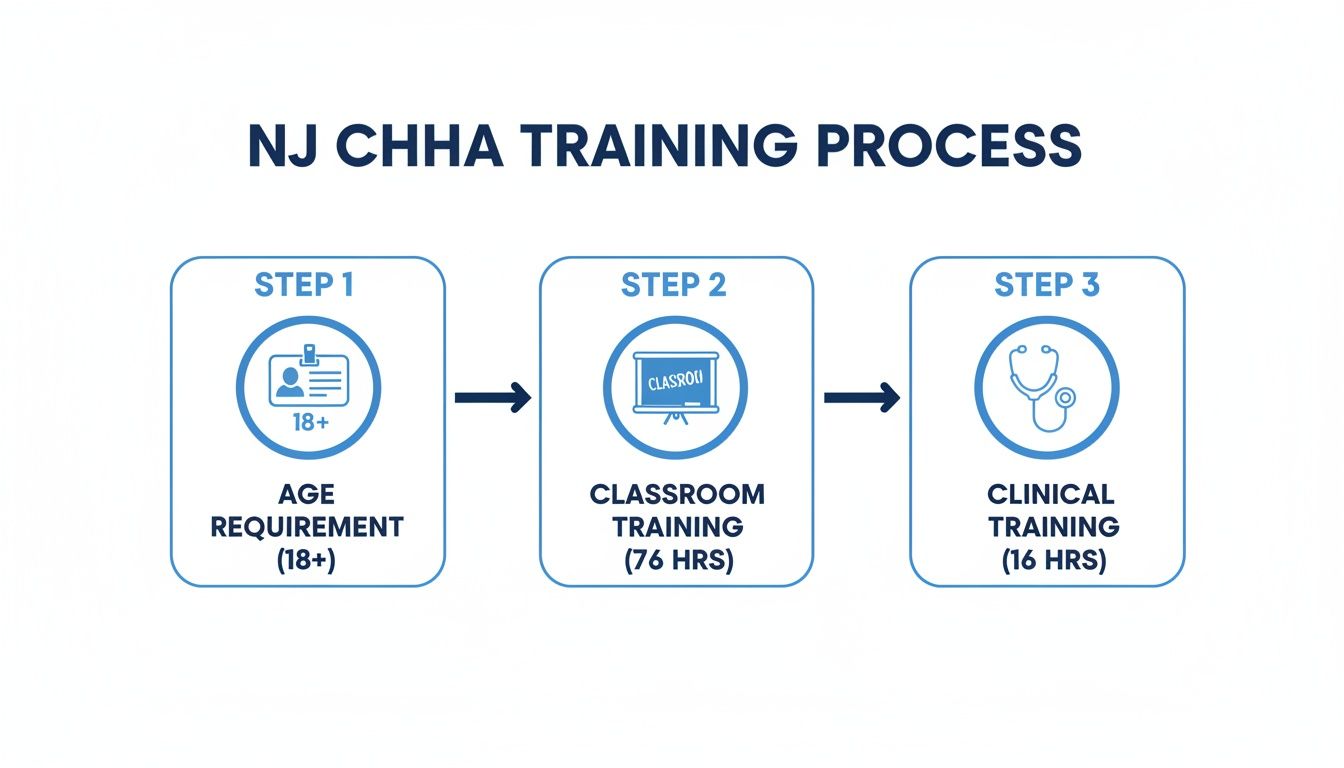
As you can see, it comes down to a few key milestones: meeting the age requirement, getting through the required classroom hours, and then putting it all into practice with hands-on clinical training.
Evaluating Program Quality and Support
A great program will do more than just teach you the 76 hours of required material. The best ones offer real support to help you succeed once the class is over. This could look like job placement assistance, workshops on building your resume, or even direct introductions to reputable local agencies.
When you're comparing your options, keep these things in mind:
- Class Size: Smaller classes usually mean you get more one-on-one time with the instructor. That personal attention is a huge help, especially during the hands-on clinical skills part.
- Flexible Scheduling: Let's be real, most of us are juggling other things. Look for programs that get it and offer evening or weekend classes.
- Training Facility: Is the classroom clean? Does the clinical lab have modern equipment? You'll learn better in a professional, well-kept environment.
For a deeper dive into finding a quality course, our guide to caregiver training courses has some great pointers on what to look for.
Think of your training program as an investment. Go with a school or agency that seems truly invested in your success, not just in getting you through the door. A program with strong connections in the local healthcare community can open a lot of doors for you later.
Once you’ve aced your training, there's just one final hurdle: the New Jersey CHHA competency exam.
Mastering the CHHA Competency Exam
This exam is designed to make sure you have both the book smarts and the practical skills to be a safe, effective caregiver. It's broken into two parts, and you have to pass both to get your home care aide certification.
- Written Examination: This is a multiple-choice test covering everything you learned in the classroom. Expect questions on things like patient rights, infection control, safety, and basic nutrition.
- Skills Demonstration: For this part, an evaluator will watch you perform a few common caregiving tasks. They’re checking to see if you can do them correctly and safely.
The skills you’ll be asked to show are the same ones you practiced over and over in your clinical training. This could be anything from proper handwashing technique and taking vital signs to helping a client move from a bed to a wheelchair.
Honestly, the key to passing is just practice. Don't just read about how to do a patient transfer—go through the motions. Say the steps out loud. It helps build muscle memory and calms the nerves on test day. Remember, the evaluator wants you to succeed; they just need to see that you can do the job safely. For those thinking about long-term career growth, an Access to Higher Education Diploma for Health Professionals can be a great next step to broaden your qualifications down the road. If you prepare well, you can walk into that exam feeling confident and ready to pass on your first try.
Getting Your Background Check and Health Screening Done
Once you’ve aced your training and passed the competency exam, you're on the home stretch to earning your official home care aide certification. But before the New Jersey Board of Nursing can issue your license, there are two final—and crucial—steps you need to complete.
These aren't just administrative hoops to jump through. The background check and health screening are fundamental requirements designed to protect the vulnerable clients you’ll be serving and uphold the professional standards of caregiving.
First up is the mandatory criminal history background check. This is a non-negotiable part of the process that directly addresses patient safety. You'll need to get your fingerprints taken so the state can conduct a thorough review of your record.
How the Fingerprinting Process Works
To get started, you'll need to schedule an appointment with a state-approved vendor for fingerprinting. Don't worry about finding one on your own—your training program or a prospective employer like NJ Caregiving will usually give you all the forms and instructions you need. It's a pretty straightforward procedure, but make sure you follow the directions to the letter to avoid any delays with your application.
So, what are they looking for? The state reviews your record for any specific criminal convictions that could disqualify someone from working with vulnerable adults. This typically includes offenses related to abuse, neglect, theft, or fraud. The whole point is to ensure that every Certified Homemaker-Home Health Aide (CHHA) is trustworthy and reliable.
Completing your background check and health screening promptly is one of the most proactive things you can do. These steps often run on their own timelines, and getting them done early prevents them from becoming the one thing holding up your certification.
After your fingerprints are taken, the results are sent directly to the New Jersey Board of Nursing. This can take several weeks, so it’s a smart move to get this step done as soon as you're given the green light.
Meeting the Health Screening Requirements
Along with the background check, you also have to show that you're in good health and can safely handle the duties of a home care aide. This requirement protects both you and your future clients from the spread of communicable diseases.
The screening usually involves a few key things. You'll need a physical examination from a licensed physician, which confirms you're physically capable of the job's demands—things like lifting, bending, and helping clients move around.
You'll also have to provide documentation for specific health tests and shots. The most common requirements include:
- Tuberculosis (TB) Test: A negative TB test is mandatory. This is usually a two-step PPD skin test or a blood test to make sure you don't carry this infectious respiratory disease.
- MMR Vaccination: You'll need to show proof of immunization for measles, mumps, and rubella.
- Physical Exam Clearance: This is simply a signed form from your doctor stating that you're fit for duty.
Think of this health screening as part of your professional toolkit. It shows your commitment to keeping a safe care environment for everyone. By keeping your health records organized and submitting everything correctly, you’ll breeze through the final stages and get one step closer to starting your rewarding new career.
Budgeting for Your Certification: Costs and Timeline
Pursuing your home care aide certification is an investment in your future. And like any good investment, it helps to know what you’re putting in—both in terms of money and time. Getting a clear picture of the budget and schedule from the start takes the pressure off so you can focus on what really matters: learning the skills to become a fantastic caregiver.
Let’s walk through the numbers and dates so you can plan your journey to becoming a Certified Homemaker-Home Health Aide (CHHA) in New Jersey with total confidence.
A Realistic Look at Certification Expenses
So, what does it actually cost to get certified? The total can shift a bit depending on the training provider you go with, but the main expenses are pretty standard across the board. Planning for these upfront means no surprises down the road.
The biggest line item is usually the 76-hour training program tuition. This can swing from a few hundred dollars to over a thousand, so it really pays to shop around and see what different schools offer.
Besides the course fee, you’ll have a few other smaller costs to factor in:
- Competency Exam Fee: Once you finish your training, there's a fee to sit for the state-required competency exam.
- Background Check Fee: This covers the cost of fingerprinting and the official criminal history check, which is a non-negotiable part of the process.
- State Application Fee: The New Jersey Board of Nursing charges this fee to process all your paperwork and issue your license.
- Health Screening Costs: This can include a physical exam and any required shots or tests. What you pay out-of-pocket here often depends on your health insurance.
How to Manage the Costs of Your CHHA Training
Here’s the good news: you don't always have to foot the entire bill yourself. Many aspiring aides find ways to cut down on—or completely eliminate—their out-of-pocket training costs.
One of the smartest routes to take is looking for agency-sponsored training programs. Leading home care agencies, like NJ Caregiving, frequently invest in their future team members by covering the full cost of CHHA training. Typically, this is offered to candidates who agree to work with the agency for a period after getting certified. It’s a win-win, giving you a direct path to a job and wiping the financial slate clean.
Choosing an agency-sponsored program is a great strategic move. You’re not just getting your education for free—you’re also lining up a job with a supportive employer who’s already invested in your success from day one.
Before we get into timelines, let's pull all those potential costs together.
Estimated Costs for CHHA Certification in New Jersey
Here’s a table breaking down the typical expenses you can expect during the certification process. Remember, these are estimates, and your final costs might be a little different.
| Expense Item | Typical Cost Range | Notes |
|---|---|---|
| Training Program Tuition | $300 – $1,200+ | Varies widely by school. Some agencies sponsor this cost. |
| Competency Exam Fee | $80 – $100 | A standard fee for the state-required final exam. |
| Background Check & Fingerprinting | $60 – $80 | A mandatory criminal history check. |
| NJ Board of Nursing Application Fee | $50 | The fee to process your application and issue your license. |
| Health Screening & Physical | $50 – $200+ | Dependent on your insurance coverage and provider. |
| Course Materials/Uniform | $25 – $100 | Some programs include this in tuition, others don't. |
| TOTAL ESTIMATED COST | $565 – $1,730+ |
This breakdown gives you a solid baseline for budgeting. Always ask any potential training program for a complete list of fees so you know exactly what to expect.
Mapping Out Your Certification Timeline
Knowing the timeline is just as crucial as knowing the costs. The whole process is pretty straightforward, but a few steps involve some waiting. All in all, you can expect the journey from enrolling in a class to holding your license to take about one to three months.
Here’s a general idea of how that time breaks down:
- Completing the Training Program (2-4 weeks): The 76-hour course itself is often finished in just a few weeks, especially if you’re in a full-time program.
- Scheduling the Exam and Getting Results (1-2 weeks): After your class wraps up, you'll need to schedule your competency exam. It can take a week or two for the official results to come back.
- Processing the Background Check (2-6 weeks): The fingerprinting and background check can sometimes be the longest wait. It’s a good idea to get this started as soon as your program allows.
- Board of Nursing Application Review (2-4 weeks): Once you’ve submitted all your documents, the Board of Nursing needs time to review everything before they issue your official CHHA license.
By keeping these costs and timeframes in mind, you can navigate the certification process smoothly and step confidently into your new career.
Building Your Career After Certification
Earning your home care aide certification is a huge accomplishment, but it's also just the beginning. This is where your professional journey truly launches. With your new CHHA license in hand, you're not just qualified for a job; you're ready to build a meaningful and sustainable career.

The first big decision you'll make is whether to work on your own or join a home care agency. While going solo might seem tempting, partnering with a supportive agency provides a powerful foundation for long-term success. The best agencies offer a structured environment designed to help you thrive.
This kind of support system often includes consistent scheduling, mentorship from experienced Registered Nurses, and a whole team you can rely on. Working with an agency also provides crucial liability protection—a safety net that is incredibly difficult to secure when you're on your own.
The Value of Agency Support and Growth
Joining a top-tier agency is about so much more than just finding clients. It's about becoming part of a professional community that actively invests in your growth. This partnership offers several key advantages that are essential for new CHHAs.
- Ongoing Professional Development: Leading agencies provide continuous training to keep your skills sharp and current with the latest care techniques and safety protocols.
- Clinical Supervision: You'll work under the guidance of a Registered Nurse who provides mentorship, answers clinical questions, and helps you navigate complex care situations.
- Career Advancement Opportunities: Agencies often have clear pathways for growth. Your role as a CHHA could lead to specialized positions or even help you explore the differences between an HHA vs. CNA if you consider further education down the road.
This structure allows you to focus entirely on what you do best: providing exceptional care. The agency handles the administrative headaches like scheduling, billing, and compliance, freeing you up to make a real difference in your clients' lives.
Think of a great agency as your career partner. They provide the resources, protection, and opportunities, while you provide the compassionate, skilled care that families depend on. It’s a collaboration that benefits everyone involved.
Keeping Your Certification and Skills Current
In New Jersey, your CHHA license needs to be renewed every two years. While the state itself doesn't mandate specific continuing education units for renewal, your commitment to learning shouldn't stop after the exam. This is another area where a quality agency really shines.
They often provide specialized training in areas like dementia care, palliative support, or managing specific chronic conditions. This not only makes you a more effective aide but also significantly enhances your professional resume. When you're ready to showcase your skills, looking at professional nursing CV examples can give you some great ideas for your own home care aide application.
By staying engaged and taking advantage of these opportunities, you transform your certification from a simple license into a launchpad for a long, rewarding, and ever-evolving career.
Your Top CHHA Certification Questions Answered
As you get closer to starting your career as a home care aide, you're bound to have some questions. It’s totally normal. Getting the right answers helps you map out your journey with a lot more confidence. Let’s tackle some of the most common things aspiring CHHAs in New Jersey ask about.
How Long Does a New Jersey CHHA Certification Last?
Think of your New Jersey CHHA license as a professional credential that you need to keep active. Your license is good for two years. To keep it that way, you’ll need to renew it directly with the New Jersey Board of Nursing.
When it’s time to renew, here’s what you’ll need to do:
- Submit the official renewal application and pay the fee before your current license expires.
- Go through another criminal history background check to confirm you’re still eligible.
- Confirm that you’ve worked a minimum number of hours as a CHHA under the supervision of a registered nurse.
While the state doesn't mandate continuing education units (CEUs) for renewal, you'll find that the best agencies provide ongoing training. This is how you stay sharp, learn new skills, and provide the best possible care.
Can I Transfer My Certification From Another State?
This is a big one for aides moving into the Garden State. New Jersey does not have direct reciprocity, which means you can’t just swap your out-of-state license for a New Jersey one. But don't worry, there's a clear path forward called endorsement.
To get certified by endorsement, you’ll need to show the NJ Board of Nursing that the training you received in another state is just as thorough as New Jersey’s 76-hour standard. This means you'll submit your credentials for a detailed review. If the Board gives your training the green light, you can move ahead with the rest of the New Jersey application, including the background check.
Key Takeaway: While you can't just transfer your license directly, the endorsement process is a well-defined route to becoming a certified CHHA in New Jersey without having to start all over again.
What Is the Starting Salary for a CHHA in Princeton?
Let's talk about what you can expect to earn—it’s an important piece of the puzzle. In Princeton and the surrounding Mercer County area, a CHHA's starting salary can vary. It often depends on the agency you work for, your level of experience, and how complex a client's needs are.
The key takeaway is that certified aides always earn a competitive hourly wage, well above the state minimum wage.
Your certification is the single most powerful factor in maximizing your income. Agencies know how valuable professionally trained and certified caregivers are. Because of this, they almost always offer better pay rates, benefits, and overtime opportunities to their certified team members.
Ready to take the next step in your caregiving career with an agency that supports your growth? NJ Caregiving is dedicated to helping compassionate individuals like you succeed. Learn more about our services and career opportunities at https://njcaregiving.com.
