

When you boil it down, the real difference between a power of attorney and a guardianship comes down to one thing: proactive choice versus reactive court intervention.
A Power of Attorney (POA) is a document you put in place while you’re fully capable, hand-picking the person you trust to act for you. A guardianship, on the other hand, is a legal process where a court steps in and appoints someone for you, but only after you’ve already lost the ability to make your own decisions.
Understanding Proactive Choice vs. Court Order
As you plan for the future, getting this distinction right is absolutely critical. One path empowers you, giving you control over your own life. The other involves a court proceeding that can result in a significant loss of your personal autonomy. Grasping these differences is the first step toward protecting your wishes.
It all comes down to timing and your mental capacity. A POA has to be created before you need it, while you are still of sound mind. It’s a smart, proactive move that lets your chosen agent step in seamlessly if you ever become incapacitated. Best of all, it’s a private, flexible, and relatively inexpensive arrangement.

In stark contrast, a guardianship is what happens when someone becomes incapacitated and has no POA in place. It’s a public and often very expensive court case. Family members have to petition the court, provide medical evidence of your incapacity, and ask a judge to appoint a decision-maker. This can be an incredibly stressful and time-consuming process for your loved ones, and the judge may not appoint the person you would have wanted.
Think of it this way: A Power of Attorney is your voice, legally documented to speak for you when you cannot. A guardianship is the court’s decision, made on your behalf because your voice wasn’t recorded ahead of time.
Quick Comparison: Power of Attorney vs. Guardianship
To make things clearer, let’s break down the key differences side-by-side. This table gives you a high-level look at how these two legal tools are established, who has control, and what the process generally involves.
| Attribute | Power of Attorney (POA) | Guardianship |
|---|---|---|
| Initiation | A voluntary, private document you create (the principal) while you have mental capacity. | A public, court-ordered process started by a third party when an individual (the ward) is already incapacitated. |
| Decision-Maker | You choose a trusted person (the agent) to make decisions for you. | A judge appoints a guardian, who may or may not be the person you would have chosen. |
| Control | You keep full control. You define the agent’s powers and can revoke the POA at any time while you’re competent. | You lose your legal right to make personal, financial, or medical decisions. The court has the final say. |
| Cost & Privacy | Generally inexpensive to set up with an attorney. The process is completely private and keeps you out of court. | Can be very expensive due to court costs, lawyer fees, and ongoing reporting. The proceedings are a public record. |
As you can see, the differences are significant. While both serve to protect an individual, the POA does so by honoring their wishes, while guardianship is a last-resort protection imposed by the legal system.
How a Power of Attorney Protects Your Autonomy
A Power of Attorney (POA) isn't just another legal form; it’s a powerful statement about your right to choose. It allows you to hand-pick the person who will manage your affairs if you can't, ensuring your life stays in the hands of someone you trust implicitly. Taking this step is one of the most effective ways to protect your independence and avoid a court-appointed guardian later on.
The person creating the POA is called the principal—that’s you. The trusted person you appoint is known as the agent or attorney-in-fact. Your agent is bound by a fiduciary duty, a legal obligation to always act in your best interests, manage your affairs responsibly, and keep detailed records. This duty is the core of the POA, designed to shield you from neglect or exploitation.

Unlike guardianship, which is imposed by a court, a POA is created entirely on your terms. As long as you have the mental capacity to understand what you’re doing, you are in complete control. You pick the agent, define their powers, and decide when those powers kick in. Best of all, you can revoke the POA anytime you wish, which really solidifies its role as a tool for personal empowerment.
Understanding Different Types of POAs
Not all Power of Attorney documents do the same thing. Each type serves a different purpose, giving you the flexibility to plan for specific situations. Knowing the main types helps you choose the one that best protects your interests.
Here are the most common POAs you'll encounter in New Jersey:
- Durable Power of Attorney: This is the go-to for most long-term planning. The word "durable" is key—it means the document stays valid even if you become incapacitated. This allows your agent to manage your finances without missing a beat, which is essential for things like paying the mortgage or covering medical bills.
- Springing Power of Attorney: This is a type of durable POA that only "springs" into effect when a specific event happens, usually after a doctor certifies that you've become incapacitated. While this gives you a bit more control upfront, it can also cause delays when your agent needs to act quickly but first has to get medical paperwork in order.
- General Power of Attorney: This grants your agent wide-ranging authority over your financial and legal matters. The major drawback? It automatically becomes invalid if you become incapacitated, making it a poor choice for disability planning.
- Special or Limited Power of Attorney: This gives an agent authority for a single, clearly defined purpose. For example, you might use one to let your brother sell your car while you're traveling abroad. Once that specific task is done, the POA ends.
The crucial difference between a Power of Attorney and guardianship lies in who holds the power of choice. With a POA, you make the decision. With guardianship, a judge makes it for you after you've lost the capacity to choose for yourself.
The Legal Framework of a Valid POA
For a Power of Attorney to hold up legally, it has to be created properly. As the principal, you must be of sound mind. This means you need to fully grasp what the document is, what powers you’re giving away, and what the consequences are.
The process usually involves signing the document before a notary public. While New Jersey law doesn't always require witnesses, having them sign can add an extra layer of protection, making it harder for someone to challenge the POA's validity down the road.
What makes a POA so effective is that you're in the driver's seat. You set the rules. You can give your agent broad authority to handle everything, or you can restrict their power to specific bank accounts or transactions. This level of customization is why a POA is such a vital tool for keeping control over your life, even when you can no longer manage the day-to-day details yourself. By planning ahead, you ensure your wishes are followed and your legacy is managed exactly the way you want.
Understanding the Guardianship Process
Think of a Power of Attorney as a proactive choice you make for your future. Guardianship, on the other hand, is a legal process that happens out of necessity. It's the court's solution when someone can no longer make safe decisions for themselves and doesn't have a POA in place.
Because it involves transferring a person's fundamental rights to someone else, this court-supervised process is always seen as a last resort.
The process kicks off when a concerned party, usually a family member, files a petition with the court. This petition asks a judge to declare an individual legally incapacitated. The person at the center of the case is known as the "alleged incapacitated person" or ward.
To succeed, the petitioner has to provide strong evidence, including detailed medical evaluations from physicians, proving the ward can't manage their own affairs.
The Court's Role in Appointing a Guardian
Once the petition is filed, the court sets a formal hearing. This isn't just a meeting; it's a serious legal event where a judge carefully reviews all the evidence and listens to testimony. The judge's primary job is to decide if the person is truly incapacitated and, if so, appoint a guardian to act in their best interests.
This direct court intervention is the biggest difference between a power of attorney and a guardianship. A POA is a private decision made by an individual with full capacity. Guardianship is a public declaration made by a court, resulting in a significant loss of personal freedom for the ward.
Depending on what the ward needs, the court can appoint two different types of guardians:
- Guardian of the Person: Makes decisions about the ward’s healthcare, where they live, and their general personal well-being.
- Guardian of the Estate: Manages the ward's finances, property, and other assets, from paying bills to handling investments.
Often, the court appoints one person to handle both roles. But sometimes, these responsibilities are split between two different people. This infographic helps break down the key differences.
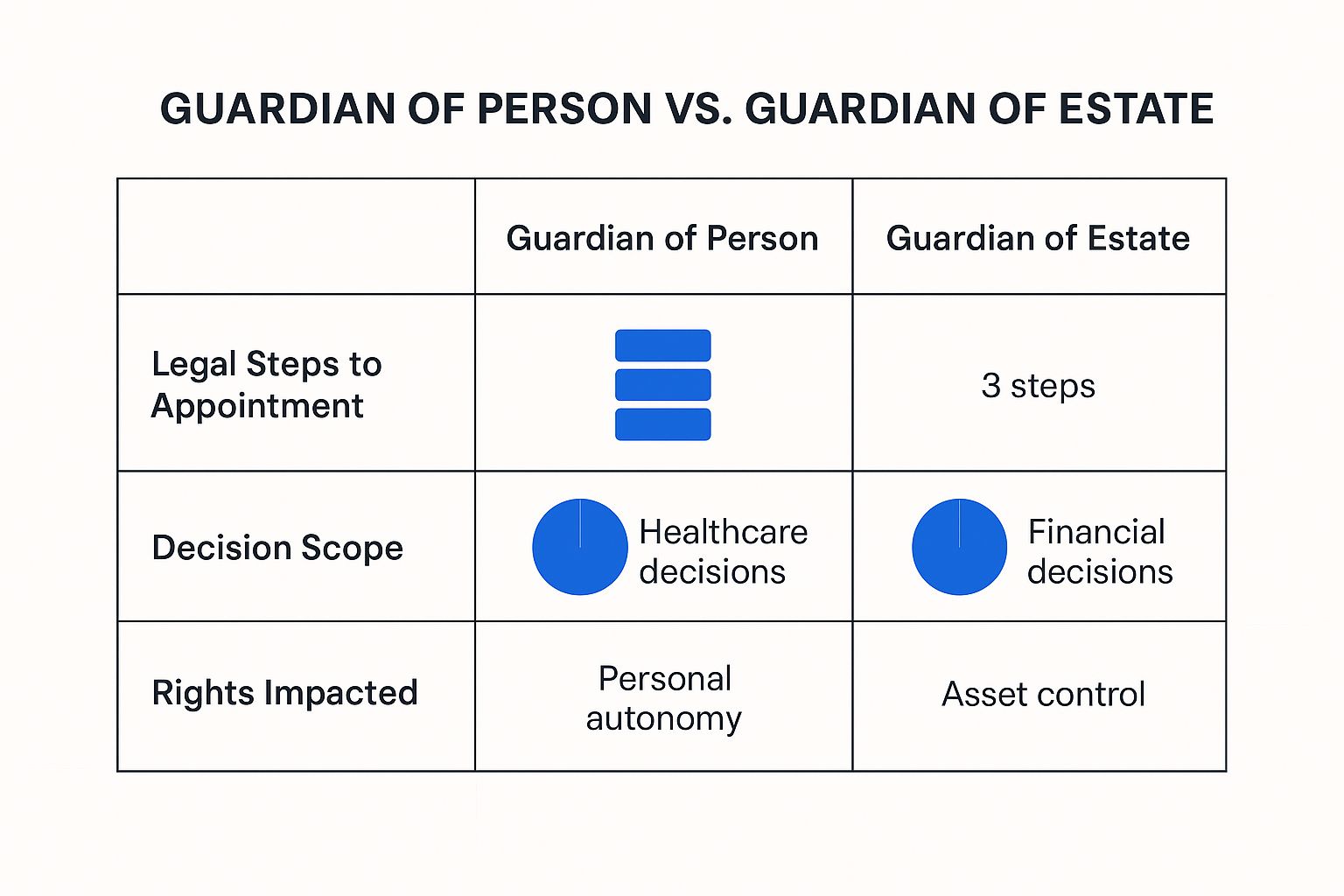
As you can see, each type of guardianship targets a different part of a person's life—one focuses on personal autonomy, and the other on financial control.
The Real-World Impact and Loss of Autonomy
Let's look at a real-world scenario. An elderly man has a severe stroke that leaves him unable to communicate or make his own decisions. He never got around to creating a Power of Attorney. Now, his children are stuck. They can't access his bank accounts to pay for his mounting medical bills or make critical healthcare choices for him because they lack the legal authority.
Their only path forward is to petition the court for guardianship.
This is exactly why guardianship exists. But for the family, the process is often emotionally draining and expensive. And for the ward, the consequences are profound. A guardianship order legally strips them of the right to decide where they live, what medical treatments they receive, and how their own money is spent.
The core function of guardianship is protection, but it comes at the cost of the ward's independence. It is a protective shield forged by the court, not a sword chosen by the individual.
Guardianship laws and their application can vary widely. For instance, the percentage of adults with intellectual and developmental disabilities under guardianship ranges from 5.5% in some states to a staggering 89.0% in others, with a national average of 41.2%. This huge gap suggests that some regions are much better at using alternatives, like a Power of Attorney, than others.
Ultimately, the guardianship process is designed to protect our most vulnerable. But its public nature, high costs, and restrictive power are exactly why proactive planning with a Power of Attorney is almost always the better choice.
If you find yourself in a situation where you need to explore this option for a loved one, it's crucial to understand the road ahead. Our detailed guide on how to get legal guardianship of a parent offers a complete roadmap to help you navigate this complex journey.
Comparing Power of Attorney And Guardianship In Detail
When you’re looking at a Power of Attorney (POA) versus a guardianship, it might seem like they serve the same purpose: protecting someone who can't make their own decisions. While that’s true on the surface, they exist in completely different worlds. The real difference comes down to their origin—one is a private choice you make for yourself, and the other is a public action taken by a court.
Getting this distinction right is the key to effective life planning. A POA is a tool you use to stay in control, created while you’re of sound mind. A guardianship is what happens when that plan was never made, forcing the court system to step in as a last resort.
Let's unpack this and see how they really stack up against each other.
The Point Of Initiation: Proactive Vs. Reactive
The single biggest difference is how each one gets started.
-
Power of Attorney (A Proactive Choice): A POA is something you do ahead of time. You have to have full mental capacity to create one, giving you the power to thoughtfully choose someone you trust—your "agent"—to act for you if you ever become unable to. It's a deliberate planning step for a future possibility.
-
Guardianship (A Reactive Court Action): Guardianship is always reactive. It only comes into play after a person has already lost the ability to make decisions for themselves. A concerned family member or friend has to petition the court, kicking off a formal legal process to have that person declared legally incapacitated.
Who Makes The Decisions: The Agent Vs. The Guardian
The person who ends up in charge is another critical distinction, and it’s all about who transfers control.
A Power of Attorney is your chosen voice, legally documented to speak for you when you cannot. A guardianship is the court’s decision, made on your behalf because your voice wasn’t recorded ahead of time.
With a POA, you select your agent. This is someone you know personally and trust implicitly—a person who gets your values and knows what you would want. This personal choice is what makes a POA so powerful; it keeps control within your trusted circle.
In a guardianship, a judge appoints the guardian. While the judge often looks to family members first, they aren't required to. The court's primary duty is to pick someone who will act in the best interests of the "ward" (the incapacitated person), and that might not be the person you would have ever chosen for yourself.
To help you see these differences side-by-side, we’ve put together a detailed comparison table.
In-Depth Feature Comparison: Power of Attorney vs. Guardianship
This table breaks down the key legal, financial, and personal differences between setting up a Power of Attorney and going through a guardianship proceeding.
| Feature | Power of Attorney | Guardianship |
|---|---|---|
| Initiation | Proactive: You create it with full mental capacity. | Reactive: Court process started after incapacity. |
| Decision-Maker | Your Choice: You appoint a trusted agent. | Court's Choice: A judge appoints a guardian. |
| Scope of Authority | Flexible & Customizable: You define the agent's powers. | Court-Supervised: Powers are limited by court order. |
| Oversight | Private: No ongoing court involvement is required. | Public & Monitored: Requires annual reports to the court. |
| Cost | Low: A one-time fee to an attorney. | High: Court fees, legal bills, and ongoing costs. |
| Privacy | Confidential: Your affairs remain private. | Public Record: The entire process is part of the public court record. |
| Revocability | Easily Revocable: You can cancel it while competent. | Difficult to End: Requires a new court order to terminate. |
As you can see, the path you take has significant long-term consequences, not just for you but for your family as well.
Scope Of Authority: Flexible Vs. Restricted
The amount of power the decision-maker holds is also worlds apart.
A POA gives you incredible flexibility. As the "principal," you get to spell out the exact authority your agent has. You can grant them broad powers to manage all your finances or restrict them to very specific tasks, like paying bills from a single bank account. This customization ensures your agent has exactly the power they need—no more, no less.
Guardianship powers, on the other hand, are court-restricted and heavily supervised. The guardian must work within the strict boundaries of the court's order. They have to file regular reports and financial inventories, and they often need a judge’s sign-off for major decisions like selling a house or making investments. This oversight is meant to be a safeguard, but it adds a significant layer of bureaucracy.
Financial And Administrative Costs
The price tag for a POA versus a guardianship is starkly different.
-
Power of Attorney (Affordable and Private): Getting a POA drafted by an attorney is a relatively low, one-time expense. Once it’s signed, there are no ongoing court costs or administrative fees. The entire arrangement is private, keeping your personal and financial business out of the public eye.
-
Guardianship (Expensive and Public): A guardianship is a public court case that can become incredibly expensive. You’re looking at initial court filing fees, lawyers' fees for multiple people, and ongoing costs for bonding and annual court reports. These expenses can drain the ward's assets, which is a major problem when you’re trying to find ways of protecting assets from nursing home costs and other long-term care bills.
Revocability And Permanence
Finally, let’s talk about your ability to change your mind. With a POA, you are always in control as long as you are mentally competent. You can revoke it at any time, usually with a simple written statement. It’s your document, and you can terminate your agent’s authority whenever you see fit.
A guardianship, however, can only be ended by a court order. This means going back to court for another legal proceeding to prove that the ward has regained their capacity—a very high bar to clear. This makes guardianship a far more permanent and restrictive situation to be in.
Choosing the Right Legal Tool for Your Situation
Knowing the textbook definitions of power of attorney and guardianship is one thing, but figuring out how they apply to your family is what really matters. This decision isn't just about legal documents; it’s about looking at your current circumstances, your hopes for the future, and the well-being of the people you love. The choice you make today can have a profound impact on your family’s financial stability and emotional health for years to come.
Let's move from theory to practice and walk through some real-world scenarios. By seeing how these legal tools actually work in everyday life, you’ll get a much clearer picture of which path best protects your autonomy and security.
Scenario 1: The Proactive Planners
Meet Sarah and Tom, a healthy couple in their late 50s. While updating their wills, their attorney stresses the importance of planning for potential incapacity. They decide to create Durable Powers of Attorney for both finances and healthcare, naming each other as primary agents and their eldest son as the backup.
Years later, Tom is diagnosed with early-onset Alzheimer's. As his condition progresses, Sarah seamlessly steps in as his agent. She uses the POA to manage their joint investments, pay medical bills from his retirement account, and make healthcare decisions based on conversations they had years ago. The entire process is private, immediate, and happens without any court interference. This allows the family to focus on Tom’s care, not on legal battles.
Scenario 2: The Unplanned Crisis
Now, let's look at David, a 45-year-old who suffers a traumatic brain injury in a car accident. He never created a Power of Attorney. His wife, Maria, is suddenly in an impossible situation. She can't access his individual bank accounts to pay the mortgage or approve a critical medical procedure because she has no legal authority to act on his behalf.
Maria is forced to petition the court for guardianship. The process is public, expensive, and emotionally exhausting. She has to hire a lawyer, pay for court-ordered medical evaluations for David, and then wait weeks for a hearing. The court eventually appoints her as his guardian, but the financial and emotional toll on their family has already been huge.
The core lesson is clear: a Power of Attorney is a tool of empowerment created by choice, while guardianship is a remedy imposed by a court out of necessity. The former preserves dignity and privacy; the latter often sacrifices both.
Scenario 3: Conflict and Complications
Finally, consider two siblings, Mark and Lisa, whose mother, Eleanor, has advancing dementia. Years ago, Eleanor created a Durable Power of Attorney and named Mark, who lives nearby, as her agent. When Eleanor can no longer manage her finances, Mark uses the POA to pay her bills and arrange for in-home care. He keeps Lisa, who lives out of state, in the loop on every decision. There’s no conflict because Eleanor’s wishes were clearly spelled out in a legal document.
Contrast that with a family where no POA exists. When their mother becomes incapacitated, the siblings can’t agree on her care. One wants to move her to a nursing home; the other insists on keeping her at home. Their dispute ends up in court, with both fighting to be appointed guardian. The legal battle permanently damages their relationship and drains their mother's savings—a painful example of how not having a POA can fuel family conflict.
This preference for less restrictive, autonomy-preserving tools isn't just a local trend. After Japan introduced its Adult Guardianship Law in 2000, for example, legal systems worldwide began favoring power of attorney to reduce the burden on courts and better protect adults with diminished capacity.
A Checklist for Your Decision
Making this decision is a crucial part of effective long-term care planning. As you get ready to speak with an elder law or estate planning attorney, use this simple checklist to think through your needs:
- Capacity: Are you (or your loved one) currently of sound mind and able to understand legal documents? If yes, a Power of Attorney is the way to go.
- Trust: Is there a person you trust completely to manage your affairs and honor your wishes? This is non-negotiable for appointing an agent.
- Family Dynamics: Are there potential conflicts among family members? A POA can prevent disputes by clearly designating one decision-maker.
- Privacy: Do you want your financial and medical affairs to remain private? A POA avoids the public court record that comes with a guardianship proceeding.
- Cost: Are you looking for an affordable way to plan for the future? A POA is significantly less expensive than a court-appointed guardianship.
If you answered "yes" to these questions, a Durable Power of Attorney is almost certainly the right choice to protect your future.
Unpacking Common Questions About POA and Guardianship
Even after you understand the core differences between a power of attorney and a guardianship, some practical questions always seem to pop up. Getting clear on these common points of confusion is often the last step needed to feel confident about the decisions you're making for your family's future.
Let's walk through some of the most frequent questions we hear and give you the straightforward answers you need.
Can Someone Challenge a Power of Attorney?
One of the biggest worries for families is whether a POA can be contested later on. The short answer is yes, a Power of Attorney can be challenged and even overturned in court. However, it's not a simple process—the person bringing the challenge has to provide solid evidence to back up their claim.
A legal challenge usually comes from a family member or another concerned party who believes the document is invalid or that the agent is misusing their power. To have any chance of success, they have to prove specific legal grounds.
Common reasons a court might throw out a POA include:
- Lack of Capacity: The challenger must prove the person signing the document wasn't of sound mind and didn't truly understand what they were agreeing to.
- Undue Influence or Coercion: This means showing that the person was manipulated, threatened, or forced into signing the POA against their own free will.
- Fraud: This involves proving that the person was tricked about the document they were signing.
- Agent Misconduct: If it can be shown that an agent is abusing their power—like stealing money or neglecting the person they're supposed to be helping—a court can step in, remove them, and cancel their authority.
The legal bar for proving things like incapacity or undue influence is set quite high. A properly drafted and notarized Power of Attorney, created when the principal is clearly competent, is your best defense against future challenges.
What if the Chosen Agent Can't Serve?
Another critical "what if" scenario is what happens when your designated agent can no longer handle the job. Life is unpredictable. An agent could pass away, become seriously ill, or simply find the responsibility too overwhelming. If you don't have a backup plan, your POA could become useless right when it's needed most.
This is exactly why naming successor agents is so crucial. When you create your POA, you should always name at least one alternate agent, and ideally two. These individuals are listed in order of succession and can step into the role if the primary agent is unable to serve, preventing any gaps in managing your affairs. It's a simple step that provides an essential safety net.
Can a Guardianship Override a Power of Attorney?
Finally, people often wonder which document wins out if both exist. In nearly all situations, the answer is a firm yes—a court-ordered guardianship will override an existing Power of Attorney.
If a judge determines that a guardianship is necessary, the court order that establishes it will supersede the POA. This often happens if an agent is abusing their authority or the POA document is no longer sufficient to protect the individual. The court-appointed guardian's authority takes over completely, and the POA agent's powers are terminated. This really highlights the comprehensive and final nature of a court's decision in these matters.
Navigating these complex legal decisions can feel like a heavy burden, but you don't have to carry it alone. If you need compassionate, professional support for a loved one, NJ Caregiving provides expert in-home care services to ensure their safety and well-being. Learn more about how our dedicated caregivers can help your family in Princeton, NJ, and the surrounding areas.
