
When you're trying to figure out the right kind of care, the difference between a Certified Nursing Assistant (CNA) and a Home Health Aide (HHA) often comes down to two things: their training and where they work. CNAs have more extensive medical training and are usually found in clinical settings like hospitals. HHAs, on the other hand, focus on personal care right in a client's home and have a different certification path.
Ultimately, your choice hangs on whether the need is primarily medical support or personal assistance with daily life.
CNA vs HHA: An Immediate Comparison
While both Certified Nursing Assistants and Home Health Aides are absolutely vital to providing great care, their roles are shaped by very different training paths and professional duties. Getting a handle on these differences is the first step for families looking for the right support and for anyone considering a career in caregiving.
A CNA goes through a state-approved training program and has to pass a formal certification exam. This process prepares them to handle basic medical tasks, always under the supervision of a licensed nurse. In contrast, an HHA’s training is typically less intensive, zeroing in on the skills needed to help clients with daily activities in the comfort of their own home.
This infographic gives a great visual breakdown of where their duties overlap and where they split.
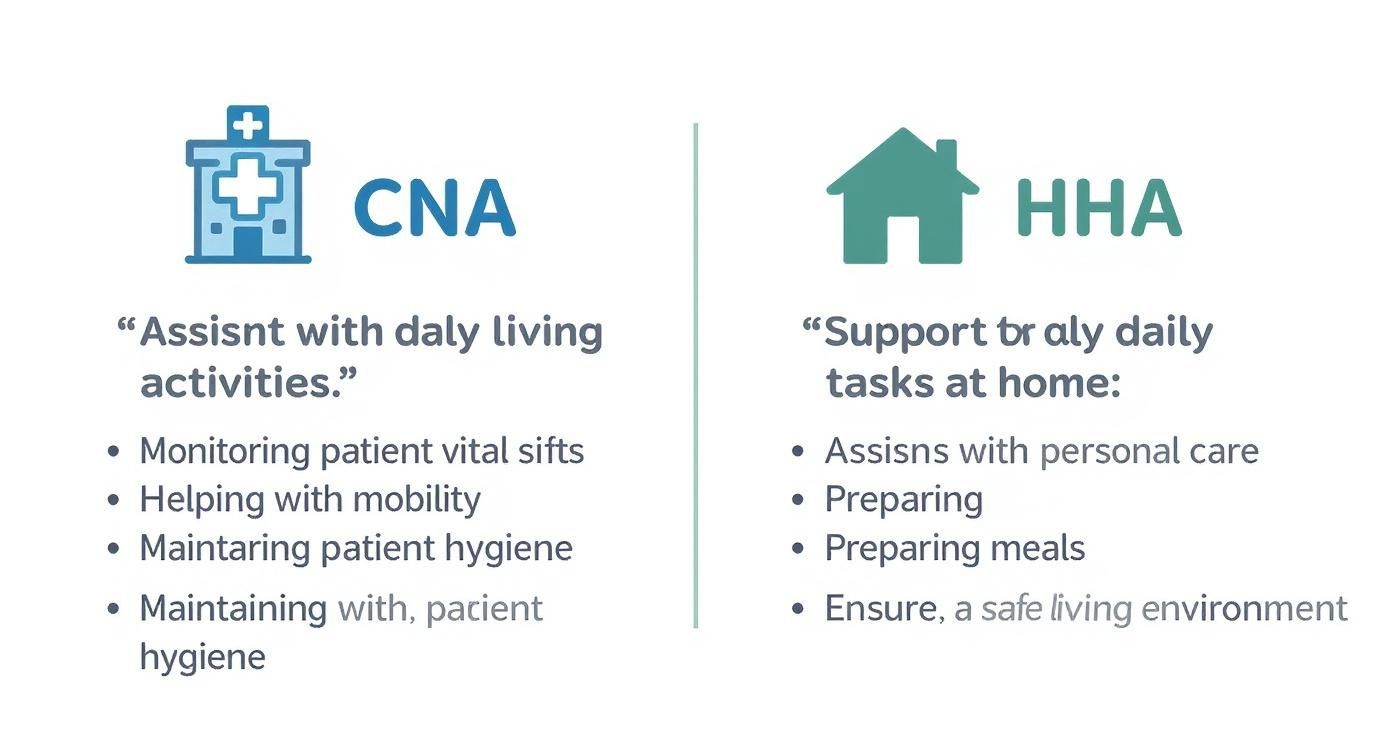
As you can see, the CNA is very much part of a larger medical team, while the HHA provides more holistic, one-on-one support right at home.
Key Differences at a Glance
To make the CNA vs. HHA decision a little easier, it helps to see their core responsibilities side-by-side. The work environment, required skills, and even earning potential can be quite different. One path is geared toward clinical healthcare teams, while the other is all about personalized, in-home assistance.
For many families, the lines can get blurry, especially when care is needed at home. It's really important to understand the nuances between home health and home care to make sure your loved one gets exactly what they need.
The biggest differentiator is the state licensure and what it allows them to do. A CNA’s certification lets them perform medically-focused tasks like taking vital signs, while an HHA's role is built around personal care, safety, and companionship.
Before we dive deeper into the day-to-day duties and career paths, this table offers a clear, high-level summary of what sets these two roles apart.
Key Differences Between CNA and HHA Roles at a Glance
| Attribute | Certified Nursing Assistant (CNA) | Home Health Aide (HHA) |
|---|---|---|
| Primary Workplace | Hospitals, nursing homes, long-term care facilities | Client's private residence, assisted living |
| Core Duties | Monitoring vital signs, assisting nurses, patient mobility | Personal care (bathing, dressing), light housekeeping |
| Training Level | State-approved certification program and exam (75+ hours) | Shorter training program, often state-certified |
| Medical Tasks | Can perform basic medical tasks under nurse supervision | Generally limited to non-medical personal care |
| Supervision | Supervised by a Registered Nurse (RN) or LPN | May be supervised by a nurse or agency coordinator |
This table gives you the foundational knowledge to start with. In the sections ahead, we’ll explore the details of their training, daily responsibilities, and career opportunities more closely.
Navigating Training and Certification Requirements
The paths to becoming a Certified Nursing Assistant (CNA) and a Home Health Aide (HHA) are fundamentally different. These distinctions in training are what really shape their professional skills and the kind of care they can provide. While both jobs require a ton of compassion and dedication, the educational journey for a CNA is much more medically intensive and standardized.
Understanding these training differences is key to the whole "CNA vs HHA" conversation because it explains why their day-to-day responsibilities are so distinct. A CNA's education prepares them to work as part of a clinical team, while an HHA's training is laser-focused on providing safe, effective support right in someone's home.
The Certified Nursing Assistant Educational Path
To become a CNA in New Jersey, you have to complete a state-approved Nurse Aide in Facilities Training and Competency Evaluation Program (NATCEP). It’s a pretty rigorous and structured program designed to ensure a high level of competency in patient care.
While federal law requires a minimum of 75 hours of training, New Jersey ups the ante, mandating a more comprehensive 90-hour program. This breaks down into two core parts:
- 50 hours of classroom instruction: This covers the heavy-hitting topics like anatomy, physiology, infection control, patient rights, and fundamental nursing skills.
- 40 hours of hands-on clinical practice: This is where the rubber meets the road. Students get real-world experience in a supervised setting, like a nursing home, practicing their skills on actual patients.
Once the program is complete, aspiring CNAs must pass the state competency exam, which has both a written test and a practical skills demonstration. Only after passing this exam are they added to the New Jersey Nurse Aide Registry and can officially call themselves a Certified Nursing Assistant.
A CNA's certification isn't just a one-and-done deal. They have to keep up with continuing education and work requirements to maintain their status, ensuring their skills stay sharp and current.
This structured, medically-focused training is exactly what gives CNAs the legal green light to perform tasks like taking vital signs and helping with medical equipment—always under the direct supervision of a licensed nurse.
The Home Health Aide Certification Process
The journey to becoming a certified HHA in New Jersey, while also regulated by the state, is built with a different goal in mind: preparing people for the unique challenges of in-home care. The training is managed by the New Jersey Board of Nursing and is tailored to personal care and home safety, not clinical medical procedures.
The state mandates 76 hours of training for HHAs, just a bit less than for CNAs. This program is typically structured like this:
- 60 hours of classroom/online theory: Here, the curriculum focuses on personal care skills (like bathing, dressing, and grooming), nutrition, creating a safe home environment, handling emergencies, and communicating well with clients and their families.
- 16 hours of supervised practical training: This hands-on component makes sure aides can confidently and safely perform their duties in a home-like setting.
After finishing the training, HHA candidates need to pass a competency evaluation and apply for certification from the NJ Board of Nursing. If you want a complete breakdown of this process, our guide on New Jersey home health aide requirements has all the details.
The main takeaway here is that HHA training is specialized for the home. It gives aides the skills to manage activities of daily living and maintain a safe, supportive atmosphere for clients, rather than performing the clinical tasks reserved for CNAs. This difference in educational focus is the primary reason their roles, responsibilities, and work environments are so distinct.
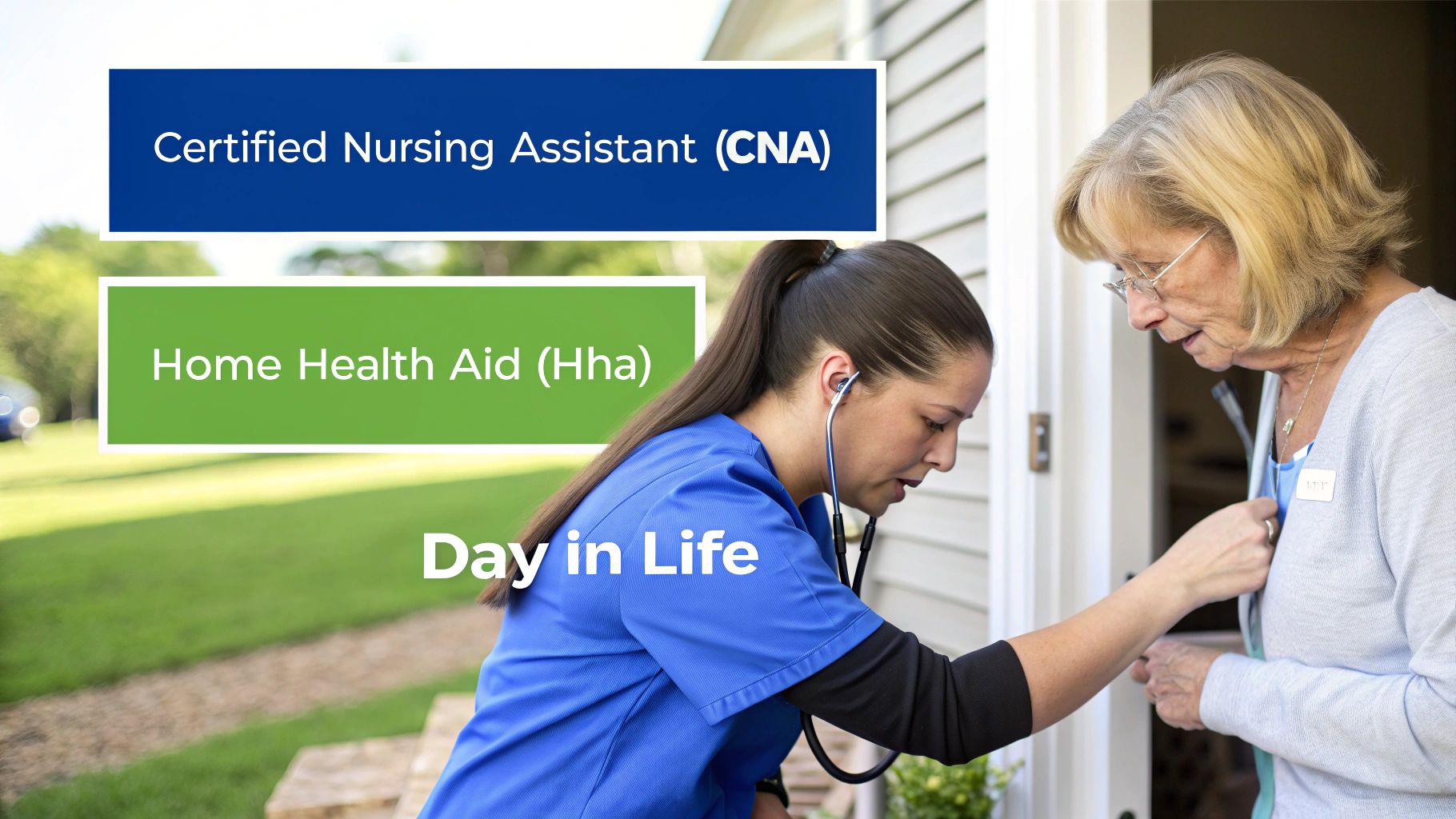
A Day in the Life: Comparing Duties and Work Environments
To really get a feel for the difference between a Certified Nursing Assistant (CNA) and a Home Health Aide (HHA), you have to picture their typical workdays. While both jobs are built on a foundation of compassionate care, the setting and the specific tasks create two totally different professional experiences. The flow of their day, what they do, and how much medical work is involved are all shaped by where they work.
A CNA's day is usually fast-paced and happens within a structured clinical place like a hospital, rehab center, or nursing home. They are a critical piece of a larger healthcare team, working directly under the watch of a Registered Nurse (RN) or Licensed Practical Nurse (LPN). Being part of a team like this is essential for managing the complex needs of multiple patients at once.
In contrast, an HHA spends their day in a client's own home. This environment requires a much more personal and independent approach. The HHA is often the main support system for one person, focusing on one-on-one care and helping around the house.
A CNA's Shift in a Clinical Setting
Picture a CNA starting their shift at a busy nursing facility. Their day kicks off with a handover report from the nurses on the previous shift, where they get updates on the condition of their assigned patients. The rest of the shift is a constant cycle of scheduled tasks and responding to needs as they arise.
A typical morning for a CNA might look something like this:
- Making Rounds: The CNA goes from room to room, helping residents with their morning routines—getting out of bed, bathing, dressing, and grooming.
- Vital Signs Monitoring: They are trained to take and record vital signs—blood pressure, heart rate, temperature, and breathing rate. Any unusual readings are reported to the supervising nurse right away.
- Documentation: Every little thing, from how much a patient drinks to changes in their skin, has to be carefully noted in patient charts. This information is crucial for the nursing team to plan care.
- Mobility Assistance: They help patients move around safely, whether that means transferring them from a bed to a wheelchair, assisting with walkers, or helping with physical therapy exercises.
Throughout the day, a CNA is on their feet, answering call bells, helping with meals, and making sure the patient's environment is clean and safe. They are truly the eyes and ears of the nursing staff, providing that essential hands-on care. To get an even clearer picture, you can explore detailed breakdowns of the daily duties and work environments of Nursing Assistants (CNAs).
An HHA's Day in a Client's Home
Now, let's switch gears and imagine an HHA arriving at their client's front door. The vibe is immediately different—less clinical, more personal. The HHA’s goal is to help one person live independently and maintain their quality of life in the comfort of their own home. The relationship is often deeper, with a strong focus on companionship.
A day in the life of an HHA often includes:
- Personal Care Assistance: Helping the client with bathing, dressing, and personal hygiene in a private and respectful way.
- Meal Preparation: Planning and cooking healthy meals that follow any dietary rules, and often sitting down to eat with the client.
- Light Housekeeping: Common tasks like laundry, tidying up living spaces, and washing dishes help keep the home safe and comfortable.
- Errands and Appointments: An HHA might drive the client to the doctor, pick up prescriptions, or go grocery shopping.
- Companionship: This might be the most important part of the job. HHAs provide social interaction, whether it’s through conversation, playing games, or going for a walk.
The core distinction lies here: CNAs perform medically-oriented tasks as part of a clinical team, while HHAs deliver holistic, personal support within a client's residence. The CNA's role is clinical and procedural, whereas the HHA's is personal and environmental.
This fundamental difference in setting and duties has a direct impact on job opportunities and pay. CNAs, who work in facilities with more medically complex patients, often see higher average wages, with some earning $20 to $25 per hour with specialized training. HHAs, on the other hand, usually have more flexible schedules but a slightly lower hourly rate. Our detailed caregiver job description provides more context on the skills needed for both of these vital roles.
Analyzing Salary Potential and Career Advancement
When you're deciding between a career as a CNA or an HHA, the conversation almost always turns to pay and long-term opportunities. It's a critical piece of the puzzle. While both roles are foundational to healthcare, their salary structures and career ladders look quite different, largely because of their unique training requirements and typical work environments.
Right off the bat, the more intensive medical training a CNA undergoes usually translates into a higher starting wage. But the full picture is more nuanced, with factors like your location, years of experience, and specific employer playing a huge role in what you can expect to earn. Let's break it down.
Comparing Pay Scales and Influencing Factors
So, where does the real difference in pay between CNAs and HHAs come from? It boils down to their work settings and the complexity of their duties. Certified Nursing Assistants, with their state-mandated training and ability to handle basic medical tasks, typically command a higher wage. They’re often found in fast-paced environments like hospitals and nursing homes where patient needs are more acute, which justifies better pay.
Home Health Aides, on the other hand, provide incredibly valuable personal care, but their scope is non-clinical. Because their training is less intensive and their focus is on non-medical support, their average hourly rate tends to be a bit lower.
To put some numbers to it, recent U.S. data from 2024 shows that CNAs earn an average of $41,270 per year, which is about $19.84 per hour. In contrast, Home Health Aides earn a lower average salary of around $34,990 annually, or $16.82 per hour. This gap really highlights the differences in their day-to-day responsibilities and work settings.
Of course, several key factors can move those numbers up or down for both roles:
- Geographic Location: Wages can vary quite a bit across New Jersey, with pay in urban centers often being higher than in more rural areas.
- Experience Level: A seasoned CNA or HHA with years of hands-on experience is in a much better position to negotiate higher pay than someone just starting out.
- Work Setting: A CNA working in a specialized hospital unit will almost always earn more than one in a standard long-term care facility. Likewise, an HHA working for a private, high-needs client might earn more than one employed through a large agency.
Mapping Out Career Progression
Beyond the starting salary, it’s just as important to think about where each path can take you. Both CNA and HHA roles are fantastic entry points into the broader healthcare industry, but they tend to fork into different long-term career tracks.
The CNA certification is widely seen as a direct stepping stone toward a nursing degree. The clinical experience you gain as a CNA is invaluable and is often a prerequisite for getting into competitive nursing programs.
For many healthcare professionals, the CNA role is the first rung on a ladder that leads to becoming a Licensed Practical Nurse (LPN) or a Registered Nurse (RN). The skills learned directly translate to more advanced medical responsibilities.
An HHA career path, meanwhile, often leads to specialization and leadership within the home care world. Experienced HHAs can move into roles with more responsibility, such as:
- Care Coordinator: Managing schedules, client care plans, and a team of fellow aides.
- Specialized Aide: Focusing on specific conditions like dementia or hospice care, which requires additional training and usually comes with higher pay.
- Agency Supervisor: Overseeing the quality of care provided by other HHAs and ensuring compliance.
Both paths are expected to see significant demand in the coming years.
Projected Job Growth for CNAs and HHAs (2022-2034)
The U.S. Bureau of Labor Statistics projects strong growth for both professions over the next decade, driven by an aging population and increased demand for healthcare services. This table gives a clear picture of what to expect.
| Profession | Projected Growth Rate | Annual Job Openings |
|---|---|---|
| CNA (Nursing Assistant) | 4% (As fast as average) | About 177,900 |
| HHA (Home Health Aide) | 22% (Much faster than average) | About 615,000 |
As you can see, while both roles are stable, the projected growth for HHAs is exceptionally high, reflecting the growing preference for aging in place. This high demand can lead to excellent job security and opportunities.
Ultimately, both careers offer stability and avenues for growth. For anyone looking to get into or advance in a CNA or HHA role, a polished resume is key. You might want to explore resources that offer helpful medical resume examples and templates to make your application stand out. Whether you're drawn to the clinical setting of a CNA or the personal connection of an HHA, you're building a solid foundation for a rewarding future in healthcare.
How to Choose the Right Path for You
Deciding between a Certified Nursing Assistant (CNA) and a Home Health Aide (HHA) is a huge choice, whether you're mapping out a career or finding care for a family member. The right answer isn't about which one is "better"—it's about which one fits the specific situation. This goes way beyond a simple list of duties. It’s about personality, the preferred work environment, and, most importantly, the exact level of care someone needs.
For anyone looking to start a career in caregiving, the CNA vs. HHA question is about matching your personal strengths with your long-term goals. For families, it’s about getting the right skills for a loved one to ensure they are safe, comfortable, and living their best life.

Guidance for Aspiring Professionals
If you’re thinking about one of these rewarding careers, the first step is a little self-reflection. Think about the environment where you feel most energized, your communication style, and where you see yourself in five years. One path puts you in a structured, clinical setting as part of a team, while the other gives you the autonomy to build a deep, one-on-one relationship.
The good news is that demand for both roles is booming, largely thanks to an aging population. The job outlook for CNAs is solid, with a projected growth of 4% to 5% between 2022 and 2032. But the need for HHAs is exploding, with an expected growth of 17% from 2024 to 2034, showing just how much people value the option to receive care at home. You can dive deeper into these trends with this CNA job outlook analysis.
Consider the CNA Path If…
The CNA role is a fantastic fit for people who are drawn to the medical side of care and enjoy the buzz of working with a larger healthcare team. It's a job for those who are detail-oriented and can handle a fast-paced day.
- You thrive in structured, clinical settings. If you like the energy of hospitals, nursing homes, or rehab centers and work well under the direct supervision of nurses, the CNA role will feel like a natural fit.
- You see this as a stepping stone to nursing. Becoming a CNA is a well-respected launchpad for a career as a Licensed Practical Nurse (LPN) or Registered Nurse (RN). The hands-on clinical experience you’ll gain is invaluable.
- You are comfortable with hands-on medical tasks. You'll be responsible for monitoring vital signs, helping with medical equipment, and carefully documenting patient information.
Consider the HHA Path If…
The HHA role is perfect for compassionate people who value their independence and want to form a close, personal bond with their clients. This path is less about clinical tasks and more about providing holistic, personal support.
- You prefer working one-on-one. If you get real fulfillment from building a deep, trusting relationship with a single person in their own home, the HHA role offers that unique connection.
- You value autonomy and a flexible schedule. As an HHA, you often have more say over your daily routine and work far more independently than a CNA in a large facility.
- You enjoy a variety of non-medical tasks. Your day is never boring. It could involve anything from preparing meals and light housekeeping to simply providing companionship or running errands.
Guidance for Families Seeking Care
When your family needs to hire help, the choice between a CNA and an HHA comes down to one critical question: What level and type of care does your loved one truly need? Getting this assessment right is the key to ensuring their safety and well-being, not to mention being a good steward of your finances.
Choosing incorrectly can lead to gaps in care or paying for skills you don't need. Understanding the specific situations where each professional shines will help you make a confident, well-informed decision.
The most important question a family can ask is: "Does my loved one require medical monitoring and assistance, or do they primarily need help with personal care and daily living?" The answer will immediately clarify whether a CNA or an HHA is the better fit.
Let’s walk through a few common scenarios to see which makes more sense.
When to Hire a Certified Nursing Assistant
A CNA's medical training becomes non-negotiable when a loved one's health requires clinical oversight. Their ability to track changes and report them to a supervising nurse is what makes them essential in these cases.
- Post-Operative or Post-Hospitalization Care: If your family member is coming home after surgery or a hospital stay, a CNA can monitor their vital signs, assist with wound care (under nurse direction), and help manage mobility challenges safely.
- Chronic Illness Management: For people with ongoing conditions like congestive heart failure, COPD, or diabetes, a CNA can track symptoms, report any changes to a healthcare provider, and assist with medical equipment like oxygen tanks.
- Complex Mobility Needs: When someone needs help transferring with specialized equipment, like a Hoyer lift, a CNA’s training is critical to performing these tasks without causing injury.
When to Hire a Home Health Aide
An HHA is the ideal—and more cost-effective—choice when the main goal is providing non-medical support to help someone live safely and comfortably at home. Their work is all about personal care and companionship.
- Elder Companionship and Safety: For seniors who are feeling lonely or might be at risk of falling, an HHA provides crucial social interaction and a watchful eye to keep them safe.
- Assistance with Activities of Daily Living (ADLs): If your loved one is medically stable but needs help with bathing, dressing, grooming, or preparing meals, an HHA has the perfect skill set.
- Support for Dementia or Alzheimer's: In the early to mid-stages of dementia, an HHA can provide routine, companionship, and help with daily tasks in a familiar environment, which can be incredibly comforting and beneficial.
Your Questions Answered: CNA vs. HHA
Even after laying out the differences, you probably still have a few questions rolling around in your head. It’s completely normal. Choosing between these roles—whether for your own career or for a loved one’s care—involves thinking through the practical, day-to-day realities of the job.
Let’s tackle some of the most common questions we get.
Can a CNA Work as an HHA in New Jersey?
This is a big one, and the short answer is yes, a New Jersey CNA can absolutely work as an HHA. In fact, their training is more extensive and medically oriented, so it covers everything an HHA does and then some.
That said, it’s not always a simple one-for-one swap. A home care agency might ask a CNA to go through a short “bridge” program. This isn’t starting from scratch; it’s usually just a few hours of training to get them up to speed on the specifics of working in a private home, like:
- Safety and emergency plans unique to a home setting.
- Understanding a client's rights within their own residence.
- The personal dynamics of providing one-on-one care in someone's private space.
The Bottom Line: A CNA's training is considered a higher level of certification, but agencies want to ensure they’re prepared for the transition from a clinical facility to a client's home. It’s always best to ask the hiring agency about their specific policies.
This ability to "cross over" gives CNAs a fantastic amount of career flexibility, opening doors in both busy medical facilities and more intimate home care environments.
Which Role Offers More Scheduling Flexibility?
When it comes to scheduling, the Home Health Aide (HHA) role is the clear winner for flexibility. This is one of the most significant lifestyle differences between the two paths and a major draw for people choosing home care.
HHAs typically work with clients in scheduled blocks of time—maybe a few hours each morning, an afternoon shift, or even a live-in arrangement. This structure is perfect for someone who needs to build a work schedule around school, family, or other commitments. Agencies are often pros at matching an aide's availability with a client's needs.
CNAs, on the other hand, usually work in places that never close, like hospitals or nursing homes. Their schedules tend to be much more structured, built around standard 8, 10, or 12-hour shifts that often include nights, weekends, and holidays. It offers predictability and steady hours, but far less of the day-to-day wiggle room you find with HHA work.
What Are the Biggest Challenges for Each Role?
Both of these careers are incredibly meaningful, but they each come with a unique set of challenges that are important to face with eyes wide open.
Common Challenges for a CNA:
- A High-Paced, High-Stress World: Clinical settings are demanding. A CNA might be responsible for a dozen patients at once, all with complex needs, in an environment where things can change in an instant.
- The Physical Toll: The job is physically tough. It involves a lot of lifting, turning patients, and spending long shifts on your feet, which can lead to burnout and strain.
- The Emotional Weight: You're on the front lines, caring for people who are very sick or nearing the end of their lives. That can be emotionally draining.
Common Challenges for an HHA:
- Working in Isolation: Unlike a CNA who is surrounded by a team of nurses and doctors, an HHA spends most of their time working alone in a client’s home. It requires a lot of independence and can sometimes feel isolating.
- Setting Professional Boundaries: When you work in someone’s personal space, the lines between caregiver, friend, and employee can get blurry. Knowing how to maintain a professional-yet-caring relationship is a crucial skill.
- Adapting to Different Environments: Every home is a new workplace. HHAs have to be incredibly adaptable, ready to navigate different family dynamics, living situations, and household routines with each new client.
Thinking through these hurdles can help you figure out which path is a better fit for your own personality, resilience, and what you want out of your work life.
Making the right choice for in-home care starts with a conversation. At NJ Caregiving, our team is here to help you understand your options and create a personalized care plan that fits your family's unique needs in Princeton, Hamilton, and throughout Mercer County. Contact us today to learn how we can support you.
