
When a loved one starts to struggle with their daily routine, an activities of daily living assessment is often the first step toward getting them the right help. This isn’t a test to pass or fail. Think of it more as a collaborative conversation—a way to get a clear, honest picture of how well a person can manage fundamental self-care tasks on their own.
The whole point is to identify where a little extra support could make a world of difference in their safety and independence.
What an ADL Assessment Reveals About Daily Life
An Activities of Daily Living (ADL) assessment is like a friendly check-up for life's most essential routines. For families across New Jersey, it's a crucial tool for understanding what a loved one truly needs and building a care plan that actually works.
It helps answer those tough questions that keep you up at night: Can Mom still get in and out of the shower safely? Is Dad having trouble getting dressed in the morning? Is preparing a simple meal becoming too much of a challenge? Getting straightforward answers is the key to preserving their quality of life.
Why This Evaluation Is So Important
The insights you get from an activities of daily living assessment are foundational. They tell you exactly what level of support is needed, whether it's just a few hours of help each week or more hands-on, daily assistance. The evaluation zeros in on those core self-care skills we all take for granted until they become difficult.
Some of the key areas examined include:
- Personal Hygiene: The ability to bathe, groom, and manage oral and hair care without assistance.
- Dressing: Being able to choose appropriate clothes and put them on or take them off.
- Eating: The ability to feed oneself (this doesn't necessarily include cooking the meal).
- Toileting: Managing continence and cleaning oneself after using the restroom.
- Transferring: The physical strength and coordination to move from a bed to a chair or wheelchair.
At its heart, this assessment is a conversation. It's about identifying strengths and pinpointing specific challenges. The outcome isn't a grade, but a practical roadmap for providing compassionate, targeted care that respects a person's dignity.
By understanding these core functions, you and your healthcare team can make truly informed decisions. Someone struggling with dressing might just need a caregiver's help in the mornings. A person having trouble with transferring, on the other hand, might need mobility aids or more professional assistance to prevent a fall.
To get a better feel for these tasks, you can explore detailed activities of daily living examples and see how they play out in real life. Ultimately, this evaluation empowers families to be proactive, addressing needs before they turn into a crisis and ensuring their loved one can live as safely and comfortably as possible.
Understanding ADLs vs IADLs
To get a true sense of someone's ability to live independently, we need to look at two different, but connected, types of life skills. Think of them as layers. The first layer covers the absolute basics of self-care, while the second involves the more complex tasks needed to manage a household and navigate the community.
It’s so important to distinguish between them because a person can often handle one category just fine while struggling significantly with the other. This detailed insight is what allows us to create a care plan that’s actually helpful, not just a one-size-fits-all guess.
ADLs: The Foundation of Self-Care
Activities of Daily Living, or ADLs, are the absolute must-do skills for taking care of your own body. These are the fundamental tasks we all perform every day to manage our immediate personal needs. If someone can't perform these activities, they simply can't live safely on their own without support.
These foundational tasks include:
- Eating: The physical act of getting food from a plate to your mouth.
- Bathing and Hygiene: Keeping clean, brushing teeth, and general grooming.
- Dressing: Choosing appropriate clothes and being able to put them on, including managing buttons or zippers.
- Toileting: Getting to and from the bathroom, using it, and cleaning up afterward.
- Transferring: Moving from one position to another, like getting out of bed and into a chair.
If you think of a person's independence as a house, ADLs are the concrete foundation. Any cracks or weak spots here put the entire structure at risk.
This infographic gives a great visual of what an ADL assessment really aims to do.
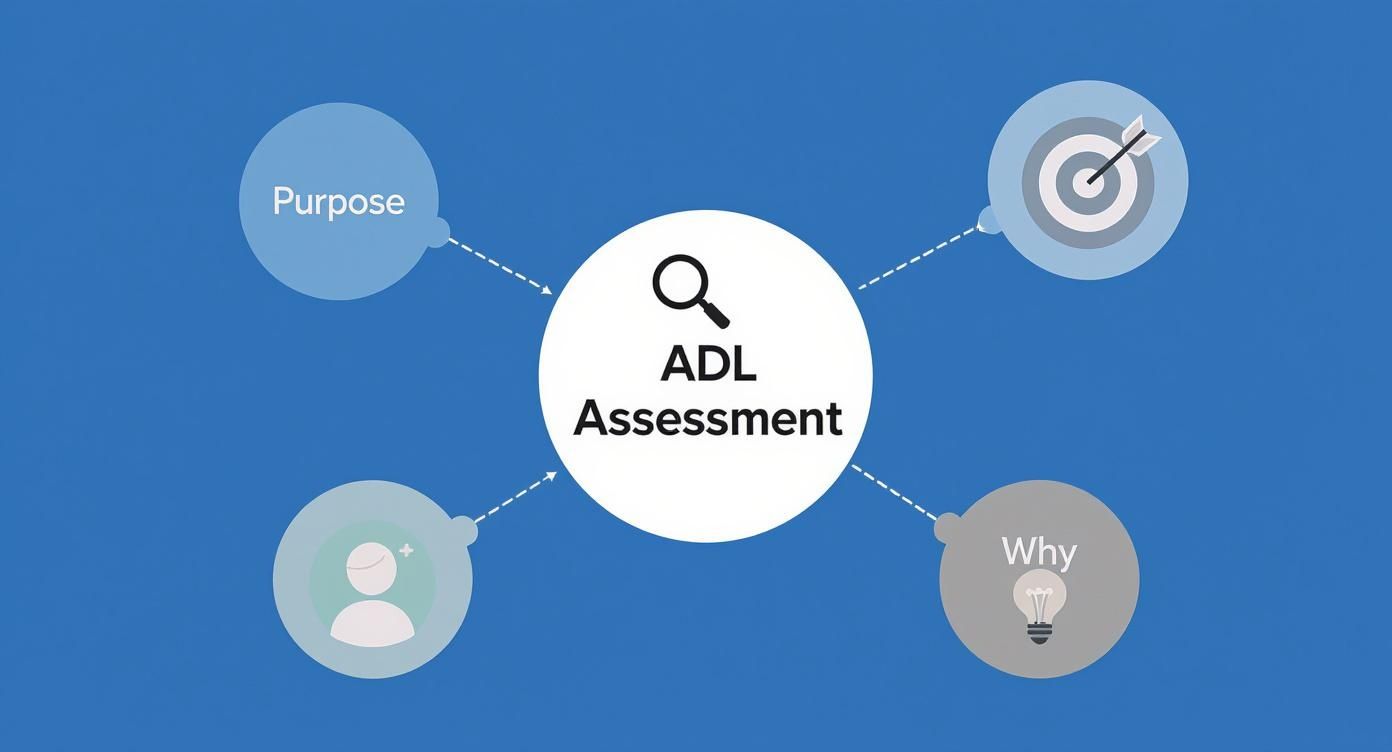
As you can see, the goal is to pinpoint exactly who needs help and what kind of help they need, which becomes the blueprint for a personalized care strategy.
IADLs: The Framework for Independent Living
Instrumental Activities of Daily Living, or IADLs, are the next layer up. These are the more complicated tasks a person needs to master to live independently in their home and community. While they aren't strictly essential for basic survival, they are absolutely vital for running a household and managing personal affairs.
IADLs are the bridge between just getting by and truly living independently. They're the skills that allow someone to not just survive, but to thrive as a member of their community.
Often, trouble with IADLs is the first sign that someone might need a bit more support, long before they have issues with basic ADLs. Maybe they can still dress and feed themselves perfectly, but keeping track of bills or getting to the grocery store has become a real struggle. Noticing these early flags is key. You can explore a deeper dive into what instrumental activities of daily living are to get a better handle on these nuances.
This clear distinction between skill sets wasn't always so well-defined. Healthcare professionals and policymakers realized that without a standard way to measure abilities, planning for care was chaotic. The big push for standardization kicked off around 1988, when federal agencies finally tackled the major inconsistencies in how functional ability was being measured.
Comparing ADLs and IADLs
Putting both categories side-by-side really helps clarify their different roles. The following table breaks it down with some clear-cut examples, showing how a complete activities of daily living assessment looks at both sides to build a holistic picture of a person's needs.
| Category | Description | Examples |
|---|---|---|
| ADLs (Basic Self-Care) | Core tasks essential for survival and managing one's own body. | Bathing, dressing, eating, toileting, transferring. |
| IADLs (Independent Living) | Complex tasks required to manage a household and live in the community. | Cooking, managing finances, transportation, shopping, medication management. |
This side-by-side view makes it easy to see why evaluating both ADLs and IADLs is essential. It's the only way to understand the full scope of support a person might need to live safely and with dignity at home.
Key ADL Assessment Tools and What They Measure
When a healthcare professional sits down to figure out what kind of support a person needs, they aren't just guessing. They rely on standardized, well-respected tools to get an objective and complete picture. Think of these tools less like a test and more like different lenses, each designed to bring a specific part of a person's abilities into sharp focus.
Just like a doctor uses both a stethoscope and a blood pressure cuff, a care manager chooses the right assessment tool for the job. Some give a quick snapshot, while others create a detailed blueprint for a care or rehabilitation plan. Getting to know the "personality" of each tool helps you understand why one might be used for your loved one over another.
The Katz Index of Independence in ADLs
The Katz Index of Independence in Activities of Daily Living is one of the originals and is still widely used because it's so direct. It’s like a foundational check-up that quickly sizes up a person's ability to handle the six most essential self-care tasks. The scoring is a simple yes/no for each activity, which gives a clear, high-level view of where they stand.
The six core ADLs measured are:
- Bathing
- Dressing
- Toileting
- Transferring (moving from a bed to a chair, for example)
- Continence
- Feeding
Scoring is straightforward: your loved one gets one point for each task they can manage on their own. A score of 6 means they are fully independent, while a score of 0 points to a high level of dependency. This simplicity makes it a great starting point for screenings in hospitals or rehab facilities.
Here's a visual example of how the Katz Index is often laid out.
As you can see, the evaluation starts with more complex activities like bathing and works its way down to the most fundamental ones, like feeding.
The Barthel Index
If the Katz Index is a quick check-up, the Barthel Index is more like a detailed diagnostic test. It also looks at basic ADLs, but it provides a much more nuanced picture of a person's abilities. Instead of a simple yes/no, it uses a wider scoring range to capture the degree of independence.
This tool looks at ten key areas and assigns weighted points based on how much help is needed. For instance, being completely independent in bathing is worth more points than needing a little help to get it done. This detailed scoring, usually on a scale of 0 to 100, is incredibly valuable in rehabilitation settings. It helps therapists track small but meaningful progress over time, which can be a huge motivator.
The Barthel Index helps answer not just "Can they do it?" but "How well can they do it?" This detailed insight is perfect for measuring progress after a stroke, injury, or surgery, showing how therapy is directly impacting daily life.
By capturing these subtle improvements, the Barthel Index provides a dynamic picture of recovery, helping care teams fine-tune therapy to maximize a person's potential to live independently again.
The Lawton IADL Scale
While the Katz and Barthel scales focus on basic self-care, the Lawton Instrumental Activities of Daily Living (IADL) Scale zooms out to look at the bigger picture. It's more of a "community living scorecard," evaluating the complex skills someone needs to manage a household and live safely on their own.
This assessment is critical because a person might be able to handle all their basic ADLs but still be unsafe at home if they can't manage their IADLs. The Lawton Scale checks abilities in eight key areas:
- Using the telephone
- Shopping for groceries or necessities
- Preparing meals
- Housekeeping
- Doing laundry
- Getting around (transportation)
- Managing their own medications
- Handling finances
A low score here can be an early red flag that someone needs support, even if they seem fine on the surface. For example, not being able to manage medications or pay bills can lead to serious problems quickly. To get a better feel for this part of an evaluation, it can be helpful to review a home health care assessment form to see what kinds of questions are asked. Understanding a person’s IADL abilities is the key to creating a support system that truly helps them stay independent at home.
To help you keep these tools straight, here’s a quick overview of how they compare.
Overview of Common ADL Assessment Scales
| Assessment Tool | Primary Focus | Scoring Summary | Best For |
|---|---|---|---|
| Katz Index | Basic self-care (the 6 core ADLs). | Simple "yes/no" scoring (0-6 points). Quick and easy to administer. | Initial screenings; getting a high-level view of dependency in hospitals or long-term care. |
| Barthel Index | Nuanced self-care ability. | Weighted scoring system (0-100 points) that measures degrees of independence. | Rehabilitation settings; tracking functional improvements after an injury, stroke, or surgery. |
| Lawton IADL Scale | Complex skills for independent community living. | Assesses 8 domains of instrumental activities, with scores indicating level of assistance needed. | Evaluating the ability to live safely alone; identifying needs for in-home support services. |
Each of these scales offers a unique perspective. By combining their insights, care professionals can build a comprehensive and truly personalized plan that supports both safety and independence.
What to Expect During the ADL Assessment Process
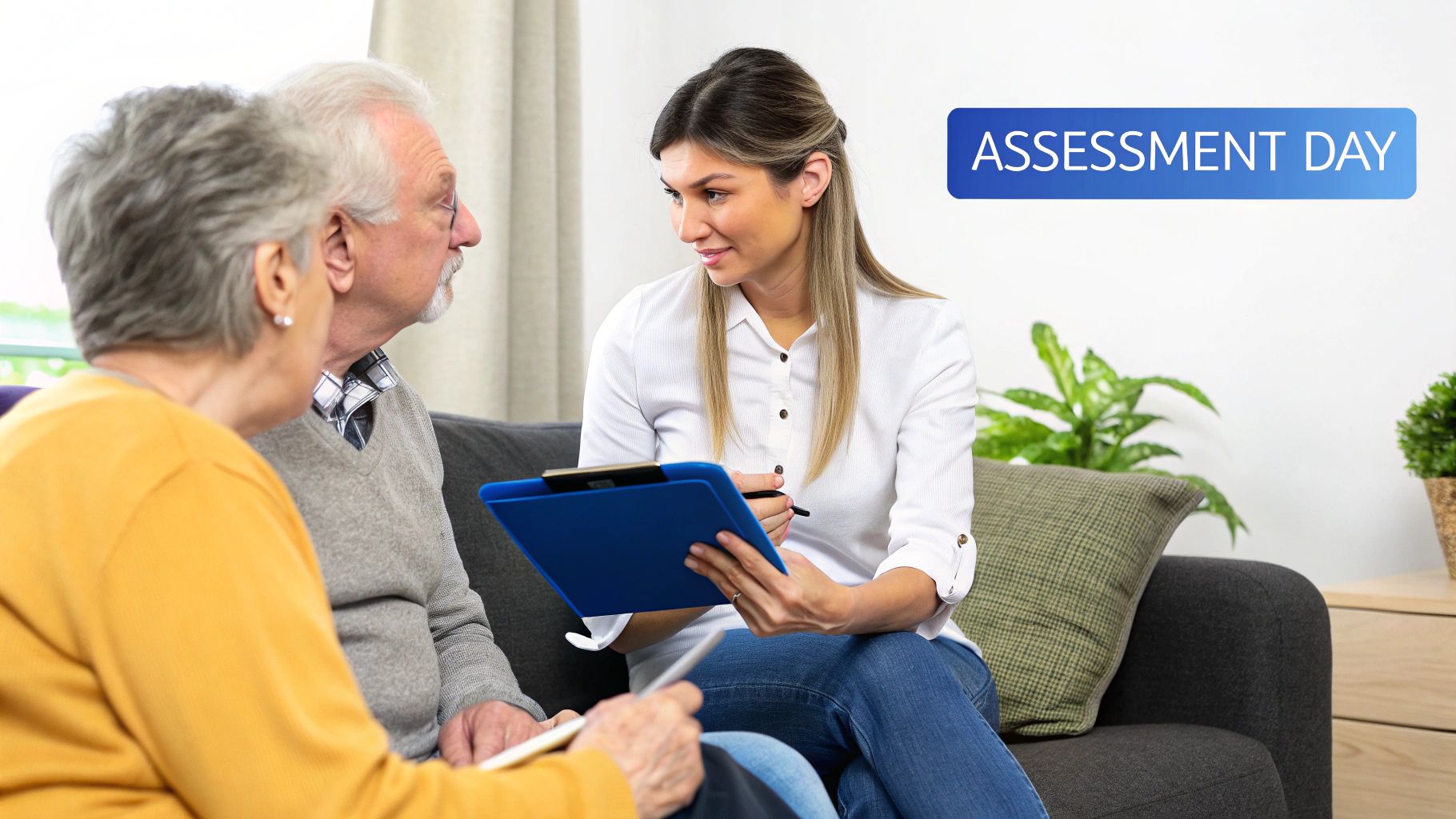
The idea of an activities of daily living assessment can feel a bit intimidating, but knowing what’s involved beforehand can make all the difference. This isn't a test with a pass or fail grade. Think of it instead as a friendly, collaborative conversation designed to build a clear and accurate picture of a person's abilities.
The whole point is to create a partnership between the assessor, your loved one, and your family. It's a respectful process aimed at identifying strengths and figuring out where a little extra help could make life safer and more independent. Once you understand the steps, everyone can feel more confident participating.
Who Conducts the Assessment
These assessments are always handled by a trained healthcare professional who specializes in evaluating day-to-day function. You can expect the evaluation to be led by one of the following:
- Registered Nurse (RN): RNs often perform these assessments as part of a larger health evaluation, particularly when setting up services with an in-home care agency.
- Occupational Therapist (OT): OTs are the experts in helping people perform daily activities. They have a deep understanding of the physical and cognitive skills needed for both ADLs and IADLs.
- Social Worker: A social worker looks at the big picture, focusing on a person's overall well-being and the support systems they have in place, which adds critical context to the assessment.
Each of these professionals is trained to be empathetic and respectful, making sure your loved one feels comfortable and truly heard throughout the process.
The Assessment Methods Used
An assessor gathers information from a few different angles to get a complete view. This isn't just about filling out a form; it's about understanding how things work in the real world. The process typically has three main parts.
- Direct Conversation and Interviews: The assessor will chat directly with your loved one about their daily routine, asking what feels easy and what’s become a bit of a struggle.
- Observation of Tasks: When it's appropriate and safe, the assessor might ask your loved one to do a simple task, like getting up from a chair or reaching for something in a cupboard. This gives them a firsthand look at mobility, balance, and coordination.
- Family and Caregiver Input: The assessor will also want to talk with you. As a family member, you see things day in and day out and can offer invaluable insight into changes you've noticed over time.
Think of the assessment as assembling a puzzle. The individual's self-report is one piece, direct observation is another, and family input is a third. Only by putting them all together can the assessor see the complete picture of what’s needed.
Preparing for a Productive Assessment
A little preparation can make the activities of daily living assessment a much smoother and more productive experience for everyone. Your input is vital, so taking a few simple steps beforehand ensures nothing important gets missed.
Before the appointment, it helps to:
- Jot down specific observations: Make a few notes on any recent changes you’ve seen. It could be something like, "Dad has stopped cooking his own meals," or "Mom has been having trouble with the buttons on her shirts lately."
- Gather key documents: Have a list of medications, contact info for doctors, and a brief medical history on hand.
- Prepare questions: Write down any questions or concerns you have for the assessor about the process or potential care options.
This preparation helps you be a strong advocate and ensures the final care plan is built on a solid foundation of accurate, detailed information. While these tried-and-true assessment tools have helped families for decades, the field is always improving. New technologies are now being explored to overcome the limitations of older tools, like potential cultural bias or subjective scoring. As you can learn about in findings on new functional evaluation tools, this push for more objective measures promises even greater accuracy in the future, ensuring these assessments remain as effective as possible.
How Assessment Results Shape Your In-Home Care Plan
The real power of an activities of daily living assessment is what happens after the scores are tallied. Those final numbers and observations aren't just data points on a page—they're the blueprint for building a safe, supportive, and dignified in-home care plan. This is where the evaluation turns into direct action, connecting specific challenges with real-world solutions.
Think of it as translating abstract data into a practical roadmap. For example, if an assessment shows someone is having a tough time with the ADL of dressing, the care plan might include an hour of help from a caregiver each morning. A low score in the IADL of meal preparation could lead to setting up a healthy meal delivery service. The goal is always to find that sweet spot: providing just enough support to maximize independence, not smother it.

From Assessment Scores to Actionable Steps
A well-crafted care plan doesn’t just offer generic solutions. It uses the assessment results to target specific needs with tailored interventions, ensuring every bit of support is relevant and effective.
Here’s a look at how different assessment outcomes can directly shape a care plan:
- Difficulty with Bathing: A low score here often points to home safety modifications. For someone struggling in the bathroom, something as simple as installing a walk-in shower can be a game-changer for staying independent.
- Challenges with Medication Management: If keeping track of prescriptions (an IADL) is becoming a problem, the plan could bring in a smart pill dispenser or schedule weekly visits from a nurse to organize medications.
- Mobility and Transferring Issues: Trouble getting from the bed to a chair isn't just an inconvenience; it’s a serious fall risk. The plan might recommend physical therapy, mobility aids like a walker, or having a caregiver on standby for assistance during transfers.
Every solution is a direct response to a need identified during the evaluation. It’s a purposeful approach that makes sure every aspect of the plan serves a clear function. This isn't just for seniors, either—it’s crucial for anyone recovering from a major health event, like a traumatic brain injury, where ADL assessments are becoming increasingly vital.
Unlocking Eligibility for Financial Support
Beyond mapping out a daily care routine, the results of an activities of daily living assessment are often the key to unlocking financial help. Many long-term care insurance policies and government programs use these very assessments to determine who is eligible for benefits.
In New Jersey, for instance, programs like Medicaid demand specific documentation of a person's functional limits.
An official assessment provides objective proof of need. It elevates the conversation from, "I think Mom needs help," to "Here is a professional evaluation detailing exactly why she needs support." That's the language insurance providers and state agencies understand.
Needing help with two or more ADLs is a common threshold for qualifying for many services. A thorough assessment delivers the formal documentation required to meet that criteria, opening the door to programs that can help cover the cost of in-home care.
The Foundation for Personalized Care in New Jersey
Ultimately, the assessment becomes a living document that guides every future care decision. It helps families in Mercer County and across New Jersey confidently answer critical questions. How many hours of care are truly needed each week? What specific skills should we look for in a caregiver? Which home modifications will make the biggest difference in safety and comfort?
By grounding the care plan in the objective findings of an ADL assessment, families can be sure their loved one is getting precisely the right level of support. It's about providing enough help to keep them safe, but not so much that it undermines their sense of independence. This assessment is the essential first step toward creating an in-home care experience that is sustainable, effective, and truly compassionate.
Taking the Next Steps with an Assessment in NJ
Understanding what an activities of daily living assessment is all about is a great first step. But what comes next? For many families across New Jersey, figuring out how to move forward can feel overwhelming. The key is turning what you've learned into a concrete plan that keeps your loved one safe and independent at home.
The whole process starts with a simple, open conversation. It’s crucial to approach this talk with empathy. Frame the assessment not as a test of what they can't do anymore, but as a helpful tool to make sure they can continue living comfortably and safely where they want to be. Think of it as getting ahead of potential problems and finding solutions together.
Preparing for the Conversation
Bringing up the need for an assessment requires a gentle touch. To keep the conversation productive and compassionate, here are a few things to keep in mind:
- Choose the Right Time: Find a calm, private moment when no one is feeling rushed or stressed.
- Focus on Safety and Independence: Keep the focus on the real goal: keeping them safe and independent, not taking away their freedom.
- Use "I" Statements: Instead of saying, "You can't cook by yourself anymore," try something like, "I get worried about you cooking alone." It feels less like an accusation.
- Involve Them in the Decision: Position the assessment as something you're doing together—a collaborative step forward.
Having this discussion with a clear head and a caring heart can make all the difference. It transforms a potentially tough topic into a productive partnership.
Your Roadmap to Getting Started in NJ
Once you're ready to move forward, having a plan simplifies everything. The path from feeling concerned to putting a care plan in place is much smoother when you have a trusted partner guiding you.
At NJ Caregiving, we see ourselves as your dedicated partner on this journey. Our job is to walk you through everything, from the initial activities of daily living assessment to designing a personalized care plan and matching you with a skilled, compassionate caregiver who feels like part of the family.
We're here to help families in Mercer County, Princeton, and the surrounding areas navigate every detail. Our team of experienced nurses and care professionals brings clarity and support to the process, so you can feel confident in every decision you make.
If you’re ready to see how an assessment could improve your loved one’s quality of life, contact NJ Caregiving for a complimentary consultation. Let us help you take this important next step with confidence and peace of mind.
Common Questions About ADL Assessments
When you're thinking about getting an activities of daily living assessment for a family member, it’s completely normal to have questions. This is a big step toward getting them the right kind of support, and getting clear on the details can bring a lot of peace of mind. Here are some straightforward answers to the questions we hear most often from families.
How Often Should We Get an ADL Assessment?
There's no single magic number here—how often you'll need one really depends on your loved one's specific situation. The first assessment is all about setting a baseline, but the follow-ups are just as important to track how things are going.
We generally recommend getting a new assessment:
- Once a year, just as a routine check-in to catch any slow, gradual changes.
- After a major health event, like a hospital stay, a fall, a new diagnosis, or surgery.
- Anytime you notice a change in their ability to manage daily tasks.
Regular re-assessments make sure the care plan is still doing its job and can be adjusted as your loved one's needs change over time.
Who Pays for an Activities of Daily Living Assessment?
This is a great question, and the answer can vary. If an assessment is ordered as part of a hospital discharge plan or is needed for someone to be admitted to a skilled nursing facility, it’s often covered by Medicare or private health insurance.
However, if you arrange an assessment directly with a private home care agency like NJ Caregiving, it's usually paid for out-of-pocket. The good news is that many agencies, including ours, offer this as a complimentary part of the initial in-home consultation. This way, you can get a clear picture of your options without an upfront expense.
Think of an assessment as an investment in your loved one’s future safety and comfort. It gives you the objective information needed to not only build a care plan that works but also to potentially qualify for long-term care insurance or state-funded programs.
What if My Family Member Doesn't Want an Assessment?
It's very common for a parent or loved one to push back against the idea of an assessment. To them, it can feel like a threat to their independence. The best way to approach this is with a lot of empathy and to focus on the positives.
Try framing it as a tool to help keep their independence, not take it away. You can explain that the whole point is to find small supports that will help them stay safe, comfortable, and in their own home for as long as possible. When you position it as a way to plan with them, they’ll feel more in control and are often more willing to participate.
At NJ Caregiving, our compassionate team is here to answer all your questions and walk you through every step. We provide professional, respectful assessments to help you build a care plan that truly supports your family. Learn more at https://njcaregiving.com.
