

Think of your medical and financial power of attorney forms as a personal 'life instruction manual' you create for moments when you can't speak for yourself. These aren't just legal papers; they're your voice, ensuring the people you trust can make healthcare and financial decisions on your behalf, exactly as you would want.
Your Personal Life Instruction Manual

Life is full of surprises, and planning for the unexpected is one of the most empowering things any of us can do. These forms aren't just for the elderly—they are essential tools for any adult who wants to keep control over their life, even when they can't be in the driver's seat.
It helps to think of it like appointing two key players to your personal "life team." You need a trusted co-pilot for your healthcare journey and a reliable treasurer for your finances. These documents let you officially name those people.
Two Distinct and Vital Roles
It’s critical to understand that these are two separate jobs, and they require two separate legal documents. They protect entirely different areas of your life and often call for very different skills from the person you choose to appoint.
- Medical Power of Attorney: Known in New Jersey as a Health Care Proxy, this document is strictly for healthcare decisions.
- Financial Power of Attorney: This document gives someone authority over your financial world—things like paying bills, managing property, and dealing with your bank accounts.
By preparing these forms now, you're giving yourself—and your family—a gift. You’re preventing the stress, confusion, and potential legal fights that can erupt during a crisis. It’s all about making sure your voice is heard, no matter what happens.
This proactive step keeps the control with you and your chosen agents, preventing a situation where a court has to get involved. The difference between having a Power of Attorney and needing a court-appointed guardian is massive; you can learn more about the difference between a power of attorney and guardianship to see why this is so important.
To get a better sense of how the financial side works in practice, this overview of a Power of Attorney for Property in Ontario provides some helpful real-world context on managing assets. With this groundwork, you're ready to make informed decisions that will protect your future.
Understanding Your Two Most Important Legal Tools

To really get a handle on these documents, we need to look at the specific jobs each one does. They work in two completely separate parts of your life—one for your health, the other for your finances. Understanding this split is the first step to building a solid plan for your future.
Think of it this way: you wouldn't ask your heart surgeon to manage your stock portfolio. And you definitely wouldn't ask your financial advisor for medical advice. The skills are just too different. It’s the same idea with medical and financial power of attorney forms; they assign these distinct roles to the people best suited to handle them.
The Role of a Medical Power of Attorney
Here in New Jersey, what's commonly known as a Medical Power of Attorney is usually called a Health Care Proxy. It's often part of a larger document known as an Advance Directive. Its one and only job is to give a person you trust—your agent—the power to make critical healthcare decisions for you if you can't speak for yourself.
This could happen after a sudden accident, during a serious illness, or in the later stages of a condition like dementia. In those moments, your agent becomes your voice. They'll be the one talking to doctors, agreeing to or refusing treatments, and making sure your personal wishes are honored. This authority can cover everything from routine medical care to the most profound end-of-life decisions.
Without this document, your family might end up in painful disagreements over what to do, all during an incredibly stressful time. A Health Care Proxy clears up any confusion and gives one person, chosen by you, the legal authority to direct your care.
Despite how crucial they are, a surprising number of people haven't taken this step. A 2025 analysis found that only about 37% of U.S. adults had completed a health care directive. That means the majority—a staggering 63%—haven't legally named a decision-maker, leaving them vulnerable in a medical crisis. You can learn more about why these documents are so vital in this insightful article on Certainty News.
The Role of a Durable Financial Power of Attorney
While your Health Care Proxy protects your well-being, the Durable Financial Power of Attorney is all about safeguarding your financial life. This document gives your agent the authority to manage your money and property when you can't. It's an incredibly powerful tool that keeps your day-to-day affairs running without a hitch.
Your agent’s responsibilities could include:
- Paying bills: Making sure your mortgage, utilities, and insurance premiums are paid on time.
- Managing bank accounts: Depositing checks, moving money, and handling routine banking.
- Overseeing investments: Working with your financial advisor to manage your portfolio.
- Handling property: Managing, selling, or buying real estate on your behalf if needed.
The key word here is "durable." A durable power of attorney stays in effect even if you become incapacitated. A non-durable POA, on the other hand, becomes void the moment you lose mental capacity, which makes it far less helpful for long-term planning.
The consequences of not having these documents are significant. If you become incapacitated without a Medical and a Durable Financial Power of Attorney, your loved ones would have no choice but to petition the court for guardianship.
This is a legal process that is often long, expensive, and public. A judge—not your family—would ultimately decide who gets to manage your healthcare and your finances. This can add a huge emotional and financial burden on your family at the worst possible time. By creating these two separate medical and financial power of attorney forms, you stay in control and protect the people you love from that difficult ordeal.
How to Choose the Right Person for the Job
Picking the person who will act on your behalf—your “agent”—is easily the most important decision you'll make when setting up your medical and financial power of attorney forms. This isn’t a role you just hand over to someone based on family tradition. It’s about choosing a person with the right mix of character and competence to handle huge responsibilities, often during a very stressful time.
Think of it like you're hiring for two completely different, high-stakes jobs. One is for a healthcare advocate, and the other is for a financial manager. The person who’d be perfect for one might not be the best fit for the other at all.
Key Qualities for Any Agent
Before we get into the different roles, let’s talk about the universal traits every agent absolutely must have. This person will hold immense power over your life, so your choice has to be rooted in total confidence.
- Absolute Trustworthiness: This one is non-negotiable. You have to trust your agent without a single doubt to always, always act in your best interest.
- Calm Judgment Under Pressure: Medical and money problems are stressful by nature. You need someone who can think clearly and make rational decisions when emotions are running high all around them.
- Assertiveness and Advocacy: Your agent has to be comfortable speaking up to doctors, financial advisors, or even other family members to make sure your wishes are respected. They are your voice.
- Strong Organizational Skills: Juggling medical records or financial accounts takes real attention to detail. An organized person is far less likely to miss a critical bill payment or an important doctor's note.
The decision of who to name as your agent is a blend of heart and head. It requires you to look past emotional ties and honestly assess who is most capable of handling these duties with integrity and competence.
Separating the Roles: Medical vs. Financial
Let’s be honest: the best person to discuss treatment options with a doctor is often not the same person you'd trust to manage your investment portfolio. The skills needed are just too different, which is why many people in New Jersey wisely choose different agents for their medical and financial documents.
A Health Care Agent should be someone who truly understands your personal values and what you’d want for your healthcare. They need to be a great communicator and not be afraid to ask tough questions in a hospital room. A close family member or friend who knows you well is often a great choice.
On the other hand, a Financial Agent needs a good head for numbers and a practical, grounded approach to money. This person should be responsible, organized, and financially stable themselves. They don't need to be a Wall Street genius, but they must be capable of handling things like paying bills on time, filing taxes, and keeping an eye on your accounts.
Unfortunately, this financial authority comes with risks. U.S. federal and state regulators see hundreds of cases every year where agents misuse funds. This really drives home how crucial it is to pick someone with unshakable integrity. You can learn more about the risks associated with financial POA documents.
Always Name a Backup
So, what happens if your chosen agent can't serve when you need them? They might be dealing with their own health crisis, be out of the country, or have passed away. This is exactly why naming a successor agent—a backup—is a critical safety net for your entire plan.
Always name at least one alternate for both your medical and financial power of attorney. This simple step ensures there’s no gap in authority, which could prevent your family from having to go to court to get a guardian appointed. Your primary agent serves first, and the successor only steps in if the primary is unable to act.
A Step-by-Step Guide to Completing Your POA Forms
You've picked your agents, and now it's time to make things official. Completing your medical and financial power of attorney forms is much more than just filling in a few blanks. You're carefully documenting your wishes and following specific legal rules that turn a simple piece of paper into a powerful, legally binding directive that banks and hospitals must honor.
This guide will walk you through the essential parts of these forms, translating the confusing legal jargon into clear, practical steps. We'll cover everything from defining your agent's authority to, most importantly, signing the documents correctly so they hold up in New Jersey.
Obtaining the Correct Forms
First things first: you need the right paperwork. While you can find generic templates all over the internet, using a form that doesn't comply with New Jersey law is a huge risk. Imagine your family needing to act, only to have a bank or hospital reject the form because it isn't valid.
To make sure your documents are the real deal, you have a few reliable options:
- New Jersey Statutory Forms: The state provides official, legally compliant forms. You can often find these on government websites or through your local Area Agency on Aging.
- Attorney-Drafted Forms: Working with an elder law attorney is the best way to get documents that are not only compliant but also perfectly tailored to your unique family and financial circumstances.
- Reputable Legal Software: Some software programs can generate state-specific legal documents, but always double-check that they are current with New Jersey's latest laws.
Defining the Scope of Power
With the right forms in hand, you'll need to decide exactly what powers you're granting. This is where you get to set the "job description" for your agent, and you can be as broad or as specific as you feel comfortable with.
For your Durable Financial Power of Attorney, you could grant your agent "general authority," which lets them handle nearly all of your financial matters. Or, you might choose to list specific powers, like only giving them the ability to pay your bills and manage one particular bank account.
In your Advance Directive (which includes the Health Care Proxy), you will name your healthcare agent. This document also contains a "living will" section. This is your chance to clearly state your wishes on medical treatments, such as how you feel about life-sustaining procedures. It provides invaluable guidance for your agent and doctors when they need it most.
This infographic breaks down the core qualities to look for in an agent, making sure you choose someone who is trustworthy, calm under pressure, and assertive enough to advocate for you.
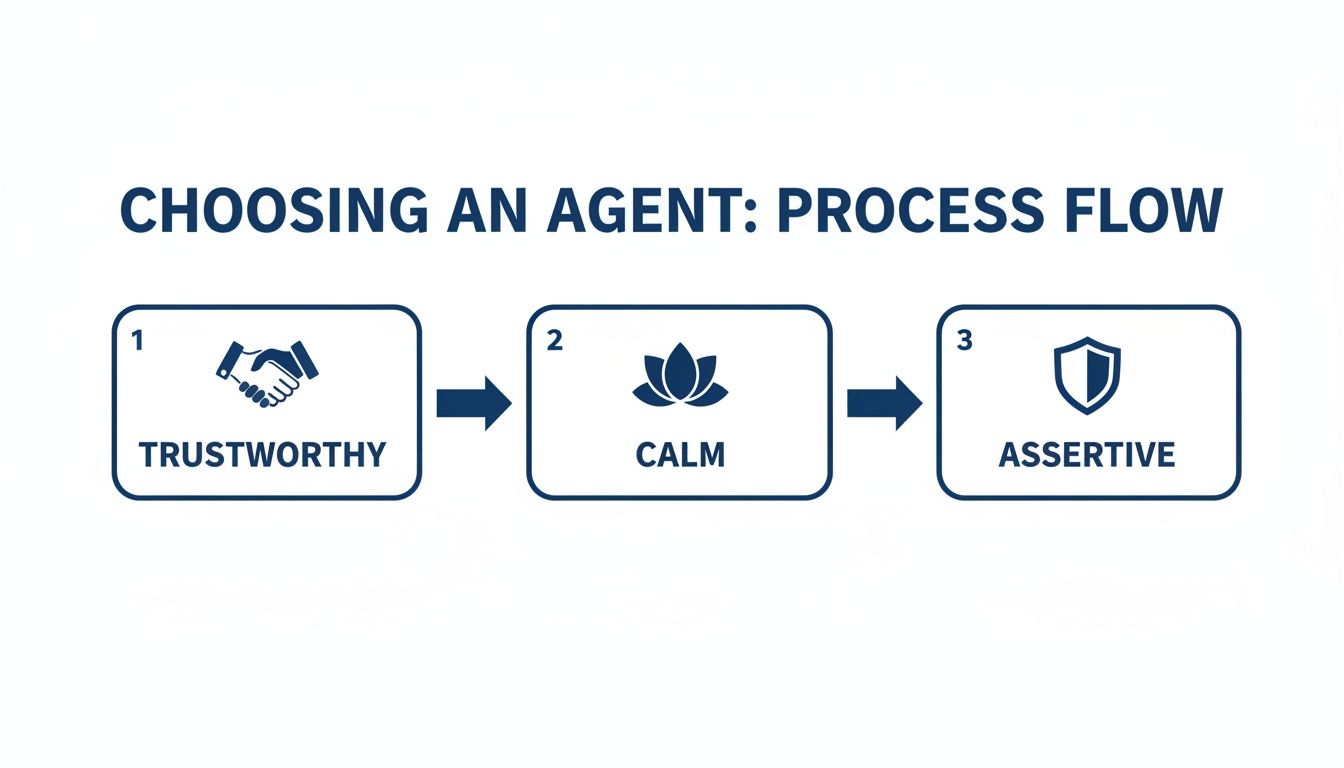
These traits are the bedrock of an effective agent, giving them the confidence to act on your behalf during what can be very stressful times.
Executing the Documents Correctly
This is it—the final and most critical step. Signing and witnessing your forms correctly is what makes them legally valid. If this part is done wrong, the entire document could be worthless. The rules are set by state law, and they are not flexible.
Legal requirements for a valid POA can vary quite a bit from state to state, which is why mismatched forms or incorrect signature procedures are common reasons for rejection. Some states might require two witnesses, others need a notary, and a few now even allow for remote notarization. You can discover more insights about these legal variations on Mayo Clinic.
Important Takeaway: Never sign these documents when you're alone. The signing, witnessing, and notarization process is a formal ceremony that must follow New Jersey law to the letter to be legally enforceable.
Here’s a simple checklist to get you through the finish line:
- Do Not Sign Yet: Read through the entire document one last time. Check that all names are spelled correctly and that the powers you've granted are exactly what you intended.
- Gather Your Witnesses: New Jersey has specific rules about who can be a witness. They must be adults, and they absolutely cannot be the person you named as your agent.
- Find a Notary Public: You will need to sign your Durable Financial Power of Attorney in front of a notary public. You can usually find one at your bank, a law office, or even some local shipping stores.
- Sign in Their Presence: This is key. You, your witnesses, and the notary must all be physically present at the same time. You’ll sign the document, your witnesses will sign to confirm they saw you do it, and the notary will add their official seal.
By following these steps with care, you can ensure your wishes are locked in and legally protected, bringing true peace of mind to both you and your family.
Managing Your Documents After You Sign Them
You’ve done the hard part—the ink is finally dry on your medical and financial power of attorney forms. It’s a huge relief, but the job isn’t quite finished. What happens next is just as critical to making sure your wishes are actually followed when the time comes.
Properly managing these documents ensures they are ready and effective the moment they’re needed. Think of your signed originals as the master keys to your entire plan. They need to be kept safe, of course, but more importantly, your agent has to be able to get their hands on them immediately.
A classic mistake is stashing the originals in a bank safe deposit box. It seems like the most secure option, but it can create a massive headache. If you become incapacitated, your agent might not have the authority to open that box—leaving them without the very document they need to help you.
Storing Your Documents for Accessibility
A much better approach is to keep the originals in a secure but accessible spot, like a fireproof safe at home. The key is making sure your primary agent (and your backup!) knows exactly where to find them and has the combination or key.
Of course, just signing the forms isn't enough; knowing how to safeguard these vital records is part of a complete strategy. You can find some excellent advice on storing your estate planning documents securely to round out your plan.
Next, you need to hand out copies. The people and institutions involved in your care and finances should have these documents on file before a crisis hits.
Who gets a copy?
- Your Primary Agent: This is non-negotiable. They need a high-quality copy they can present to doctors or banks.
- Your Successor Agent(s): Your backups should have copies so they are ready to step in without delay.
- Your Doctors and Hospital: Give a copy of your Advance Directive (Health Care Proxy) to your primary care physician and the hospital you prefer.
- Your Financial Institutions: Your bank, credit union, and financial advisor should all have a copy of your Durable Financial Power of Attorney.
By getting copies out ahead of time, you're smoothing the path for your agent. When a hospital or bank already has the document, it dramatically cuts down on the delays and resistance your agent might face.
Keeping Your Documents Current
Life doesn’t stand still, and neither should your power of attorney documents. A POA you signed 10 years ago might not reflect who you'd trust today or what you want for your future. It's a smart habit to review these forms every few years or after any significant life event.
What kind of event? Think about things like:
- A marriage or divorce
- The death of one of your named agents
- A major change in your relationship with an agent
- A significant shift in your financial picture
If you realize a change is needed, you have to formally revoke the old document before creating a new one. Just tearing it up won't cut it. You should prepare a written "Revocation of Power of Attorney."
This revocation needs to be signed, witnessed, and notarized—just like the original POA. Then, you absolutely must give a copy of the revocation to everyone who had the old document, especially your former agent and your bank. This step prevents anyone from accidentally acting on outdated instructions. Thinking ahead like this is also a crucial part of broader financial planning, similar to understanding how to go about protecting assets from nursing home costs.
Common Questions About Power of Attorney Forms
Even after you've decided to get your essential legal documents in order, a lot of practical questions can pop up. Trying to figure out the details of medical and financial power of attorney forms can feel overwhelming, but getting straight answers is the best way to feel confident about your plan.
Let's walk through some of the most common questions and clear up any confusion. Think of this as your final Q&A before putting your plan into action, helping you sidestep common mistakes along the way.
Can I Use a Power of Attorney Form I Found Online?
It's tempting to grab a free template online, but using a generic form is a huge risk. Every state has its own very specific laws for these documents. A form that isn't built for New Jersey could easily be thrown out by a court, meaning hospitals and banks might refuse to accept it right when your family needs it most.
For instance, a generic document might be missing legally required phrases or have the wrong instructions for witnesses and notarization. The safest bet is to use an official New Jersey statutory form or, even better, have an elder law attorney draft one for you. This is the only way to be sure your wishes are truly protected under state law.
What Happens If I Do Not Have a POA?
Honestly, the consequences of not having these documents can be severe, creating a nightmare of stress and expense for your family.
- Without a Medical POA: If you can't speak for yourself, healthcare decisions might be left to family members based on a legal pecking order, which can cause painful arguments. If you have no available family, a court may have to step in and appoint a legal guardian to make choices for you.
- Without a Financial POA: Your family would have no legal authority to access your bank accounts or pay your bills. Their only option would be to go to court and petition for guardianship over your finances.
Both of these scenarios drag your family into a public, expensive, and time-consuming court process. It can freeze your assets just when the money is desperately needed to pay for your care. You can learn more about the difficult process of how to get legal guardianship of a parent and why it's so critical to avoid it.
When Does a Power of Attorney Become Effective?
This all comes down to how the document is written. A Durable Financial Power of Attorney can be set up to be effective the moment you sign it. Or, it can be a "springing" document, meaning it only activates after a doctor certifies that you're incapacitated. Most attorneys suggest making it effective immediately to avoid any delays in an emergency.
A Medical Power of Attorney is different. By its very nature, it only kicks in when a doctor determines you cannot make or communicate your own healthcare decisions. It lies dormant until it's medically necessary.
Can I Have More Than One Agent?
Yes, you can name co-agents who must act together, but this can get messy. If your agents can't agree on a critical decision, everything can grind to a halt.
A much better strategy is to name one primary agent you trust completely. Then, name at least one successor (or backup) agent. This person only steps in if your first choice is unable or unwilling to serve. It ensures there's always someone ready to act on your behalf without any gap in authority.
At NJ Caregiving, we understand how important it is to plan ahead so your loved ones are cared for with dignity and respect. We provide dedicated in-home care services throughout Mercer County, including Hamilton and Princeton, to support families every step of the way. If you need assistance navigating senior care options, visit us at https://njcaregiving.com.
