
Ever wondered if you could get hospital-quality medical care without leaving your living room? That's the basic idea behind home health nursing. It’s prescribed medical care brought right to your doorstep by licensed professionals, like Registered Nurses (RNs). This isn't just a convenience; it's a vital service for anyone recovering from a major surgery, a serious injury, or managing a complex illness at home.
What Is Home Health Nursing, Really?
Think of a home health nurse as a specialized medical expert who brings the clinic to you. It's easy to confuse this with general home care, but they are worlds apart. While home care focuses on non-medical help like cleaning, cooking, or companionship, home health nursing is strictly clinical. It's always part of a formal plan of care ordered by a doctor to help you heal, get stronger, and regain your independence.
The whole point is to support a full recovery, keep you out of the hospital, and give you and your family the tools and knowledge you need to manage your health confidently. In short, it’s the bridge that gets you from a hospital bed safely back to your own life.
To make things crystal clear, here’s a quick breakdown of what home health nursing is all about.
Home Health Nursing At a Glance
| Component | Description |
|---|---|
| Who Provides It? | Licensed medical professionals like Registered Nurses (RNs), Licensed Practical Nurses (LPNs), and therapists. |
| What Is It? | Skilled medical services (e.g., wound care, IV therapy, medication management) ordered by a doctor. |
| Why Is It Needed? | To help a patient recover from surgery, injury, or a serious illness in their own home. |
| Who Pays? | Often covered by Medicare, Medicaid, and private insurance when medically necessary. |
| The Goal | To improve health outcomes, prevent rehospitalization, and teach patients self-care skills. |
As you can see, this is far more than just a helping hand—it's professional medical treatment delivered where you're most comfortable.
More Than Just Medical Tasks
A great home health nurse does far more than just change a dressing or give a shot. They take a holistic view of your well-being. They become the doctor's eyes and ears in your home, constantly observing, educating, and coordinating your care. They're trained to spot subtle changes in your condition that could signal a bigger problem, often catching issues before they become emergencies.
You’ll find their role is incredibly dynamic and includes:
- Patient and Family Education: This is a huge part of the job. They'll teach you how to manage medications, recognize warning signs, and safely use any medical equipment you might need.
- Care Coordination: They are constantly talking with your entire healthcare team—your primary doctor, specialists, physical therapists, and social workers—to make sure everyone is on the same page.
- Skilled Medical Services: This is the hands-on clinical work that only a licensed professional can perform, like complex wound care, IV infusions, or managing a catheter.
A Vital and Growing Part of Healthcare
The need for this kind of care is exploding. In the United States, the home health care market was valued at around $100.95 billion in 2024 and is on track to hit $176.30 billion by 2032. Every year, about 12 million Americans depend on these services to get the skilled care they need in the place they feel most at ease. If you're interested, you can discover more insights about home health trends and how they're shaping patient care.
By bringing skilled medical expertise directly into the home, home health nursing not only improves patient outcomes but also enhances their quality of life, allowing them to heal in a place of comfort and dignity.
The Medical Services a Home Health Nurse Provides
When a home health nurse steps into a home, they're bringing a high level of clinical expertise with them. This is far more than just a simple check-in. These are licensed professionals—registered nurses (RNs) or licensed practical nurses (LPNs)—tasked with carrying out skilled medical services that are crucial for someone recovering from an injury, managing a chronic illness, or transitioning home from the hospital.
Think of them as the direct, hands-on extension of your doctor. They work under a physician's orders, implementing a specific care plan designed to get you or your loved one back on the road to health, all from the comfort and familiarity of home.
Core Clinical Responsibilities
The specific tasks a home health nurse performs can vary widely depending on the patient's unique needs, but a few core duties highlight the depth of their skill.
You'll often find them handling critical medical tasks like these:
- Complex Wound Care: This is a big one. It's much more than changing a bandage. Nurses expertly manage serious wounds, like surgical incisions or pressure sores, by cleaning the site, applying fresh dressings, and watching carefully for any signs of infection to make sure everything heals correctly.
- IV Therapy Management: Safely managing IVs at home requires incredible precision. Nurses are responsible for administering medications, fluids for hydration, or liquid nutrition directly into a patient’s bloodstream, which involves handling IV lines, pumps, and exact dosages.
- Medication Administration and Management: From giving injections to juggling a complex schedule of pills, nurses ensure the right medications are taken at the right times. A huge part of this is also teaching the patient and their family about potential side effects and how to manage the regimen themselves.
- Vital Signs Monitoring: Nurses are constantly tracking key health indicators like blood pressure, heart rate, temperature, and breathing. This regular monitoring helps them catch subtle changes that might signal a brewing problem, allowing for quick action before it becomes a bigger issue.
Patient and Family Education
One of the most valuable aspects of what is home health nursing is the focus on education. A nurse’s visit isn’t just about doing a task; it’s about teaching the patient and their family how to be active participants in their own care.
For instance, a nurse might spend time showing a patient newly diagnosed with diabetes how to test their own blood sugar and give themselves an insulin shot. This kind of hands-on guidance builds confidence and fosters the long-term independence that is a central goal of home health.
By turning the home into a learning environment, home health nurses give patients the skills and knowledge they need to manage their condition on their own, reducing their reliance on others and helping to prevent future hospital stays.
The nurse also serves as a vital communication link, breaking down complex medical jargon into plain English for the family. They make sure everyone in the patient’s support circle is on the same page. Today's home health field is also finding ways to use technology to become more efficient; tools for healthcare documentation automation are helping streamline the paperwork, which frees up more of the nurse's time to focus directly on patient care.
Home Health Nursing vs. Home Care: Unpacking the Key Differences
If you’ve ever felt confused by the terms ‘home health’ and ‘home care,’ you’re not alone. Many families use them interchangeably, but it's a common mix-up that can lead to real problems. Understanding the difference is critical because they offer two completely different kinds of support.
Choosing the wrong service can leave you with gaps in care, unexpected costs, and a lot of frustration. The core difference is actually quite simple: one is medical, and the other is non-medical.
Let's try an analogy. Think of a home health nurse like a physical therapist who comes to your house after you've had knee surgery. Their job is clinical and has a clear goal: they guide you through specific exercises to heal the injury, teach you how to manage pain, and report your progress back to your surgeon. Their work is temporary and focused entirely on recovery.
A home care aide, on the other hand, is like a personal assistant you might hire to help manage daily life while that knee heals. They can’t prescribe exercises or adjust your medications, but they can drive you to your doctor’s appointments, cook your meals, and help you get dressed safely. Their focus is on support, comfort, and helping with everyday activities.
The Defining Lines: Medical vs. Non-Medical Support
The biggest dividing line is the type of care being provided. Home health nursing is skilled medical care prescribed by a doctor and can only be performed by a licensed professional. This involves clinical tasks like changing wound dressings, administering IV medication, or monitoring a serious health condition like heart failure.
Home care provides non-medical assistance, often called personal or companion care. A home care aide helps with Activities of Daily Living (ADLs)—things like bathing, grooming, and preparing meals. You don't need a doctor's prescription for this, and families typically pay for it out-of-pocket. Getting this distinction right is the first step, and you can explore a more detailed breakdown in our guide on home health vs. home care to see how these services fit different family needs.
This graphic breaks down the primary jobs a skilled nurse performs.
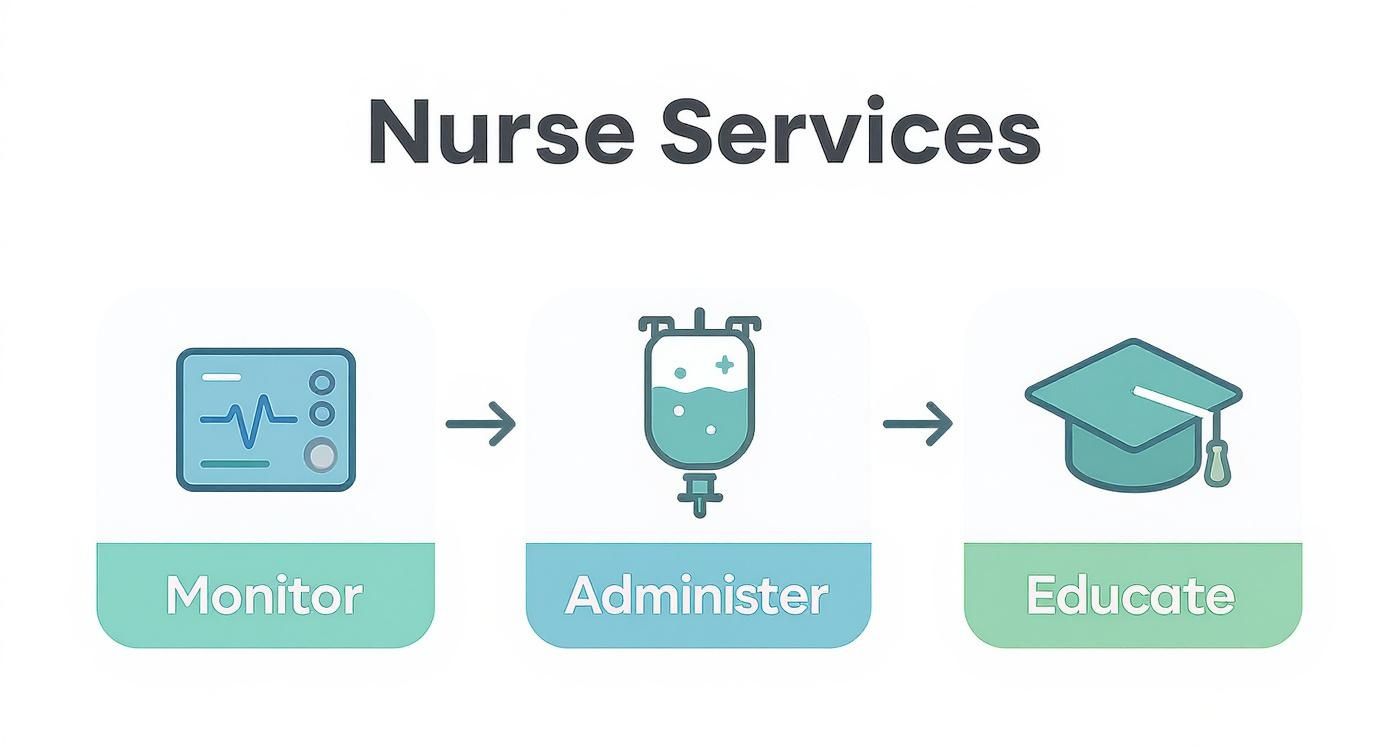
As you can see, a nurse's role is all about active medical intervention—monitoring conditions, giving treatments, and teaching the patient and family how to manage the recovery process.
To give you a clearer picture, we’ve put together a table comparing the key features that set these two essential services apart.
Comparison: Home Health Nursing vs. Home Care
| Feature | Home Health Nursing | Home Care (Personal Care) |
|---|---|---|
| Type of Care | Medical and Skilled: Involves clinical tasks like wound care, IV therapy, and medication administration. | Non-Medical: Focuses on personal care, companionship, and help with daily activities. |
| Provider | Licensed Professionals: Registered Nurses (RNs), Licensed Practical Nurses (LPNs), therapists. | Caregivers/Aides: Professionals trained in personal care, but not licensed to provide medical services. |
| Requirement | Doctor's Prescription: Must be ordered by a physician as part of a formal plan of care. | No Prescription Needed: Services can be arranged directly by the family at any time. |
| Payment Source | Insurance-Based: Primarily covered by Medicare, Medicaid, and private health insurance. | Private Pay: Usually paid for out-of-pocket, though some long-term care insurance may cover it. |
Ultimately, knowing whether you need a nurse or a caregiver comes down to whether the tasks require medical skill or supportive assistance.
Who Qualifies for Home Health Nursing Services?
So, how do you actually get home health nursing? It's not something just anyone can sign up for. There are a few specific boxes that need to be checked to make sure it’s the right level of care for the situation.
Think of it like getting a prescription from a doctor. You can't just walk into a pharmacy and get any medication you want; you need a doctor's approval first. It's the same idea here.
The first and most important step is getting a doctor's order. A physician has to officially certify that you need skilled nursing care on an intermittent basis, or require services like physical or speech therapy. This order is the green light that confirms your condition is serious enough to need a licensed medical professional at home.
Another key piece of the puzzle is that the care must be part-time or intermittent. Home health nursing isn't a replacement for round-the-clock, long-term care. Instead, it’s designed for people who need focused, periodic visits from a clinician to help them manage a specific health issue, recover from surgery, or get back on their feet.
Understanding the "Homebound" Requirement
This is probably the most misunderstood part of qualifying. When people hear the word "homebound," they often picture someone who is completely stuck in bed and can never leave the house. That’s not quite right.
Being "homebound" simply means that leaving your home takes a considerable and taxing effort because of your illness or injury.
You can absolutely still qualify if you need to leave for medical appointments, to attend religious services, or even for occasional short outings like getting a haircut. The main point is that getting out the door isn't a simple, everyday activity for you anymore.
The homebound status is a crucial distinction for Medicare and private insurance. It confirms that bringing medical care to the patient isn't just a matter of convenience—it's a genuine necessity for their health and recovery.
The Team and the Need for Skilled Care
At the end of the day, the services you receive must require the skills of a qualified professional. This isn't about help with daily chores; it's about medical expertise brought to your doorstep. The team often includes:
- Registered Nurses (RNs) handling medical tasks like wound care, IVs, and medication management.
- Physical Therapists (PTs) working to restore mobility, strength, and balance.
- Occupational Therapists (OTs) helping you regain the ability to perform daily activities like dressing or cooking.
- Speech-Language Pathologists (SLPs) who assist with communication or swallowing disorders.
This need is only growing. Between 2014 and 2023, the number of direct care workers in the U.S. shot up from 3.5 million to 5 million. Today, about 12% of all registered nurses work in home health care, a field that continues to expand as our population ages. You can learn more about the growing demand for home health nurses and what it means for families. Meeting these qualifications is what ensures you get the right professional support, right where you need it most.
Navigating the Costs and Payments for Home Health Nursing
Figuring out the financial side of skilled in-home care is a huge step for any family. But here’s the good news: when home health nursing is medically necessary, you often don’t have to carry the entire financial burden alone. There are several well-established ways to cover these vital services, making recovery at home a truly affordable and accessible option.
The whole process usually follows a pretty clear, logical path. It's less of a maze and more of a sequence designed to make sure the right care gets delivered and paid for correctly.
- Doctor's Referral: Everything kicks off with a doctor. A physician has to determine that skilled nursing care is medically essential for a patient's recovery or illness management and then write a formal order for it.
- In-Home Assessment: Next, a registered nurse from a home health agency will pay a visit. They'll conduct a detailed evaluation of the patient's health, their living situation, and exactly what kind of care they need.
- Personalized Care Plan: Using the assessment and the doctor's orders, the agency creates a formal plan of care. This is the roadmap, outlining the specific services, the goals of the care, and how often a nurse or therapist will visit.
How Medicare Covers Home Health Nursing
For seniors who are eligible, Medicare is usually the primary payer for home health services. When all the requirements are met—like being homebound and needing intermittent skilled care—Medicare Part A and Part B can cover 100% of the costs. This isn't just for nursing visits; it also includes physical, occupational, and speech therapy.
This coverage is a real cornerstone of our healthcare system. In fact, Medicare is the single biggest payer for these services in the country, funding about 42% of all home health visits. Typically, this allows for up to 28 hours of skilled care per week, which can even be extended to 35 hours if it's medically justified. It's a level of support that shows just how much value is placed on recovering at home, where patient satisfaction rates hit an impressive 91%. You can dig deeper into these important home health statistics and trends on BoostHomeHealth.com.
For individuals who qualify, the skilled nursing care, therapies, and medical supplies they need to recover at home can come with zero out-of-pocket costs under Medicare. This is what makes it a financially realistic choice for countless families.
Other Avenues for Payment
While Medicare is a major player, it’s certainly not the only game in town. Families in New Jersey have a few other paths to explore when it comes to funding skilled care at home.
- Medicaid: For those who meet the income requirements, New Jersey's Medicaid program offers comprehensive coverage for home health services.
- Private Health Insurance: Many commercial insurance plans, like the kind you get through an employer, have benefits for home health nursing. Of course, the specific coverage details and copayments will vary from plan to plan.
- Out-of-Pocket Payment: You can always choose to pay directly for services. This gives you the most flexibility in choosing your agency and the exact scope of care.
Getting familiar with these options is the key to planning well. For a more detailed look at what to expect, check out our guide on the cost of home health care in New Jersey. A little financial planning ahead of time ensures your loved one gets the medical support they need without adding a mountain of financial stress.
How to Choose the Right Home Health Agency in New Jersey
Picking the right home health agency is one of the most critical decisions your family will ever make. This choice goes way beyond just medical services; it's about inviting a trusted partner into your home. Not all agencies are created equal, so taking the time to carefully vet your options is essential for everyone's safety, quality of care, and peace of mind.
The best way to start is by asking the right questions. Think of it like you're interviewing someone for a key role on your loved one’s healthcare team—because that’s exactly what you’re doing. A good agency will welcome your questions and give you straight answers. A great first step is to check out a curated list of licensed home health care agencies in New Jersey to build a shortlist of potential partners in your local area.
Key Questions to Ask Potential Agencies
Before you make any commitments, have a checklist of questions ready to go. These will give you a clear picture of an agency's professionalism, their standards of care, and how they handle the unexpected.
- Licensing and Certification: Start with the basics: "Are you licensed by the state of New Jersey and certified by Medicare?" This is non-negotiable. It confirms the agency meets federal health and safety standards.
- Staff Screening and Training: Dig a little deeper: "How do you screen and train your nurses and therapists?" You're looking for an agency that runs thorough background checks and insists on ongoing professional education for its team.
- Emergency Protocols: Plan for the "what-ifs": "What is your procedure for after-hours emergencies or if a scheduled nurse can't make it?" A solid backup plan is the hallmark of a well-managed organization.
Your goal is to find an agency that doesn't just provide excellent clinical care but also communicates clearly and respects your family's needs. Trust your gut during these conversations.
Verifying Credentials and Quality
Beyond just asking questions, it’s smart to do your own homework to verify an agency’s reputation. A fantastic resource is Medicare's official Home Health Compare tool. It lets you review quality ratings and see patient satisfaction scores from real families who have been in your shoes.
While you're focused on finding an in-home agency for skilled nursing, it’s also helpful to know about all the healthcare options out there, including the various telehealth services available in New Jersey. By using official resources and asking direct questions, you can make an informed choice and feel confident in the partner you select for this important journey.
A Few Common Questions About Home Health Nursing
Stepping into the world of skilled in-home care can feel overwhelming, and it almost always brings up a lot of practical questions. Getting straight answers is the first step toward feeling confident and prepared for the road ahead. Here are some of the most common things we get asked about home health nursing.
How Long Can Someone Receive Services?
This is a big one. The duration of home health nursing is tied directly to medical need and what the doctor orders. It's important to know that it isn't designed for long-term, indefinite care. Think of it more as a specific recovery period after a hospital stay, a surgery, or an illness, lasting until a person's health condition is stable.
Typically, services are ordered for a 60-day period at a time. As this window comes to a close, the nurse and the rest of the care team will reassess how things are going. If skilled care is still medically necessary, the doctor can re-certify the plan for another 60 days. This cycle can continue as long as the patient's condition meets the criteria for needing that level of care.
What Happens if a Condition Changes?
Having a skilled nurse in the home means you have a professional who can spot and react to changes quickly—and that's a huge advantage. If a patient’s condition suddenly worsens, gets better, or a new problem pops up, the nurse's first move is to assess the situation and get on the phone with the doctor.
A care plan isn't set in stone; it's a living document. Based on what the nurse observes and reports, the doctor can immediately update orders for medications, treatments, or even how often the nurse should visit. This fluid approach ensures the care being provided is always a perfect match for the patient's current health status.
One of the most critical roles of a home health nurse is being the doctor's eyes and ears. Their constant monitoring allows for nimble adjustments to the care plan, preventing potential complications before they escalate into emergencies.
It's also worth noting that while many people receiving home health services are seniors, it's not restricted by age. Any adult with a qualifying medical need can be eligible. And while you can always request a specific nurse, whether it's possible will come down to the agency's scheduling and that nurse's availability.
At NJ Caregiving, we know you have questions, and we're here with answers. If you're looking into skilled nursing options in Mercer County, our team is ready to walk you through the process and help create a care plan that brings comfort and confidence to your family. Learn more about our compassionate in-home nursing services today.