
When you first start looking into home health care, the numbers can feel a little intimidating. It's a lot like planning a big family trip—you know where you are and where you need to go, but the final cost really depends on the route you choose and the level of comfort you want along the way.
Think of the average cost of home health care as your starting point on the map. This guide will give you that starting point, first with a look at the national picture and then zooming right into what you can expect here in New Jersey and Mercer County. We'll give you a baseline to work with, then walk through all the little things that can shift that number up or down.
Setting Your Budget for Home Health Care

National Averages: A Starting Point
Let's start with the big picture. Nationally, the median hourly rate for a home health aide is about $30. For someone needing full-time help (around 44 hours a week), that comes out to roughly $6,483 a month.
Annually, that's an average cost of $77,792. When you compare that to the cost of a private room in a nursing home—which averages a staggering $127,750 per year—it's clear that home care is often a much more financially sustainable path. More importantly, it allows your loved one to stay in a comfortable, familiar environment while getting the professional support they need. You can explore more home health statistics to get the full picture.
New Jersey Costs: A Closer Look
While national numbers are a great benchmark, costs can really change from state to state. New Jersey has a higher cost of living, and that's naturally reflected in home care rates. You can expect to see hourly rates here that are a bit higher than the national median.
To give you a clearer idea, here’s a quick comparison of the numbers.
Home Health Care Cost Snapshot: National vs. New Jersey
This table provides a quick reference comparing average home health care costs at the national level versus the typical range found in New Jersey, highlighting hourly and monthly estimates.
| Care Level | National Median Hourly Rate | New Jersey Average Hourly Rate | Estimated Monthly Cost (44 hrs/wk) NJ |
|---|---|---|---|
| Home Health Aide | ~$30 | ~$30 – $35 | ~$5,720 – $6,670 |
As you can see, the rates are competitive, but planning for the higher end of the range is a smart move in the Garden State.
In Mercer County and the surrounding areas, that investment in home care ensures your loved one receives high-quality, personalized support from skilled and compassionate caregivers. This localized approach is absolutely key to effective and reliable care.
It's also worth noting that the slightly higher cost in New Jersey often comes with higher standards of care and more rigorous screening and training for caregivers. You're not just paying for a service; you're investing in peace of mind. Now, let's break these costs down even further so you can build a budget that's tailored to your family's specific situation.
Understanding the Different Flavors of Home Care
Not all home care is the same, and the biggest driver of your final cost will be the specific services you need. Think of it like a 'care menu'—you only select what's necessary. Understanding the differences is the key to creating a plan that truly supports your loved one without paying for services they don’t need.
This is more important now than ever. With our population aging and more people managing long-term health conditions, the demand for care at home is skyrocketing. The global home healthcare market was valued at a staggering $285.3 billion and is expected to hit $473.8 billion by 2030. That's a clear signal that families are choosing to age in place. You can explore more about these market trends to see the bigger picture.

Companion Care: The Foundation of Support
Companion care is the most fundamental level of service, and it's all about social interaction and emotional well-being. This is for seniors who are generally healthy and independent but could really use a friendly face and a little help around the house.
It's the perfect solution for preventing loneliness and making sure someone has a safe, engaging environment.
- Who it's for: A senior who lives alone and feels a bit isolated, or someone who's had to give up driving and needs a hand with errands and getting to appointments.
- Services include: Good old-fashioned conversation, working on hobbies, whipping up light meals, running to the grocery store, and providing transportation.
- Cost impact: This is your most affordable option because it doesn't involve any hands-on personal or medical assistance.
Personal Care: A Helping Hand with Daily Life
When a loved one starts needing help with the physical tasks of daily living, that’s where personal care comes in. Aides who provide this service are trained to offer hands-on, non-medical help while preserving a person's dignity and independence as much as possible.
This level of care is a game-changer for people with mobility challenges, those recovering from an injury, or someone experiencing cognitive changes that make self-care a struggle.
Key Takeaway: Personal care is all about helping with "Activities of Daily Living," or ADLs. These are the basic skills we all need to care for ourselves—things like eating, bathing, getting dressed, and using the restroom. How many ADLs a person needs help with is a huge factor in their care plan and overall cost.
Example Scenario
Picture an 85-year-old man with arthritis that makes it tough to stand for long. A personal care aide could pop in each morning to help him safely get out of bed, take a shower, get dressed for the day, and fix a healthy breakfast. That little bit of support empowers him to start his day with confidence and safety.
Skilled Nursing Care: Bringing Medical Support Home
Skilled nursing care is the highest and most specialized tier of in-home support. This isn't just a caregiver—this is care provided by a licensed nurse, either a Registered Nurse (RN) or a Licensed Practical Nurse (LPN). They handle medical tasks that can only be performed by a trained professional.
This is about bringing clinical-level care right into the living room. It's often needed after a hospital stay, for complicated wound care, or to manage a serious, ongoing medical condition.
Common Skilled Nursing Services:
- Medication Management: This goes beyond simple reminders. We're talking about administering injections, managing IV therapies, and handling complex medication schedules.
- Wound Care: Properly cleaning and dressing surgical wounds or pressure sores is crucial to prevent infection and help the body heal.
- Medical Monitoring: This involves tracking vital signs, keeping a close eye on chronic conditions like COPD or congestive heart failure, and providing education to the family.
- Catheter and Ostomy Care: A nurse provides professional management of urinary catheters or ostomy bags to ensure everything functions correctly and safely.
Because it requires medical expertise and state licensure, skilled nursing care comes with the highest hourly rate. The good news? It’s often needed for shorter periods or on an intermittent basis rather than around the clock, which helps keep the overall average cost of home health care manageable. Getting a handle on these distinct tiers of service is the first real step to building a care plan that fits just right.
What Factors Influence Your Final Home Care Bill?
Once you've zeroed in on the right level of service—whether that's companion, personal, or skilled nursing care—you can start to really dial in your budget. It helps to think of the base rate as your starting point. From there, several "cost dials" can shift the final number up or down. Getting a handle on these factors is the key to accurately forecasting your family's investment and spotting opportunities to save.
The cost of home health care isn't a single, static number. It's a living figure, shaped by your family's unique situation and schedule. Let's break down the most significant variables that will move the needle on your final expenses.
The Impact of Your Care Schedule
The most straightforward factor driving your cost is the total number of hours you need each week. Most agencies will have a minimum number of hours per visit, often around four, to make the arrangement efficient and sustainable for both you and the caregiver.
But it’s not just about the number of hours; the time of day also plays a huge role. Think about it: you'd expect to pay a plumber more to fix a burst pipe on a holiday weekend. The same logic applies to caregiving.
- Nights and Weekends: Expect to pay a premium for care provided overnight or on Saturdays and Sundays. These shifts are less traditional and rightly command a higher pay rate.
- Holidays: Major holidays almost always come with an increased hourly rate, sometimes as much as time-and-a-half.
- Live-In vs. 24-Hour Care: These two sound alike but are worlds apart financially. Live-in care means a caregiver sleeps in the home (with a required, uninterrupted break) and is usually billed at a flat daily rate. In contrast, 24-hour care involves multiple caregivers working in shifts to ensure someone is always awake and alert. This is a much more intensive service billed at a significantly higher hourly rate.
You can get a more detailed look at how these schedules break down by exploring our guide to the home care cost per hour. It provides a deeper dive into how scheduling choices directly impact your budget.
Your Geographic Location Matters
Where you live in New Jersey can absolutely change the going rate for care. Agencies in densely populated, high-cost-of-living areas like North Jersey or communities closer to New York City will often have higher rates to reflect higher caregiver wages and operating costs. This is often different from the rates you might find in more rural parts of the state.
Think of it like real estate. A house in a bustling town center will cost more than a nearly identical one an hour's drive away. The same principle applies to home care, where costs are driven by local wages, demand, and the cost of living.
Even within Mercer County, you can see slight variations from one town to the next based on things like travel time for caregivers and local economic conditions. This is exactly why getting a quote based on your specific address is so critical for accurate budgeting.
The Complexity of Your Care Needs
The final—and perhaps most important—factor is the level of skill and expertise your loved one's situation demands. Basic companionship is one thing; managing complex medical needs is another entirely. Care situations that require advanced training and experience will, and should, come at a higher price.
Specialized needs that can increase the cost of home health care include:
- Dementia and Alzheimer's Care: This requires caregivers who are specifically trained to manage cognitive decline, navigate challenging behaviors, and create a safe and calming environment.
- Post-Operative or Rehabilitation Support: Care after a surgery might involve helping with physical therapy exercises, watching for signs of complications, and assisting with walkers or other mobility aids.
- Hospice and Palliative Care: End-of-life care demands a special set of skills focused on comfort, symptom management, and providing emotional support for the entire family.
- Complex Medical Conditions: Managing ongoing conditions like Parkinson's disease, diabetes, or stroke recovery requires specific knowledge and hands-on expertise.
The behind-the-scenes efficiency of a home health care provider can also play a role in their cost structure. For instance, the use of modern tools like medical voice recognition software can help caregivers and administrators streamline documentation and reporting, which can be a factor in how an agency sets its rates.
How To Navigate Your Home Care Payment Options
Getting a handle on the average cost of home health care is the first hurdle. The next, and often trickier, part of the puzzle is figuring out exactly how to pay for it. While the financial side can feel overwhelming, there are several well-established pathways families can use to manage these essential expenses.
Think of it like putting together a funding toolkit. You might have a few different tools at your disposal—government programs, private insurance, personal savings. The key is knowing what each tool is for so you can build a solid financial plan. This ensures your loved one gets the care they deserve without causing the family undue financial strain.
The Role of Medicare in Home Health
Most people immediately think of Medicare, but its role in home care is very specific and often misunderstood. Medicare is built for short-term, skilled medical care, not for long-term personal assistance with daily life.
To get home health services covered by Medicare, a person has to meet some pretty strict criteria:
- They must be under a doctor's care, with a formal plan that the doctor regularly reviews.
- The doctor has to certify they need intermittent skilled nursing or therapy services (like physical or occupational therapy).
- They need to be certified as "homebound," which means it's extremely difficult for them to leave the house without help.
This is the most important takeaway: Medicare is designed to help someone recover from an illness, injury, or hospital stay. It absolutely does not cover ongoing "custodial care"—the everyday help with tasks like bathing, dressing, and making meals.
Understanding this distinction is critical for budgeting. It’s also why we’re seeing a major shift in how healthcare is delivered. In fact, some analysts predict that by 2025, up to $265 billion in services currently provided in facilities could move into home settings, signaling a huge increase in at-home medical care. You can discover more about this healthcare shift and what it means for families.
Unlocking Support Through Medicaid
This is where Medicaid comes in. Unlike Medicare, Medicaid is designed to help low-income individuals and can be a lifeline for covering long-term care. Since it's a joint federal and state program, the specific rules and covered services can vary quite a bit right here in New Jersey.
Medicaid can pick up where Medicare leaves off, covering the non-medical, personal care services that so many families need. For many, it becomes the cornerstone of their long-term care strategy.
However, the application process can be a real beast to navigate. To make these benefits more accessible, New Jersey has specific "waiver programs" that provide funding for home and community-based services. The whole point is to help people get the care they need in their own homes instead of an institution. For a deep dive into these options, you can learn more about NJ Medicaid waiver programs and see how they work.
The image below shows how the main cost factors—your schedule, location, and specific needs—come together to determine the final cost you'll be covering with these payment options.
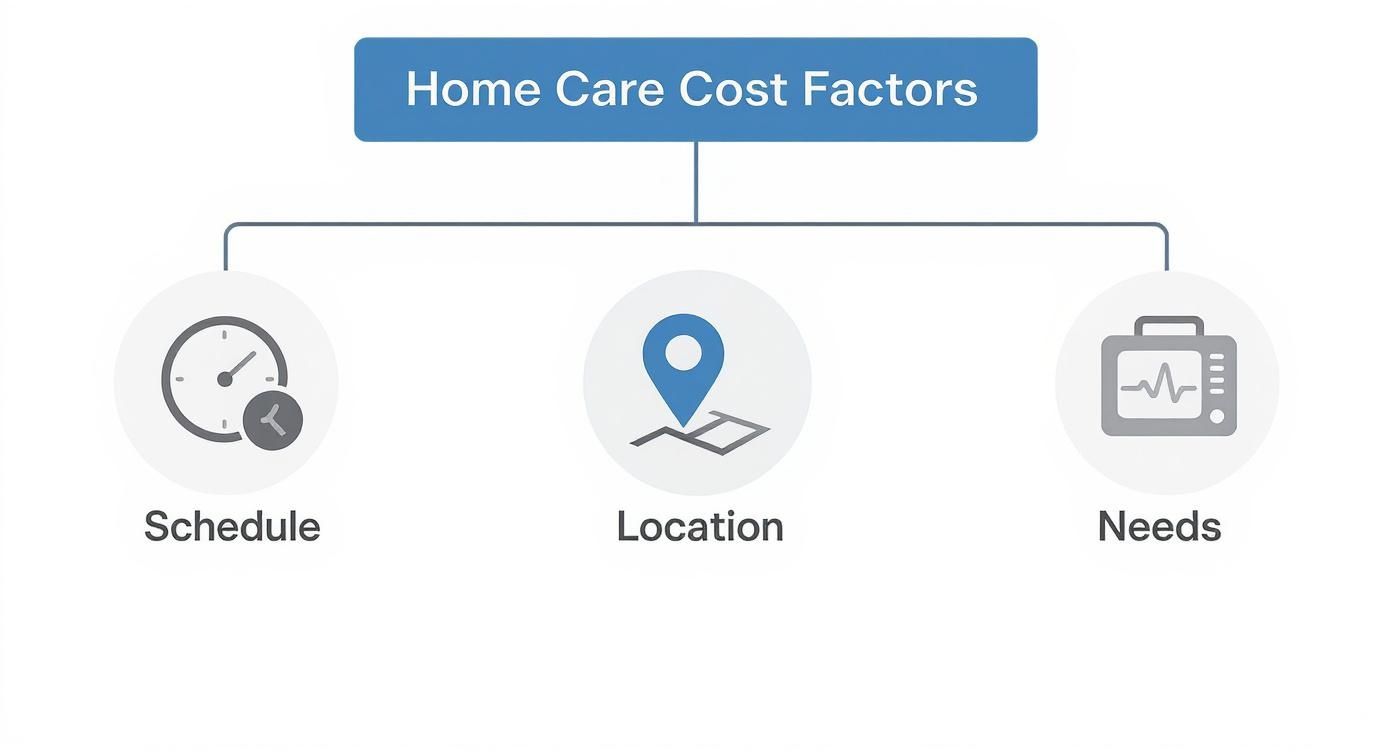
It’s like a decision tree—each choice you make, from the hours of care needed to the complexity of that care, directly shapes the final bill.
Exploring Private Payment Options
Beyond government aid, there are several private ways to fund home care. These routes often give families more flexibility and control over the care their loved one receives.
To make sense of the landscape, here is a quick summary of the primary ways people pay for care.
Home Health Care Payment Options at a Glance
| Payment Method | Typical Coverage | Eligibility Highlights | Best For |
|---|---|---|---|
| Medicare | Short-term, intermittent skilled nursing and therapy after a qualifying event. | Must be certified as "homebound" and under a doctor's plan of care. Strict criteria. | Post-hospitalization recovery or short-term rehabilitation at home. |
| Medicaid | Long-term personal care, custodial care, and skilled nursing. | Based on income and assets. Rules vary by state (NJ has specific waiver programs). | Individuals with limited income/assets needing ongoing, long-term personal care. |
| Private Pay | Any and all services. No restrictions. | No eligibility requirements. Based on personal financial resources. | Families who want maximum flexibility and control or who don't qualify for aid. |
| Long-Term Care Insurance | Varies by policy, but typically covers personal care, skilled nursing, and companion care. | Based on the policy's terms (benefit amounts, elimination periods). | Individuals who planned ahead and purchased a policy to protect their assets. |
Let's dig a little deeper into the most common private options.
-
Long-Term Care Insurance: This is a specific type of policy you buy to cover future care costs. The details matter, so you have to check the "elimination period" (how long you wait before benefits start) and the daily benefit amount.
-
Veterans' Benefits: Veterans and their surviving spouses might be eligible for help through the Department of Veterans Affairs (VA). Programs like Aid and Attendance can provide a pension benefit to help cover in-home care costs if you qualify based on service, income, and medical need.
-
Private Pay (Out-of-Pocket): Many families simply pay for care directly using personal savings, retirement funds, or even assets like a reverse mortgage. This approach gives you the most freedom to choose your provider and customize a care plan without jumping through hoops.
Practical Strategies to Manage Home Care Expenses

Now that you have a clearer picture of the costs and payment options, we can talk about making care more affordable. Managing the average cost of home health care isn't about cutting corners on quality. It's about being smart, strategic, and informed.
With the right approach, you can keep a handle on your budget while making sure your loved one gets the excellent support they deserve.
It all starts with a detailed care plan. Think of this as your financial blueprint. Instead of a vague request for "help around the house," get specific. Document every single task, from medication reminders and meal prep to assistance with bathing. This level of detail ensures you’re only paying for the services you actually need, stopping unnecessary costs before they start.
Maximize Your Financial Resources
Beyond the big-ticket payment methods, there are quite a few programs and financial tools that can ease the burden. Many New Jersey families just don't know what's available to them on a local and state level, but tapping into these resources can make a world of difference.
-
Explore State and Local Programs: New Jersey has several programs aimed at helping seniors and individuals with disabilities. It’s worth looking into initiatives like the Jersey Assistance for Community Caregiving (JACC) program or your local Area Agency on Aging. They often provide grants or subsidies for home care.
-
Utilize Respite Care: If you’re a family caregiver, you need a break. Burnout is real. Respite care gives you that break by having a professional step in for a few hours or a few days. It's much more cost-effective than hiring someone full-time and is absolutely essential for your own well-being.
Don’t forget to look into broader financial strategies, too. For instance, exploring new senior tax deductions can free up funds that can then be put toward care. Every dollar you save elsewhere is a dollar you can invest in your loved one's well-being.
Agency Care vs. Private Hire: A Key Financial Decision
One of the biggest choices you'll face is whether to hire a caregiver through a professional agency or find someone privately. On the surface, a private hire might look cheaper. But it’s critical to look at the whole picture, because it comes with significant financial risks and responsibilities.
Choosing between an agency and a private hire is not just a financial calculation; it's a risk assessment. An agency provides a comprehensive safety net that includes insurance, background checks, and backup care—protections that are often absent when hiring an individual directly.
Let’s put the two options side-by-side to see what the true costs really are.
| Feature | Professional Agency (e.g., NJ Caregiving) | Private Hire (Independent Contractor) |
|---|---|---|
| Screening & Training | Caregivers are thoroughly vetted, background-checked, bonded, and insured. They receive ongoing professional training. | You are responsible for conducting background checks, verifying credentials, and managing all training. |
| Taxes & Payroll | The agency handles all employer responsibilities, including payroll taxes, Social Security, and workers' compensation. | You become the employer. You must manage payroll, withhold taxes, and secure liability and workers' comp insurance. |
| Reliability & Backup | If a caregiver is sick or unavailable, the agency provides a qualified replacement, ensuring uninterrupted care. | If your caregiver calls out, you are left without support and must find a replacement on your own, often in an emergency. |
| Supervision & Quality | A licensed nurse or care manager oversees the care plan and provides ongoing supervision to ensure high standards. | You are solely responsible for managing the caregiver's performance and resolving any issues that arise. |
While a private caregiver's hourly rate might seem lower, the hidden costs and legal duties can pile up fast. Working with a reputable agency gives you financial predictability and something you can't put a price on: peace of mind. In the long run, it's often the smarter and safer investment.
So, What's Your Next Move?
Getting your head around the world of home health care—from the different types of services to what it all costs—can feel like a huge task. But you've done the hard work, and now you have a solid grasp of the basics. The next step is turning that knowledge into a real, concrete plan for your family.
This is where you start to bring clarity to the situation. It begins with taking an honest look at what your loved one truly needs, day in and day out. From there, you can sketch out a rough budget based on the cost factors we've walked through and start thinking about which payment options actually make sense for you. The key is to break this big decision down into smaller, more manageable pieces so it doesn't feel so overwhelming.
Your Quick-Start Care Planning Checklist
To help you get organized, here’s a simple checklist to get you started. Answering these questions will arm you with the information you need to have a truly productive conversation with any home care agency.
- Jot down all the daily needs. Make a detailed list of every single activity your loved one could use a hand with. Think about everything from bathing and dressing to making meals and getting medication reminders. The more specific you are, the better.
- Outline a ballpark budget. Using the New Jersey cost ranges we talked about, what’s a realistic weekly or monthly number for your family? Make a note of which payment options (private pay, long-term care insurance, etc.) are on the table for you.
- Prep your questions. Put together a list of must-ask questions for any agency you speak with. You'll want to ask about how they screen and train their caregivers, what their backup plan is if a caregiver can't make it, and how they handle emergencies.
Taking these steps isn't just about logistics; it’s about feeling in control. When you walk into a care consultation with clear notes and thoughtful questions, you put yourself in the driver's seat to make the absolute best choice for the person you care about.
Let's Talk About Your Situation
While this guide gives you a great overview of the average cost of home health care, every family's story is different. The only way to get a truly accurate price tag is to have a professional walk through your specific needs. This is where all the pieces—your loved one’s needs, your ideal schedule, and your location—come together.
We invite you to take the most important next step: schedule a no-obligation chat with our team at NJ Caregiving. We’ll sit down, listen to your story, understand your challenges, and help you build a personalized care plan with a completely transparent cost breakdown. Let us help you find that perfect balance of compassionate support and financial peace of mind.
Answering Common Questions About Home Care Costs
Once you start digging into the numbers, a lot of specific questions pop up. It’s one thing to know the average cost of home health care, but it’s another thing entirely to figure out how those numbers apply to your family.
Let's clear up some of the most common points of confusion we hear from families every day. Think of this as the practical Q&A you need to move forward with confidence.
Does Medicare Pay for 24-Hour Home Care?
This is probably the biggest misconception out there, so let's get right to it. The straightforward answer is no, Medicare does not cover 24-hour home care.
Medicare’s role is to fund short-term, skilled medical care—think a nurse or a therapist coming to the house for a limited time after a hospital stay. It was never designed to pay for long-term "custodial" care, which is the day-to-day help with things like bathing, meals, or just being there for safety. That's a crucial difference to understand when you're planning a budget.
We break this down in more detail in our guide on how Medicare covers home health services.
What Is the Cost Difference Between a Home Health Aide and a Skilled Nurse?
The price gap between a home health aide and a skilled nurse comes down to one thing: their level of medical training and what they are legally allowed to do. A skilled nurse (an RN or LPN) will always cost more per hour, and for good reason.
- Skilled Nurse (RN/LPN): These are licensed medical professionals. They handle complex medical tasks like giving injections, managing IVs, complex wound care, and monitoring serious health conditions.
- Home Health Aide (HHA): An HHA provides wonderful, hands-on personal care. They help with activities of daily living like getting dressed, bathing, moving around safely, and providing companionship.
It's like the difference between hiring a master electrician and a handyman. You call the electrician for a specialized, licensed job like rewiring the house. You call the handyman for general repairs. Both are incredibly valuable, but their skill sets—and their rates—are very different.
How Can I Get an Exact Quote for Home Care in Mercer County?
While the averages in this guide give you a solid ballpark, the only way to get a firm, reliable number is with a professional care assessment. The average cost is just that—an average. Your final cost will depend entirely on your family's unique situation.
A reputable agency will always offer a free, no-pressure consultation. A care manager will sit down with you, listen to what you need, understand the schedule you have in mind, and assess the level of support required. From that conversation, they can build a personalized care plan and give you an exact, transparent price. No more guessing.
At NJ Caregiving, we believe in complete transparency. Let us help you create a detailed care plan with a clear, upfront cost breakdown tailored to your family. Reach out today for a complimentary consultation at https://njcaregiving.com.