
A nursing care plan for anxiety isn't just paperwork—it's a living, breathing strategy. Think of it as a detailed roadmap that lays out a patient's specific anxiety-related challenges, the goals we're aiming for, and exactly how we'll get there. It’s what transforms our care from just reacting to symptoms to proactively improving someone’s well-being.
Why a Structured Anxiety Care Plan Is Essential
When we're talking about older adults, anxiety is much more than just a case of the "worries." It's a serious health issue that demands a thoughtful, structured response. This is especially true in home care, where nurses often work on their own. A formal care plan ensures we're all on the same page, providing consistent, goal-oriented support instead of just putting out fires.
We need this structured approach now more than ever. Anxiety isn't a niche issue; it's become incredibly common. Between 1990 and 2021, the global prevalence shot up from 3.7% to 4.4%. To put that in perspective, in 2019, an estimated 301 million people were living with an anxiety disorder. It's the most common mental health condition out there, and that reality shapes our daily nursing practice.
The Strategic Value of a Care Plan
A well-crafted care plan does more than just help a patient "feel better"—it creates a framework for real, measurable progress and benefits everyone involved.
Here’s a quick look at the core components of a solid plan.
Core Components of an Anxiety Nursing Care Plan
| Component | Purpose in the Care Plan |
|---|---|
| Assessment | The foundation. Gathers all subjective and objective data about the patient's anxiety. |
| Nursing Diagnosis | The "why." Identifies the specific anxiety-related problem (e.g., Anxiety, Ineffective Coping). |
| Goals & Outcomes | The destination. Sets clear, measurable, patient-centered goals (SMART goals). |
| Interventions | The roadmap. Outlines specific nursing actions to help the patient achieve their goals. |
| Evaluation | The progress check. Assesses how well the interventions are working and if goals are being met. |
Each of these pieces works together to create a powerful tool for better care.
Real-World Advantages
So, what does this look like in practice? A solid plan delivers tangible benefits:
- Consistency of Care: It makes sure that every caregiver—from the primary nurse to a weekend respite aide—is using the same effective approaches. No more guesswork.
- Patient Empowerment: We build the plan with the patient, not just for them. Involving them in goal-setting gives them a sense of control and ownership over their health.
- Clear Direction: The plan is our playbook. It gives nurses an actionable guide, which builds clinical confidence and reduces ambiguity in complex situations.
- Measurable Outcomes: We define what success looks like from the start. This allows us to track progress objectively and tweak the plan when something isn't working.
A care plan is the central communication hub for the entire team—the nurse, the doctor, the family, and most importantly, the patient. It pulls everyone's efforts together toward the same goals, preventing fragmented care.
Ultimately, a structured plan elevates the quality of care we can provide. It supports the patient's mental and physical health and also protects us, the caregivers. We know that maintaining caregiver mental health is absolutely vital for providing compassionate, sustainable support. A clear, effective plan helps reduce the stress and uncertainty that can so easily lead to burnout.
Conducting a Compassionate Anxiety Assessment
A truly effective nursing care plan for anxiety doesn't start with a checklist—it starts with a conversation. The foundation for every successful intervention is a thorough, empathetic assessment. This is especially true when caring for seniors, as anxiety often wears a disguise, showing up as physical complaints or even cognitive changes.
Our job as nurses is to look beneath the surface. For an older adult, anxiety might not sound like, "I feel worried all the time." It's more likely to look like unexplained fatigue, a sudden onset of stomach problems, or uncharacteristic irritability. The first step to uncovering these clues is simply creating a safe, unhurried space for them to talk.
Looking Beyond the Obvious Symptoms
A holistic assessment means exploring the physical, psychological, and social parts of a patient’s life. Think of yourself as a detective, gently gathering pieces of a puzzle until you can see the whole picture.
I always start by observing and asking about physical signs. Many older adults are far more comfortable discussing a racing heart than a racing mind.
- Cardiovascular Signs: Are they having palpitations or shortness of breath that isn't explained by their known cardiac history?
- Gastrointestinal Issues: Have they mentioned recent nausea, diarrhea, or that classic "nervous stomach"?
- Neurological Clues: Do they bring up dizziness, headaches, or trembling? Unexplained, persistent fatigue is another huge red flag.
Once you’ve opened the door with physical symptoms, you can carefully probe into the psychological side of things. Open-ended questions are your best friend here. Instead of asking, "Are you anxious?" which can feel clinical, try something gentler like, "Tell me about what’s been on your mind lately."
Your assessment isn't an interrogation; it's an act of building trust. The goal is to understand the patient’s unique experience of anxiety, which gives you the insight needed to create a truly personalized and effective care plan.
Using Questions and Tools to Guide the Conversation
The right questions can unlock a wealth of information. Don't forget to ask family members about recent changes or persistent patterns they've noticed, too.
- "Have you found yourself worrying more than usual about everyday things?"
- "What situations seem to make you feel most uneasy or on edge?"
- "Have there been any big changes at home recently?"
While conversation is king, standardized tools give us the objective data we need to back up our clinical judgment. Using validated anxiety assessment tools like the GAD-7 or the Geriatric Anxiety Inventory (GAI) can help quantify symptoms and, just as importantly, track progress over time. These aren't a replacement for our nursing skills, but they're a fantastic supplement.
You can see how these specific questions fit into a larger evaluation by reviewing a comprehensive home health care assessment form. This helps put everything in context. https://njcaregiving.com/home-health-care-assessment-form/
Understanding the bigger picture also helps. In 2022, about 20% of American adults experienced anxiety symptoms, yet a significant care gap remains. This statistic really highlights the critical role we play in identifying and addressing this common but often overlooked condition. Your careful, compassionate assessment is the very first step toward closing that gap for your patient.
Once your assessment has painted a clear picture of what the patient is going through, it’s time to put that information into a formal nursing diagnosis. This isn't just about sticking a label in their chart. A sharp, accurate NANDA-I diagnosis is what connects your assessment to your actions, making sure everything you do is targeted and has a real purpose.
The idea is to get more specific than just "Anxiety." While that might be true, it doesn't really tell you what problem you need to solve. A more useful diagnosis gets to the root of the issue, which is the key to an effective nursing care plan for anxiety. Think about diagnoses like Ineffective Coping, Fear, or even Social Isolation—these give you a much clearer target to aim for.
Building a Diagnosis You Can Act On
Every solid nursing diagnosis tells a complete story in three parts: the problem, the cause, and the proof.
- The Problem: This is the official NANDA-I diagnosis you've selected (e.g., Ineffective Coping).
- The Cause ("Related to"): This is the "why." What factors from your assessment are feeding into this problem?
- The Evidence ("As Evidenced By"): This is where you show your work. What specific signs and symptoms—both what the patient tells you (subjective) and what you see (objective)—back up your diagnosis?
For example, simply writing "Anxiety" is vague. A much more powerful and actionable version looks something like this:
Ineffective Coping related to recent loss of spouse and changes in living situation, as evidenced by patient stating, “I just can’t seem to handle being alone,” frequent episodes of crying, and neglecting personal hygiene.
This detailed statement immediately lets any nurse on the care team know exactly what's wrong, what's causing it, and how it's showing up for this particular patient. It’s a clear roadmap for what to do next.
Making the Diagnosis Fit the Person
Anxiety doesn't look the same on everyone, so your diagnoses shouldn't be a one-size-fits-all solution. A patient who is terrified of falling after being in the hospital will have a very different "why" than someone who feels isolated after losing their driver's license.
Getting this right is more important than ever, especially with the growing need for mental health support in our communities. Good nursing care for anxiety has to acknowledge the rising epidemiologic burden of these disorders. For instance, from 1990 to 2021, the prevalence of anxiety disorders among women of childbearing age jumped by about 77%. Statistics like this underscore why we need to be doing targeted screening and crafting diagnoses that truly reflect a patient’s unique life circumstances. You can learn more about these important public health findings00451-5/fulltext) to inform your practice.
When you formulate a diagnosis that is specific and centered on the patient, you lay the foundation for interventions that can actually make a difference—tackling the cause of their distress, not just the symptoms.
Setting SMART Goals and Practical Interventions
Once you've landed on a solid nursing diagnosis, the care plan shifts from observation to action. This is where we start setting goals and picking the right interventions to guide your patient toward feeling more at ease.
The biggest mistake I see is setting vague goals like "the patient will feel less anxious." That's not a target; it's a wish. To make real progress, we need to get specific.
That's why the SMART framework is a nurse's best friend. It ensures every goal is Specific, Measurable, Achievable, Relevant, and Time-bound. It turns a fuzzy idea into a clear objective that you, the patient, and the rest of the care team can actually work toward.
Crafting Goals That Drive Action
Think about the difference it makes. A vague goal leaves you guessing. A SMART goal gives you a roadmap and a finish line.
- Vague Goal: Patient will have less anxiety.
- SMART Goal: "Patient will identify and verbalize two personal anxiety triggers to the nurse during daily visits within the next three days."
- SMART Goal: "Patient will demonstrate the 4-7-8 deep breathing technique to manage feelings of panic before scheduled doctor's appointments, starting this week."
This kind of clarity makes it easy to see what's working. It also gives you and your patient a shared purpose and a way to celebrate those small but incredibly meaningful wins together.
The process of building a nursing diagnosis, which you can see in the infographic below, flows right into setting these kinds of targeted goals. You've already identified the cause and the symptoms—now you just have to address them.
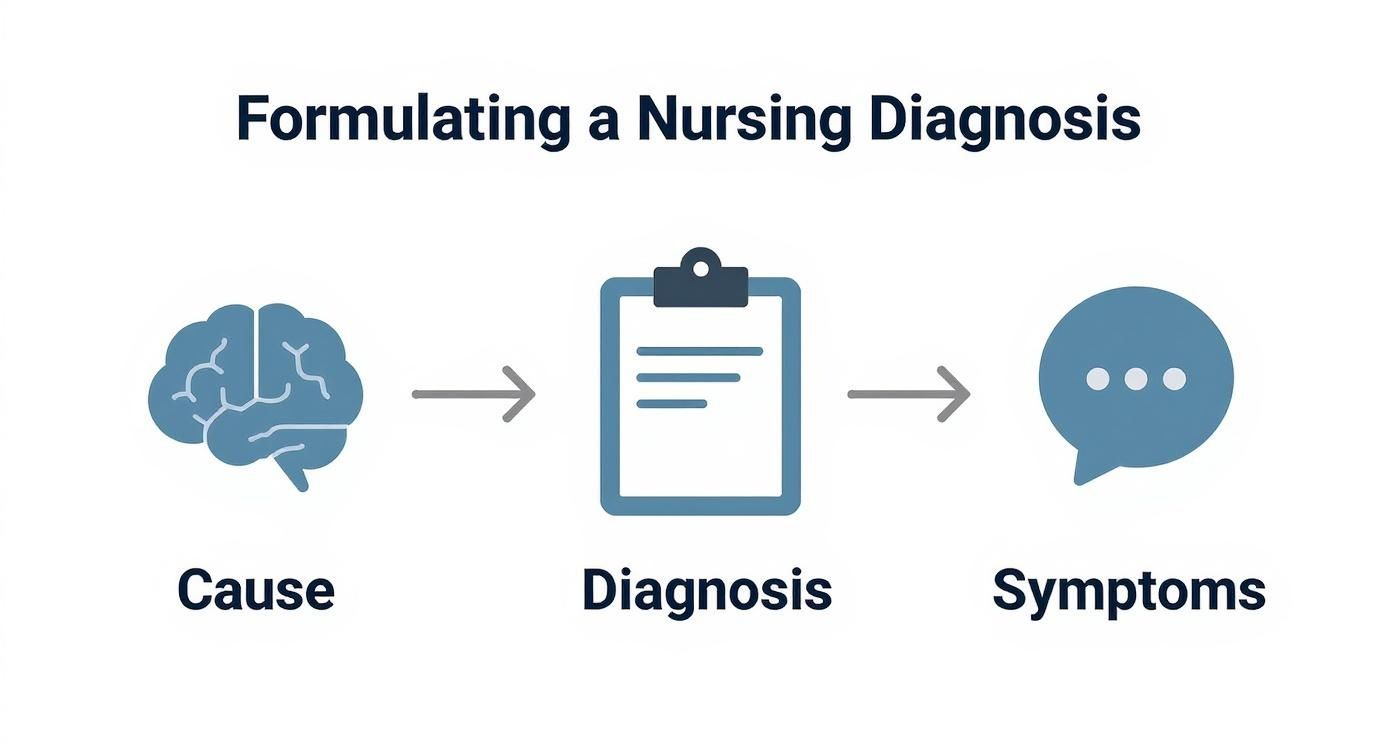
As the visual shows, once you understand the underlying cause and can see the symptoms, you can land on a precise diagnosis. That diagnosis is your launchpad for creating goals and interventions that will actually make a difference.
Choosing Evidence-Based Nursing Interventions
With your goals locked in, it’s time to choose the interventions that will get your patient there. In my experience, the best approach is a blend of non-pharmacological techniques and well-coordinated medication management. Implementing practical strategies for coping with anxiety is key to giving people the tools they need for calmer days.
Our interventions generally fall into two buckets: hands-on, non-drug strategies and collaboration with prescribers on medication.
Non-Pharmacological vs. Pharmacological Interventions
| Intervention Type | Examples | Nurse's Role |
|---|---|---|
| Non-Pharmacological | Mindfulness, deep breathing (e.g., box breathing), progressive muscle relaxation, establishing daily routines, guided imagery. | Educator & Coach: Actively teaching and demonstrating techniques. Guiding the patient through exercises during visits to build their confidence and skill. |
| Pharmacological | Anxiolytics (e.g., benzodiazepines), SSRIs, beta-blockers. | Observer & Advocate: Administering medication, monitoring for therapeutic effects and side effects, educating the patient and family, and collaborating with the prescriber. |
Both approaches are vital for holistic care. Non-pharmacological strategies empower the patient, while medication can provide necessary stability. As a nurse, you're the one who makes sure these two pieces work together seamlessly.
Non-Pharmacological Strategies You Can Use Today
These are the tools you can teach your patients that they can use anytime, anywhere. They are the foundation of any good anxiety care plan.
- Mindfulness and Breathing: Teach simple but powerful techniques like box breathing or guided imagery. Actually walk them through it. I often say, "Let's try one together. Breathe in for four counts… hold it… now let it out slowly for six."
- Progressive Muscle Relaxation: This is a fantastic one for physical tension. Guide the patient to systematically tense and then release different muscle groups, starting from their toes and working their way up to their face. The physical release often triggers a mental calm.
- Establishing a Routine: For many seniors, especially those living at home, a loss of structure can be a huge source of anxiety. Helping them map out a predictable daily schedule for meals, gentle activity, and rest can be incredibly grounding.
The most powerful interventions are often the simplest. Teaching a patient just one reliable relaxation technique gives them a sense of control that can fundamentally change their relationship with anxiety.
Coordinating Medication Management
Your role in medication management goes far beyond just administering pills. You are the eyes and ears on the ground—a critical link between the patient and the prescriber.
This means you’re responsible for:
- Patient Education: Explaining what each medication is for, the correct dose, and potential side effects in plain, easy-to-understand language.
- Monitoring Efficacy: Asking specific questions that get you real answers. Instead of "Is the pill working?" try, "Since starting the new medication, have you noticed any difference in how often you feel worried?"
- Assessing Side Effects: Keeping a sharp eye out for common side effects like drowsiness, dizziness, or dry mouth. Ask about them directly and document everything meticulously.
- Collaborating with Prescribers: Giving the doctor or NP clear, objective feedback on the patient’s response is essential. Your detailed notes are what allow for timely and effective adjustments to their treatment plan.
Integrating these interventions creates a powerful support system. For families just starting this journey, understanding the full scope of available mental health services for seniors is a vital step toward ensuring their loved one gets the comprehensive care they deserve.
Anxiety Care Plan in Action: A Case Study
Theory is one thing, but seeing how a care plan comes together for a real person makes all the difference. Let’s walk through a realistic scenario to see these steps in action.

Meet Mrs. Davis. She's an 82-year-old widow who lives on her own. Recently, she took a fall. While she was lucky to escape with only minor bruises, the experience has left her shaken. She’s now intensely fearful of moving around her home, which has led to her isolating herself and constant worrying.
Her daughter is concerned, noting that Mrs. Davis has stopped attending her weekly bridge club and often calls her in a state of panic. This is where we, as home care professionals, step in.
Assessment Summary
During our initial visit, we gather key subjective and objective information.
Mrs. Davis tells us directly, “I’m terrified I’ll fall again when no one is around.” She also reports sleeping poorly, feeling constantly "on edge," and having a poor appetite.
Objectively, we can see she’s restless—she’s frequently wringing her hands. Her heart rate is also a bit elevated at 98 bpm during our conversation. This data gives us a clear picture of her anxiety and its triggers, allowing us to form specific nursing diagnoses.
Sample Care Plan for Mrs. Davis
Here is a structured plan designed to address her specific needs. This format keeps goals and interventions organized, making it easy for the entire care team to stay on the same page.
Patient: Mrs. Davis, 82-year-old female
Primary Medical Diagnosis: Generalized Anxiety Disorder (exacerbated by recent fall)
Nursing Diagnoses, Goals, and Interventions
| Nursing Diagnosis | SMART Goal | Nursing Interventions & Rationale |
|---|---|---|
| 1. Anxiety related to fear of falling and uncertainty about the future, as evidenced by patient stating, "I'm terrified," restlessness, and elevated heart rate. | Patient will demonstrate two effective coping mechanisms (e.g., deep breathing, guided imagery) to reduce feelings of panic, reporting a subjective anxiety level below 4/10 within one week. | 1. Teach Deep Breathing: Instruct on the 4-7-8 breathing technique during visits. Rationale: This provides a tangible, in-the-moment tool to manage acute anxiety and empowers Mrs. Davis with a sense of self-control. 2. Establish a Safety Routine: Work with Mrs. Davis to create a "safe mobility" checklist for her to mentally review before standing up. |
| 2. Risk for Social Isolation related to fear of leaving home, as evidenced by withdrawal from her bridge club and decreased social interaction. | Patient will initiate one phone call to a friend or family member for a social chat at least three times per week, starting this week. | 1. Schedule Social Contact: Help Mrs. Davis pencil specific times into her daily schedule to make these calls. Rationale: By building social interaction back into her routine, it becomes a planned activity rather than an overwhelming task. 2. Explore Low-Risk Social Options: Discuss the possibility of inviting a friend over to her home for a short visit. |
This example shows how a personalized plan flows logically from assessment to diagnosis to action. Each intervention is tied directly to a measurable goal, which in turn addresses a clearly defined problem. By breaking her challenges down into manageable pieces, we create a clear, actionable path toward improving her well-being and restoring her confidence.
Evaluating Progress and Documenting Outcomes
A nursing care plan for anxiety isn't a "set it and forget it" kind of document. It's a living, breathing guide that has to evolve with your patient. The final—and most crucial—loop in the process is evaluating progress and documenting what you see. This is where you measure your impact, fine-tune your approach, and tell the patient's story clearly.
Effective evaluation always starts by going back to the SMART goals you set in the beginning. Were they met? Partially met? Not at all? The answer isn't about passing or failing; it's vital information that tells you what to do next. This means you need to look at objective signs and, just as importantly, ask the patient for their direct feedback.
For instance, if a goal was for the patient to use a specific breathing technique, don't just ask, "Did you do your breathing exercises?" A much better way is to ask, "Can you show me that 4-7-8 breathing technique we practiced?" Seeing them do it gives you a real, unfiltered look at their progress and how confident they feel using it.
The Power of Precise Documentation
How you document this progress is every bit as important as the evaluation itself. Your notes are the foundation of good continuity of care. Clear, objective, and detailed entries prove the value of what you're doing and make sure the entire healthcare team is on the same page.
Using a structured format like SOAP or DAR notes can really help keep things organized.
- SOAP Notes: This classic format—Subjective, Objective, Assessment, Plan—helps organize your thinking from what the patient tells you to what you plan to do next.
- DAR Notes: This is a more action-focused format: Data, Action, and Response. It hones in on the data you gathered, the nursing action you took, and how the patient responded.
Your documentation needs to paint a vivid picture. A note that just says "Patient less anxious today" is vague and doesn't help anyone. But a note that reads, "Patient reported anxiety at 3/10, down from 7/10 yesterday. Independently initiated deep breathing exercises when discussing upcoming doctor's appointment" is powerful. It's measurable and tells a clear story of progress.
Adjusting the Plan When Needed
So, what do you do when a patient isn't getting better? This is where the evaluation process really proves its worth. If goals aren't being met, it's a signal to reassess, not to feel like you've failed.
It’s time to ask some tough questions, both of yourself and the patient:
- Is the goal we set still realistic for them right now?
- Are the interventions we chose a good fit for their personality and physical abilities?
- Have any new stressors or problems popped up that we need to deal with?
Sometimes, the fix is a simple tweak, like switching from guided imagery to progressive muscle relaxation because the patient finds it easier to follow. Other times, you might need to have a deeper conversation with their primary care provider or a mental health specialist. Your detailed documentation is the solid evidence you'll need to advocate for these changes.
This continuous cycle of planning, intervening, evaluating, and documenting is the engine that drives a successful nursing care plan for anxiety.
At NJ Caregiving, we understand that exceptional care is built on a foundation of detailed planning and compassionate follow-through. Our skilled nurses specialize in creating and implementing personalized care plans that address the unique needs of seniors in Mercer County. If you're looking for dedicated in-home nursing support, learn more about our services.
