
If you're looking into NJ FamilyCare, the first step is to check if you're eligible and start gathering the right paperwork. While you can get help over the phone or at your County Welfare Agency, the quickest and easiest way to get the ball rolling is by applying online through the official portal.
Your Quick Guide to the NJ FamilyCare Application
Applying for any kind of health insurance can feel overwhelming, but don't let it be. The key is to see it not as one giant hurdle, but as a series of manageable steps. Think of this guide as your roadmap for navigating how to apply for NJ FamilyCare.
Before you get lost in the details, it helps to see the big picture. The state has set up a clear process to make sure eligible families and individuals in New Jersey get the health coverage they need without a ton of hassle.
- You'll know exactly what documents you need from the get-go, which helps avoid those frustrating back-and-forth delays.
- You have options. Whether you’re comfortable online, prefer paper and mail, or want some in-person help, there's a method that fits your needs.
- Every application goes through the same organized review, so you can trust the process is fair.
This infographic breaks down the journey into a simple, three-stage flow.
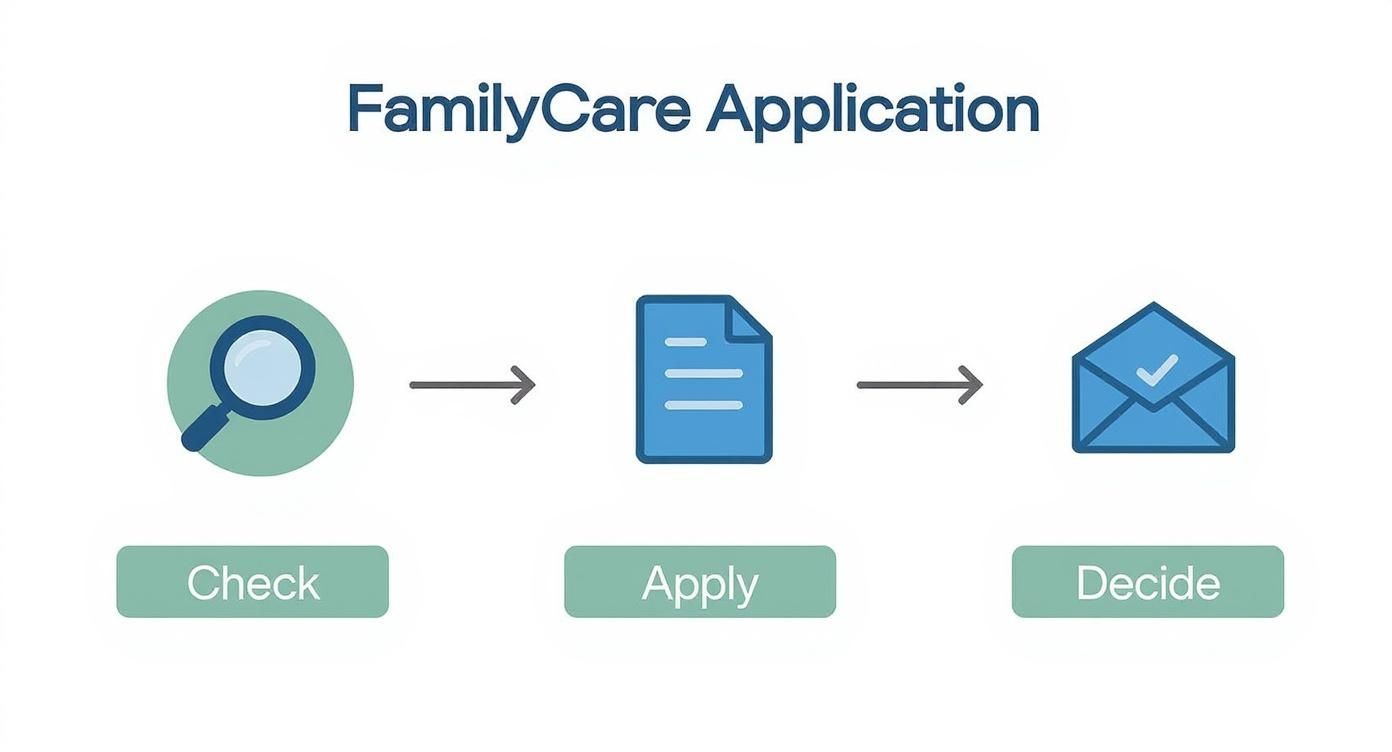
As you can see, it really boils down to checking your eligibility, sending in your application, and then waiting for the decision.
The Application Journey at a Glance
To give you an even clearer picture of what to expect, I've put together a table that outlines each phase of the process. Consider it a quick reference guide that lays out the main task for each stage and a general idea of how long it might take. This way, you can set some realistic expectations.
NJ FamilyCare Application Process at a Glance
| Stage | Key Action | Estimated Timeframe |
|---|---|---|
| Preparation | Determine eligibility and gather all necessary documents | 1-3 days |
| Submission | Complete and submit the application online, by mail, or in person | 1-2 hours |
| Review & Decision | The state reviews your application and sends an official notice | 30-45 days |
Having this timeline in mind helps you know what's happening behind the scenes after you've submitted all your information.
Figuring Out if You Qualify for NJ FamilyCare
Before you jump into the application, it’s a good idea to quickly check if you and your family are likely to qualify. Think of it as a preliminary step that can save you a whole lot of time down the road. NJ FamilyCare primarily looks at your household income, how many people are in your family, your residency, and for some, your immigration status.
These guidelines are in place to make sure the program gets to the New Jersey residents who need it most. Let's break down what that actually means for you.
Getting a Handle on the Income and Household Rules
The biggest piece of the puzzle is your household's monthly income. NJ FamilyCare uses a figure called Modified Adjusted Gross Income (MAGI), which is basically the income you put on your tax return, plus a few things added back in. The income limits aren't a single number for everyone; they change depending on who in your family needs coverage.
For instance, a family of four will have a different income limit for their kids than they will for the adults. This tiered approach is designed to cast a wider net for children and pregnant individuals.
One of the most common things I hear is that people assume their income is too high to qualify. While the limits for adults are on the stricter side, the income levels for children and pregnant individuals are much more generous than most people realize, opening the door for many working families.
The program uses the Federal Poverty Level (FPL) as its guidepost. For the most part, eligibility is based on the MAGI from your most recent federal tax return. Children under 19 can often qualify if the family income is up to 355% of the FPL—that’s about $9,512 a month for a family of four. Adults (ages 19-64) usually need an income at or below 138% FPL, which is around $1,800 a month for one person. Pregnant individuals have a higher limit of 205% FPL. You can dig into the specifics on the official NJ FamilyCare site.
Residency and Immigration Status Requirements
Besides income, you have to be a New Jersey resident to apply. That’s pretty straightforward for most people. The part that can feel a bit more confusing is the rules around immigration status, but they are actually quite specific.
Here’s the general breakdown:
- Children Under 19: Often eligible for coverage, no matter their immigration status.
- Pregnant Individuals: Just like with kids, they may also qualify regardless of their immigration status.
- Most Other Adults: Typically, immigrant adults need to be legal permanent residents (Green Card holders) for at least five years to be eligible.
It's important to know there are key exceptions to that five-year wait. People with certain statuses, like refugees or asylees, might be able to get NJ FamilyCare without waiting. If you think you fall into one of these categories, you should absolutely still apply and submit your documents. It ensures everyone who might be eligible gets a fair look. Knowing these details upfront helps you move forward with your application confidently.
Gathering Your Essential Application Documents
Getting your paperwork in order before you even start the application is the secret to making this whole process go smoothly. Trust me, it saves you from that frustrating scramble to find a missing document right when you're in the middle of everything. It’s like prepping all your ingredients before you start cooking—it just makes life easier.
We’ll walk through exactly what you need, breaking it down into simple categories. This way, you can tackle it one step at a time, which makes it feel a lot less overwhelming. It's also smart to be mindful of how you handle this information; understanding things like HIPAA compliant document sharing can give you peace of mind when submitting sensitive documents.
The official NJ FamilyCare website is your best starting point for figuring out what to pull together.
This is the portal where you'll apply online and check on your status, so it's a good idea to get comfortable with it early on.
Proof of Identity for All Applicants
First things first, the state needs to know who you are. They have to verify the identity of every single person in your household applying for coverage.
Typically, you can use one of these for each family member:
- A valid U.S. Passport or Passport Card
- Your New Jersey Driver's License or State ID card
- A U.S. birth certificate
- Naturalization or citizenship certificate
For kids, a birth certificate is almost always the go-to document. Just remember to have one for everyone on the application.
Confirming Your New Jersey Residency
Next up, you have to show that you actually live in New Jersey. This one is usually pretty straightforward, and you’ve got a few different ways to prove it.
A recent utility bill (gas, electric, or water) with your name and address is often the simplest option. You could also use a signed lease agreement, a mortgage statement, or even an official letter from a government agency that was mailed to your New Jersey address. The key is to make sure the document is recent, usually from within the last 60 days.
Documenting Your Household Income
This part is critical. Providing accurate proof of your income is probably the most important step in the whole application, and getting it right helps you avoid major delays. You’ll need to show what your household is currently earning on a monthly basis.
A word of advice: don't estimate or guess your income. Use the exact numbers from your documents. Giving the state the correct information from the start speeds up their review and leads to an accurate decision on your eligibility.
Grab these common income-related papers:
- Recent Pay Stubs: You’ll generally need your pay stubs from the last 30 days that show your gross pay (that’s your pay before taxes).
- Tax Returns: Your most recent federal tax return, the Form 1040, is a big one.
- Social Security or Pension Letters: If you get these benefits, you'll need the official award letters that state the amount.
- Unemployment Statements: If you're receiving unemployment, you'll need the documentation from the Department of Labor showing your benefits.
If your income isn't straightforward—maybe you're self-employed with fluctuating earnings, or you have assets close to the limit—it can be helpful to get a clearer picture of your financial standing. For those specifically navigating the Medicaid side of things, you can learn more about how assets are viewed with our https://njcaregiving.com/medicaid-spend-down-calculator/.
What to Do if You Are Missing a Document
It happens to the best of us. Maybe you can't find a birth certificate, or you get paid in cash and don't have traditional pay stubs. Don't panic.
If you’re missing a birth certificate, you can usually order a new copy from the vital records office in the state where the person was born. If you're a cash-based worker, try asking your employer for a signed letter that details your wages and how often you're paid. Even keeping a simple, consistent log of your cash payments can work as documentation. The main thing is to be proactive and provide the best information you can.
Navigating The Online Application Portal
Applying online is hands-down the fastest way to get your NJ FamilyCare application processed. The state’s digital portal is built to guide you, but knowing what to expect beforehand can make the whole experience that much smoother. Let's walk through it so you can move from one section to the next with confidence.

Think of the online form as a structured conversation. It asks for the exact same information you already gathered, just in a specific order. The real key here is to take your time and double-check every entry. It's the simple, avoidable mistakes that cause the longest delays.
Setting Up Your Account and Getting Started
First thing’s first: you’ll need to create an account on the official NJ FamilyCare portal. This just requires a valid email address and a password you create. Be sure to jot down this login info and keep it somewhere safe—you’ll need it again to check on your application status or upload more documents later.
Once you’re logged in, the system will take you through a series of screens. These generally cover:
- Applicant Information: Your basic details, like name, address, and social security number.
- Household Members: Info for every single person living in your home, even if they aren't the ones who need coverage.
- Income Details: A section to report all sources of income for everyone in your household.
- Document Uploads: The spot where you’ll attach digital copies of your proof documents.
My advice? Tackle it one section at a time. The system is pretty good about saving your progress, so you can step away and come back if you need to track down a document without losing all your work.
Tips for Common Trouble Spots
From my experience, a few parts of the application tend to trip people up more than others. Paying a little extra attention here can save you a major headache down the road.
When you get to the income section, for instance, be as precise as you possibly can. Always use your gross income (that’s the amount before taxes are taken out) directly from your pay stubs. If your income changes from week to week, the application will likely ask for an average. Do not estimate this number. A small miscalculation is a red flag that will trigger a request for more information, easily adding weeks to your processing time.
Another common pitfall is the household members section. You must list every person who lives with you. This is how the state determines your household size for eligibility calculations. Forgetting to add someone or entering an incorrect birthdate are mistakes I see all the time. Before you click "next," do a quick headcount on the screen and make sure it matches the number of people in your home.
If you're dealing with a more complex family situation or just want to understand the broader rules, our detailed guide on how to apply for Medicaid can offer more clarity.
A simple typo can be the difference between a quick approval and a lengthy delay. I've seen applications held up for weeks because a social security number was off by one digit. Reread every number you enter before clicking 'next.'
Avoiding Pitfalls Before You Submit
Before you hit that final submit button, give everything one last, careful review. This is your last chance to catch those small errors that can gum up the works. To make it easier, I've put together a table of the most frequent mistakes I see and how you can sidestep them.
Common Application Mistakes and How to Avoid Them
| Common Mistake | Why It Happens | How to Avoid It |
|---|---|---|
| Incorrect Income Reporting | Applicants often estimate their pay or report their take-home (net) pay instead of the required gross amount. | Use your most recent pay stubs and enter the exact gross pay. If you're paid weekly, a good monthly estimate is to multiply by 4.33. |
| Forgetting to Upload a Document | It's easy to get distracted or realize you don't have a document scanned and ready, then forget to come back to it. | Scan or take clear photos of all your documents before you even start the application. Keep them in a dedicated folder on your computer. |
| Typos in Personal Information | Rushing through the form is the main culprit for misspelled names or incorrect birthdates and Social Security numbers. | After you've filled everything out, take a five-minute break. Then come back and slowly read through the final summary page before submitting. |
| Listing an Incomplete Household | People get confused about who "counts" as a household member, like a spouse who isn't applying for coverage. | List every single person who lives in your home, regardless of whether they need insurance. The system handles figuring out who's included in the final calculation. |
Being mindful of these little details really sets you up for a smoother, faster process. The diligence you put in now pays off by getting you a decision much more quickly.
So, you’ve hit submit on your NJ FamilyCare application. What now?
The waiting game begins, and I know it can feel like your application has vanished into a black hole. But there's a process happening behind the scenes. Right now, the state is taking all the information you provided and starting to verify everything to make sure you qualify.
You should get an official decision letter in the mail, usually within about 45 days. While you're waiting, it’s incredibly important to become best friends with your mailbox and the online portal you used to apply. The state might just need one more document to approve your case, and getting it to them quickly can save you from a major headache or delay.
Seriously, don't underestimate how crucial this is. Simple procedural issues—like not sending back paperwork on time—were responsible for 75 percent of disenrollments for over 360,000 members during recent renewal periods. It's a staggering number that shows just how much a quick response matters. You can read more about these program dynamics in the 2025 budget response if you're interested in the details.
Understanding Your Decision Letter
When that envelope finally shows up, it's going to tell you one of three things. Each outcome kicks off a different set of next steps, so let’s break down what they mean.
You’re going to see one of these:
- Approved: This is the best-case scenario! It means you or your family members are officially eligible for NJ FamilyCare. The letter will explain which program you’ve been enrolled in and tell you what to do next, which almost always involves picking a Health Plan.
- Request for More Information (RFI): Don’t panic—this is not a denial. It just means the caseworker needs a little more information to make a final call. The letter will be very specific about what’s missing, like a more recent pay stub or a different proof of address.
- Denied: This means that, based on the information they have, you weren't found eligible for coverage. The letter will give you the specific reason for the denial.
An RFI is an incredibly common part of the process, and even a denial isn't the end of the road. If you think the decision was wrong, the denial letter is your first step toward filing an appeal.
Your Next Action Steps
Okay, you've got your letter. Now what?
If you were approved, the next big step is to choose a Managed Care Organization (MCO). Think of this as the health insurance company that will actually manage your benefits and care. You’ll get another packet in the mail with details about the MCOs available in your county so you can make your choice. Once your coverage is officially active, you'll want to be sure you know how to check your benefits. Our guide on Medicaid coverage verification is a great resource for that.
If you received an RFI, time is of the essence. Get them what they need as quickly as possible. The absolute fastest way is to upload the documents directly through the online portal. It gets the information to your caseworker instantly, whereas mailing it can add days or even weeks to the process.
And if you were denied, you have the right to appeal. Your denial letter will have detailed instructions on how to request a Fair Hearing. Pay close attention to the deadlines—you only have a certain window of time to request a hearing, so you need to act fast if you plan to challenge the decision.
Your Top Questions About NJ FamilyCare, Answered
Applying for health coverage can feel a bit overwhelming, and it's completely normal to have questions pop up along the way. I've heard just about all of them over the years, so I've put together answers to some of the most common ones we get about the NJ FamilyCare application process.
How Long Does It Take to Get Approved?
In a perfect world, the state usually makes a decision within about 45 days after they get your complete application. But that's a best-case scenario.
If your application is missing any documents or if they need to double-check something about your income or who lives in your house, it can definitely slow things down. Either way, you'll get an official decision letter in the mail, so keep an eye out for it.
Can I Apply if I’m Unemployed?
Yes, absolutely. In fact, that's one of the main reasons a program like NJ FamilyCare exists. Your eligibility isn't really about whether you have a job—it's based on your current monthly income.
If you're receiving unemployment benefits, that counts as income, so make sure you include proof of that with your application. Even if you have no income at all right now, you should still apply, as you may qualify.
Your employment status isn't the deciding factor—your household's current monthly income is. Don't assume you won't qualify without a job. The program is designed to be a safety net for exactly these situations.
What if My Income Changes After I’m Approved?
Life happens, and your financial situation can change. If it does, you're required by the state to report any significant changes to your household income or family size within 10 days. This could be anything from starting a new job, getting laid off, getting married, or welcoming a new baby.
Reporting these changes right away is crucial. It keeps you in the right coverage tier and helps you avoid any nasty surprises or coverage gaps when it's time for your annual renewal.
Does NJ FamilyCare Cover Dental and Vision?
For most people on the plan, yes, it does. NJ FamilyCare is designed to be comprehensive, going way beyond just basic doctor visits.
The coverage generally includes:
- For children: Dental, vision, and hearing services are fully covered.
- For adults: Many of these essential services are also included, though the exact details might vary depending on your specific health plan.
This makes it a true lifeline for the 1.8 million New Jersey residents who rely on it. That figure includes over 300,000 older adults and people with disabilities who often can't get things like dental or vision care through Medicare. If you want to dive deeper into how vital this program is, check out these insights from Justice in Aging.
At NJ Caregiving, we understand that navigating healthcare options is just one piece of the puzzle. If you or a loved one needs compassionate, professional in-home care to maintain independence and quality of life, we are here to help. https://njcaregiving.com
