
Getting better at taking medications often boils down to one thing: having a good system. This could mean using simple tools like pill organizers, setting up daily reminders, and, most importantly, truly understanding why you're taking each prescription in the first place.
Why Sticking to a Medication Schedule Is So Tough
Let's face it, managing a handful of different prescriptions can feel like a part-time job. For seniors and their families, trying to keep track of various pills, each with its own dosage and timing, gets confusing fast. This isn't about being forgetful or careless; it's a real-world challenge that millions of people quietly deal with every single day.
It's completely natural to feel a pang of worry or frustration when a loved one misses a dose. But the problem is almost always more complicated than just forgetting. The reasons people don't always take their medicine as prescribed are often complex and deeply personal.
The Real Reasons Doses Get Missed
If you want to find a solution that actually works, you have to get to the root of the problem. From what I've seen, it usually comes down to one of these common hurdles:
- Complicated Regimens: When you're juggling five or more medications, all with different instructions, it's a recipe for mix-ups.
- Nasty Side Effects: It's hard to stay motivated to take a pill that makes you feel dizzy, nauseous, or tired all the time.
- Financial Worries: The high cost of prescriptions can force people to make tough choices, like skipping doses or cutting pills in half to stretch a prescription.
- Feeling Overwhelmed: Sometimes, a person just feels like they're taking too many pills and decides to stop one on their own, without talking to a doctor first.
This isn't just a household issue; it's a massive public health problem. In developed countries, more than 50% of patients with chronic conditions don't take their medications correctly.
This has serious, far-reaching consequences. It leads to worsening health conditions and puts an incredible burden on our healthcare system. In the U.S. alone, failing to follow prescriptions is linked to an estimated 125,000 preventable deaths and $300 billion in avoidable healthcare costs every single year. You can read more about this global issue from the World Heart Federation.
By tackling this silent struggle with practical, empathetic solutions, we can get past the clinical talk. The real goal is to create a support system that turns medication management from a daily chore into a seamless routine.
Building a Foundation with Simple Organizational Tools
Before you even think about fancy gadgets and apps, getting the basics right can make a world of difference. The best way to improve medication consistency is to build a simple, almost foolproof system that takes the guesswork out of the daily routine. This isn't just about buying a pillbox; it's about creating a solid foundation that removes a huge mental burden from both seniors and their caregivers.
The first, and maybe most important, piece of the puzzle is the right pill organizer. A simple "S-M-T-W-T-F-S" container might be fine for someone who just takes a pill or two in the morning.
But for anyone juggling multiple medications at different times of day—morning, noon, evening, bedtime—a weekly, multi-dose organizer is a non-negotiable. These have separate little compartments for each time slot, so you can sort out an entire week's worth of medication in one sitting.
Just doing that one simple task each week can prevent the most common and dangerous mistakes, like accidentally taking a second dose or forgetting one entirely.
Creating a Medication Master Plan
A pillbox is great, but it's only half the battle. You also need a central document for clarity and safety. I like to call it a "Medication MAP" (Master Action Plan). This isn't just a list; it's the single source of truth that everyone involved in care—family, home health aides, doctors—can turn to. When I created one for my own dad, it became the most valuable piece of paper in the house, especially during doctor's visits or, heaven forbid, an emergency.
Your MAP should be clean, easy to read, and kept somewhere obvious. Think the side of the refrigerator or right next to the landline phone.
Here’s what your plan absolutely must include:
- A complete inventory of everything being taken. This means all prescriptions, over-the-counter drugs, vitamins, and supplements.
- The exact dosage and frequency for each one (e.g., "Metformin, 500mg, twice daily").
- The reason for taking each medication (e.g., "for blood sugar control"). Knowing the why is a powerful motivator.
- The prescribing doctor's name and phone number for every prescription.
- Specific instructions, like "take with a full glass of water" or "must be taken with food."
Having this detailed plan doesn't just help the person taking the meds; it empowers the caregiver. It gives you incredible peace of mind, knowing all the critical information is in one place, turning what feels like a chaotic daily task into a calm, manageable routine.
From Plan to Practice: A Real-World Example
Let's walk through what this looks like in real life. Picture a caregiver, Sarah, who helps her father. Every Sunday afternoon, she sits down and fills his multi-dose pill organizer for the week ahead. She uses his Medication MAP, which is taped to the inside of a kitchen cabinet, to double-check every single pill.
Once it's filled, she places the organizer on the kitchen counter right next to his coffee maker—a spot she knows he goes to first thing every morning.
This simple combination of a physical tool (the pillbox) and a strategic document (the MAP) completely turned his medication adherence around. For a closer look at building these systems, our guide on senior medication management offers more detailed strategies you can use right away.
By pairing the right tools with a consistent, predictable routine, you create a powerful defense against missed doses and medication errors. It makes daily life safer and a whole lot less stressful for everyone involved. Honestly, this foundational step is often the single most effective thing you can do.
Using Technology for Better Medication Adherence
In a world buzzing with smartphones and smart home gadgets, it’s no surprise that technology offers some fantastic ways to help with medication schedules. We've moved far beyond a simple alarm clock on the nightstand. Now, a whole range of tools can turn a confusing medication regimen into a simple, manageable part of the day.
This isn’t just a niche trend. The global medication adherence market was valued at around USD 4.1 billion in 2024 and is expected to balloon to USD 16.2 billion by 2034. That incredible growth, detailed in recent market analysis, is happening for a reason: an aging population and a growing comfort with digital health tools are changing how we manage wellness.
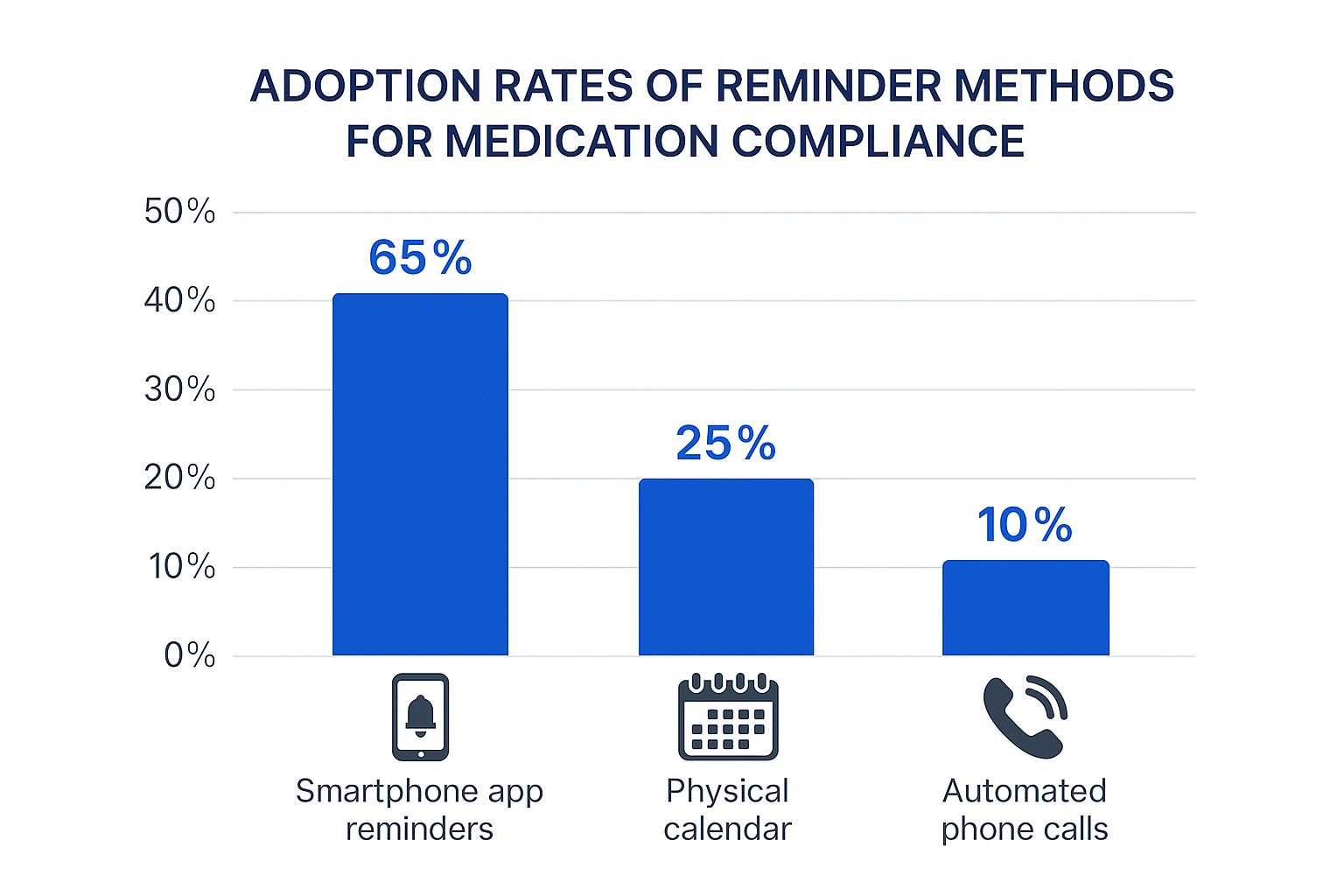
As you can see, smartphone apps are now the go-to tool for most people needing medication reminders. This really underscores the massive shift we're seeing toward digital solutions.
Finding the Right Tech for Your Needs
Here's the thing: not every gadget is a good fit for every person. The real secret is matching the tool to the individual's specific struggles and how comfortable they are with technology. Pushing a complicated device on someone who isn't tech-savvy can cause more stress than it solves.
Let's break down the main categories of tech aids you'll come across:
- Simple Reminder Apps: These are perfect for seniors who are already comfortable with their smartphones and just need a consistent nudge. Apps like Medisafe or CareZone let you schedule reminders for each pill and can even loop in family members to a "care circle" for a little extra support.
- Smart Pill Bottles and Caps: These clever devices look like regular pill bottles, but they're equipped with sensors that know when the bottle has been opened. If a dose is missed, the cap might flash or beep. Some can even send a text alert to a caregiver’s phone.
- Automated Pill Dispensers: For someone with a complex schedule or memory challenges, these are game-changers. You, a caregiver, or even a pharmacist can pre-load up to a month's worth of pills. At the right time, the machine dispenses only the correct dose while keeping the rest safely locked away.
I worked with a family once, the Martinezes, who perfectly illustrate how this can work. They set up a shared app to manage their mother's six daily medications. Her son, who lived out of state, got a notification when she logged her morning pills, and her daughter nearby got an alert if an evening dose was missed. It transformed a solitary chore into a team effort.
Choosing the right technology can make a world of difference. To help you weigh the options, here's a look at how these different tools stack up.
Comparing Medication Adherence Technology
| Technology Type | Best For | Key Features | Potential Drawbacks |
|---|---|---|---|
| Reminder Apps | Tech-savvy individuals with simple routines who just need a nudge. | Customizable alarms, refill reminders, family sharing options. | Requires a smartphone and user diligence to log doses. |
| Smart Pill Bottles/Caps | People who want a physical cue and for caregivers to be notified of missed doses. | Lights, sounds, and text alerts when a dose is missed. | Doesn't organize the pills; user still has to select the right bottle. |
| Automated Pill Dispensers | Individuals with complex medication schedules or cognitive impairment. | Dispenses pre-sorted doses at specific times; many are lockable. | Higher upfront cost; may require help to load and program. |
Ultimately, the best choice depends entirely on the user's needs, their living situation, and how comfortable they are with different gadgets.
Advanced Solutions and When to Use Them
For those with more complicated health needs or memory concerns, automated dispensers are often the best investment you can make for safety and peace of mind. Yes, they have a higher upfront cost, but they practically eliminate the risk of someone accidentally taking a dose twice or forgetting it completely.
Many of these advanced dispensers can be programmed remotely by a family member, which takes a huge daily burden off the senior. They are especially helpful for managing medications for conditions like dementia or Parkinson's, where timing and consistency are absolutely critical. Our guide on medication reminders for seniors dives deeper into these options.
The goal here is simple: add a layer of safety and reduce everyone's stress. A great approach is to start with a simple app and then graduate to a more robust system if and when needs change. It’s a practical way to boost medication compliance while supporting independence for as long as possible.
Building a Routine and Environment for Success
Pillboxes and reminder apps are great, but their real power is unlocked when they're part of a solid daily rhythm. Truthfully, getting better at taking medications consistently has less to do with memory and more to do with building habits. When taking a pill becomes as automatic as brushing your teeth, the chances of skipping a dose drop dramatically.
The whole idea is to take the "thinking" out of it. Instead of relying on memory, which can easily fail when we're tired or stressed, you weave the action right into the fabric of the day. This is how a chore becomes second nature.
A simple yet incredibly effective way to do this is by using a method I often recommend called habit stacking. You just piggyback the new habit (taking medication) onto an old one that's already completely automatic.
Weaving Medication into Daily Life
Think about the parts of the day that are non-negotiable. What happens every single morning, no matter what? For a lot of people, it’s that first cup of coffee. That's a perfect anchor.
Instead of just hoping you or your loved one remembers the morning pills, you make a tiny change to the environment. Put the pill organizer right next to the coffee maker. The new routine becomes: "After I start the coffee, I take my morning pills." The visual cue does all the heavy lifting.
Here are a few other ways this plays out in real life:
- Evening Routine: Keep the nighttime pillbox right next to the toothbrush and toothpaste. The trigger is simply getting ready for bed.
- Mealtime Doses: For pills that need to be taken with food, place that dose on the dining table or even next to their favorite placemat.
- Bedtime Pills: A small glass of water and the medication on the nightstand make it the last thing they see before switching off the lamp.
It’s all about using the environment to create powerful, automatic triggers.
Designing a Dedicated Medication Station
To cut down on confusion and the risk of mistakes, it’s smart to create one specific spot for all things medication-related. A cluttered kitchen counter is a recipe for disaster. A dedicated "medication station" brings a sense of order to the entire process.
This doesn't have to be anything fancy. A small, clear corner of a counter or a shelf in a quiet part of the house is all you need.
Your medication station should be a well-lit, clean, and organized space. This simple step makes it so much easier to read tiny print on labels, count pills accurately, and avoid grabbing the wrong bottle.
Gather everything needed in that one spot: the weekly pill organizer, a notepad for jotting down questions for the doctor, a glass for water, and the Medication MAP we talked about earlier. When everything is centralized, you get rid of that frantic "Where did I put it?" search, turning a stressful task into a calm, simple action. You're creating an environment where doing the right thing is also the easiest thing.
How to Talk to Your Doctor and Pharmacist

Your doctor and pharmacist are your best allies in making a medication plan work. It’s easy to think of them as just the people who write and fill prescriptions, but a quick chat can solve problems before they even start. Shifting from a passive listener to an active partner in these conversations is one of the most powerful things you can do for your health and safety.
So many things that get in the way of taking medication—from annoying side effects to a confusing schedule—can be ironed out with a simple discussion. Trust me, they've heard it all before and can often suggest a practical fix. Never feel like you're bothering them; their goal is the same as yours.
This isn't just about convenience, either. The health benefits are real and measurable. For instance, studies on cardiovascular patients show that hitting optimal adherence levels can prevent dozens of major health events and save the healthcare system a fortune. You can read more about these important findings on patient outcomes.
Questions to Empower Your Doctor's Visit
Walking into an appointment with a few questions ready to go can completely change the dynamic. It shows you’re invested and helps you and your doctor focus on what actually matters for sticking to the plan. Instead of just nodding along, try asking a few of these next time.
- Simplifying the Schedule: "Is there any way to simplify this? Maybe a long-acting or once-a-day version?"
- Managing Side Effects: "What are the most common side effects I should watch for, and what should I do if they pop up?"
- Understanding the 'Why': "Can you remind me exactly what this medication does and why it's so important I take it every day?"
- Checking for Interactions: "I also take a few vitamins and an over-the-counter allergy pill. Will this new prescription cause any problems with those?"
An open dialogue ensures your medication plan isn't just clinically sound but actually doable in your real life. A prescription is only effective if you can follow it consistently, day in and day out.
Addressing the Unspoken Barrier: Cost
Let’s be honest. The cost of prescriptions is a huge, yet often silent, reason people skip doses. It can feel awkward to bring up money, but it’s a conversation your healthcare team needs to have with you. Pushing through silently only leads to bigger health problems later.
If a prescription's price tag makes you nervous, you have to speak up. Your doctor can't help if they don't know there's an issue.
Here’s how to get that conversation started:
- Be Direct: A simple, "I'm worried about being able to afford this medication. What are my options?" is all it takes.
- Ask About Generics: Always ask if a lower-cost generic version is available that would work just as well.
- Explore Assistance Programs: Your doctor's office or pharmacy may know about patient assistance programs from drug companies or nonprofits that can dramatically lower your out-of-pocket costs.
Talking openly about these challenges is crucial. It's also the foundation for avoiding dangerous mistakes, a topic we dive into in our guide on how to prevent medication errors. At the end of the day, your doctor and pharmacist are there to help you find a treatment that is both effective and affordable.
Common Questions About Medication Compliance
Even with the best intentions and a solid system in place, you're going to hit some bumps in the road. Helping someone stick to their medication schedule is a process, full of real-life situations that no guide can perfectly predict. Think of this as your go-to resource for troubleshooting those tricky, all-too-common challenges.
Let's walk through some of the questions I hear most often from families and provide some practical, straightforward answers to help you handle them with confidence.
What if My Loved One Refuses Their Medication?
This is a tough one, and it's probably the most emotionally taxing issue a caregiver can face. The first rule is to approach the situation with curiosity, not confrontation. A power struggle won't get you anywhere.
A refusal is almost always a symptom of something else going on. Start by gently trying to figure out the "why." Are they dealing with a side effect they're embarrassed to talk about? Do they not understand why this new pill is necessary? Sometimes, it's about control and feeling a loss of independence. Other times, the pill is just too big to swallow comfortably.
Your job is to be a detective, not an enforcer. Listen carefully to their reasons without immediately dismissing them. Once you have a better understanding, you can bring that specific information to their doctor. More often than not, the fix might be a different form of the medication, a simpler schedule, or just a conversation with a professional who can validate their concerns.
How Do I Manage Pills for Someone with Dementia?
When you’re caring for someone with dementia or significant cognitive decline, the game changes entirely. You can't rely on their memory or reasoning, so the focus has to shift from simple reminders to direct supervision and creating a foolproof environment.
A locked automatic pill dispenser is one of the single best investments you can make. These devices are lifesavers because they only release the correct pills at the designated time, which prevents dangerous situations like accidental double-dosing. In most cases, you'll still need to be the one to physically hand them the pills and a glass of water, staying with them to make sure they swallow everything.
Routine is your best friend here. A calm, predictable environment can make a world of difference. Try to give them their medication in the same place and at the same time every day to weave it into the fabric of their daily life, which can help minimize confusion and resistance. And always, always keep a current medication list on the fridge or somewhere visible for anyone else who helps with their care.
Are There Apps to Help the Whole Family Track Meds?
Absolutely, and they can make a huge difference in spreading out the responsibility. Many of the newer medication management apps are built specifically for this kind of team-based caregiving.
Tools like Medisafe or CareZone let you set up a profile for your loved one, complete with their entire medication list and schedule. From there, you can invite family members or other caregivers to join a "care circle."
- Shared Alerts: Everyone in the circle gets a notification when it's time for a dose.
- Real-Time Tracking: As soon as one person marks the medication as "taken," the app updates for everyone else.
- Built-in Accountability: This closed-loop system provides incredible peace of mind, ensuring that someone is always on top of the schedule, even if the primary caregiver gets stuck in traffic or has another emergency. It transforms a solo mission into a collaborative effort.
Are Pre-Packaged Pharmacy Pill Packs Worth the Cost?
For most families juggling complex medication schedules, the answer is a definite yes. These pharmacy-sorted blister packs (sometimes called multi-dose packaging) take the most error-prone task—sorting all those pills into a weekly organizer—completely off your plate.
Each packet is clearly labeled with the person's name, the date, and the specific time the pills inside should be taken. It’s incredibly straightforward.
While pharmacies usually charge a small fee for this service, the value is immense. It virtually eliminates the risk of human error, a leading cause of medication mix-ups at home. The safety, convenience, and mental energy you save by not having to do that tedious and critical chore every Sunday night is often well worth the modest cost.
Navigating the complexities of senior care can be overwhelming, but you don't have to do it alone. If you need compassionate, professional support to manage your loved one's health and well-being at home, the team at NJ Caregiving is here to help. Explore our personalized in-home care services.